Showing posts with label E H Lomer. Show all posts

Monday, 12 May 2025

Spring indeed Begins

If you read here at all you will know that I take great pride in the fact that both my grandmother (Ganna) and her sister (Rhona) had novels published, first in the 30s and then, after the war, in the 50s. I have written about them before here and here.

The British Library have marvelous initiative where they are republishing novels by "forgotten" women writers. To be republished the novels have to illuminate women's lives at the time they were written, and have at least one female protagonist.  There are all sorts of wonderful names that I remember from my early days working in the library, and from my grandmother's shelves: writers like Norah Lofts and Elizabeth Von Arnim. It is a "curated collection of novels and anthologies by female authors who enjoyed broad, popular appeal in their day". I am thrilled to say that my great Aunt Rhona, Ganna's younger sister, has joined this throng of voices. In April I received a package of 6 paperback volumes of The Spring Begins, which was republished that month. The three main female characters are all, in some way, moving towards their own sexual experiences, but from very different perspectives. It is the novel about which Rhona's rather staid Methodist Aunt said "Rhona is very clever, but I hope her next book will be different." I'm not sure she felt that awakening sexuality was a "nice" subject for her niece to be writing about! 

I have here to give a shout out to the rather wonderful Simon Thomas, keeper of the equally wonderful blog StuckinaBook (and what better place to find oneself stuck?) who has been the chief mover and shaker in getting Rhona's book republished. He declared it his "favourite read of this year", having come across its virtues being extolled on Furrowed Middlebrow's also rather wonderful blog. Without Simon and Scott's enthusiasm The Spring Begins might never have seen the light of day again. Thank you both gentlemen for your praise of my Great Aunt's book, it has given me untold pleasure.

I drafted a "pen portrait" of Rhona for the British Library to draw on for the very brief bio on the novel itself. I include it here for any curious readers who might want to know more about who Rhona was.

Rhona Catherine Dunning, born in June 1900 in Arklow, County Wicklow, was the youngest of three daughters of Howard Colman Rowe and his wife Alice (nee Atkins). Her father, a practicing pharmacist in the town, was politically active, a supporter of women’s rights and also a writer, having worked for Kier Hardie, writing articles for the Labour Leader newspaper when living in England. Alice was a very talented amateur painter and their daughters, Connie, Ethel and Rhona, lived quite a free life for girls of the time, roaming the town and countryside or wandering down to the beach, often accompanied by the family’s maid. Rhona was the most robust of the three girls, her sisters both being affected by brittle bone disease, inherited from their father. This may have given her more of a sense of her own strong physicality, which permeates her writing.

A charming child listening to the sea on the shores of Arklow

The family grew up Protestants in a Catholic country. My grandmother Ethel (Rhona’s sister, and  also a published author) remembered gangs of little boys chasing them down the Arklow roads shouting “proddy woddys”. Their maternal grandfather was a Methodist Minister, and in later life all three sisters became involved with, and devoted to Christian Science. It formed a significant element of their life as a family. Letters between the sisters, and my mother’s diaries all reflect a life lived with varying levels of spirituality. I think Rhona was considered the frivolous one by her sisters, which paints a picture of a fun person, but Christian Science certainly played some part in her life, as I recall copies of Science and Health in her daughter Cecil’s house when I cleared it after her death.

A portrait photograph of a sweet faced young woman

Howard died in 1914 of heart failure, aged just 44.  Losing their father affected all three girls deeply and is reflected in Rhona’s novel Whatever the Heart Appoints. The central character, a girl of eleven whose father has been absent as a prisoner of war, declares with great joy

“I have been without my father for years and years … tonight we are going to meet again and I shall know everything about him“

Alice tried for several years to keep the business afloat, but this wasn’t possible for a widowed woman in conservative Ireland. It was the time of the Troubles and, on finding a Sinn Feiner with a drawn gun hiding out in their home one night, Alice decided she and her girls needed to move to a safer place. A map of England was brought out and, with her eyes closed, Ethel, the middle sister, popped a pin into the map on St Leonards on Sea, Sussex. Somehow a property was located and they moved there in 1921, along with Alice’s sister Annie. The girls were then 25, 23 and 21. 

Looking rather exotic in her velvet dress in the garden

All the girls had to find some kind of employment as there was no money and Alice rented rooms out to “paying guests”. While her elder sisters were musical, Rhona found work as a secretary in a local garage, Dunning Marriott and Smith. Love soon blossomed between Rhona and Guy, the son of the garage owner. They married in 1923 and had one daughter, Rhona Cecil Grace, known always as Cecil, in 1925. Rhona and Guy had a slightly precarious existence, moving several times in Sussex and Hampshire, due to problems with Guy’s businesses, and money was often short. Rhona wrote novels and numerous short stories for women’s magazines under various pseudonyms – I recall Cecil saying that sometimes all the stories in a particular edition had been written by Rhona under different names. Her writing both supplemented the family income and provided her with an outlet for her creativity. She would write every morning for several hours, and then go for a walk on the seafront with Cecil in the afternoon to plot the next sections of the story. She was also very fond of imagining the lives of people around her when, for example, taking afternoon tea in a cafĂ©. She and Cecil would speculate on who their fellow tea takers were and what their lives might be like. Rhona published five novels in all, from 1932 to 1952, one less than her sister Ethel, who was also publishing during the same time period. I would image there was some rivalry between the two. 

Rhona was a lively and flirtatious character, rather glamorous, deeply loved by and loving of her husband, enjoying company and outings in the family car, great fun and described by her niece as easy going with a sweet intense voice. My one clear memory of her is when, while staying with her and Cecil as a child, I found her standing in the bedroom wafting her arms and hands to and fro. Mystified, I asked what she was doing. “drying my nail varnish darling” was the reply, which speaks of her sense of glamour. 

With her beloved husband Guy

Guy died in 1964 and Rhona moved to live with her daughter Cecil in Henley on Thames, where Cecil was working as secretary for the Brunner family of Grey’s Court, and later custodian of the house when it was transferred to the National Trust. They lived in “the Keep” part of a group of associated buildings just behind the main house. 

in later years, chic as ever, with Cecil

Sadly, over time Rhona developed dementia as a result of a bang to her head, becoming increasingly confused. Eventually, after her mother wandered out to where Cecil was showing people round Grey's Court and invited everyone to tea, Cecil had to take the difficult decision to move her into a care home where she died in 1975. 

So that is my Great Aunt Rhona, novelist and warm and glamourous soul, now republished for a fresh generation of women. Cecil would have been immensely proud to know that one of "Mummy's" books had found its way into the world again. My mother, on the other hand, would have felt that her "Mummy's" books should also be republished: in fact, should have been republished first. That sisterly rivalry most certainly extended to their daughters!

I have, of course, passed one of Ganna's novels, For Flute and Piccolo, on to the relevant people to see if the British Library might consider republishing her story of women's lives and concerns. I give a brief outline of this here, if you would like to know more. You can image how over the moon I would be if they said "yes"!

Thursday, 27 February 2020

Family words about fathers

Howard Colman Rowe
I have read through all of Auntie Rhona's books now and have gone back to Ganna's for comparison. In both of their writings there is either a recreation of, or yearning for their lost father Howard.

Rhona would have been about thirteen when Howard died in 1914. In her books, as in Ganna's, the father figure is sometimes a man of gentle thoughtfulness, occasionally so much so that he is not entirely in the present moment. Rhona's novels also always have a small family of children, either at the heart of the story or firmly embedded in it. In one of them, Whatever the Heart Appoints, Candida Cornell has been waiting for her father to return from the war, during which he was badly injured, so delaying even further his return. In one passage, towards the end of the book, we see her inner musings and deep hope. That plaintive cry, "I have been without my father for years and years" wrung my heart with its poignancy


In Ganna's novels the father is never absent. often the family is entire and secure and there is deep and abiding love at its heart. Here, at the very beginning of Look on the Fields, Anny is travelling from London to Abbot's Ford, a loose rendition of Arklow where the girls grew up. Anny's father and mother have both died and she is coming to her Aunt and Uncle to live with them. She arrives at the station and her Uncle Jonathan (Howard) is so deep in his own thoughts that the travellers gradually clear until Anny is all alone with her suitcase, wondering at the waiting man further down the platform. Again, that gentle voice and ageless smile speaks so deeply of her love for the man who died when she was about 15.


My little Mum, although she never lost her father, felt all her life that she was a disappointment to him, that he hadn't really wanted a child at all, and that she was in the way.  Here they are when she was around 8 or 9 I'd guess, looking very happy together at the beach hut in St Leonards, which was visited every summer.


As I am transcribing her diaries, I find that, for the most part, mentions of Daddy involve playing a game with him, getting him a meal, or being bought a gift by him for a birthday or Christmas, happy things. However, this little entry below, when she was 13, tells its own story of her need for his love and attention.


Daddy being cross was obviously a deep sadness for her.

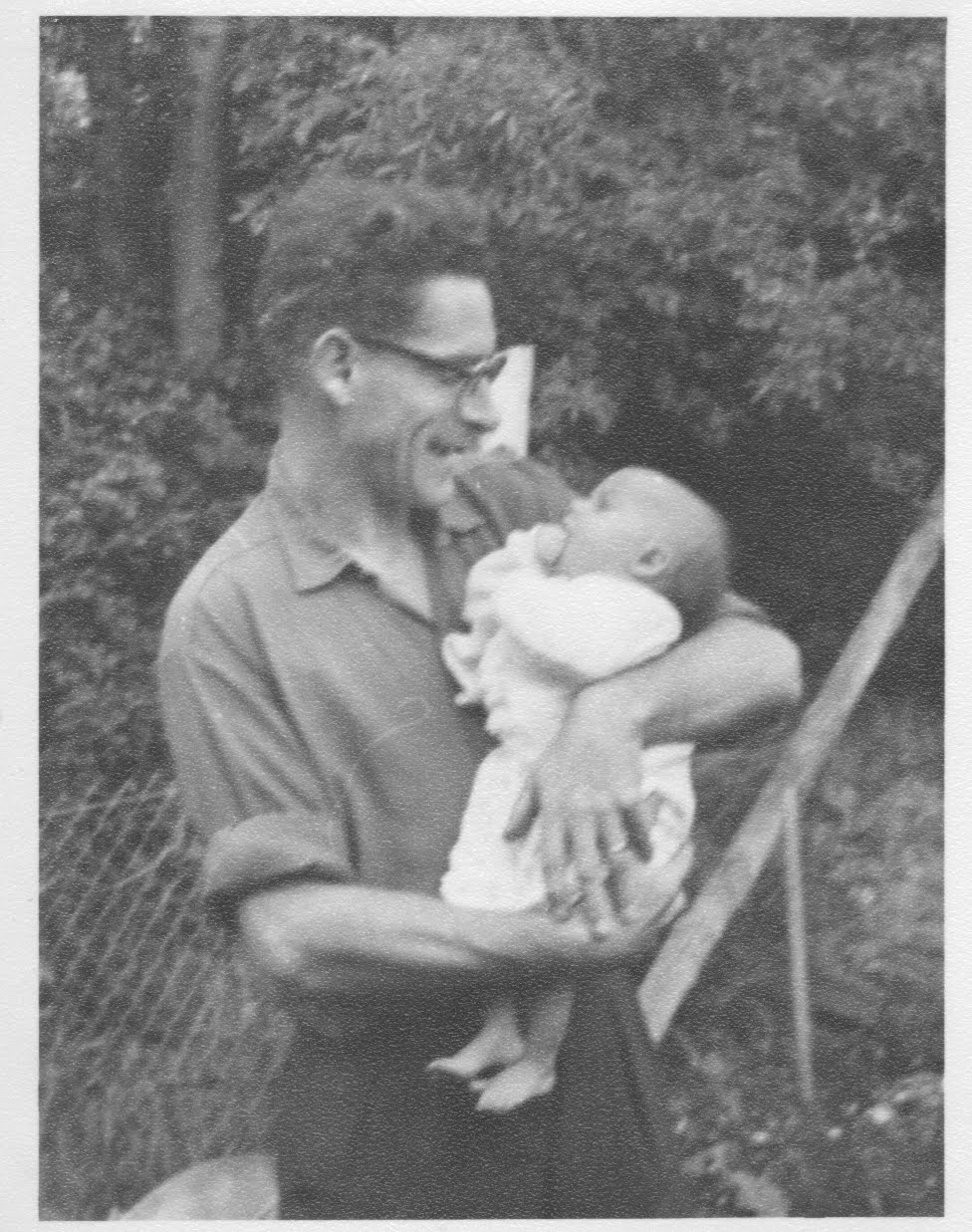
And finally me - I too lost my "Daddy" young, he died the year I turned eight. I still, as a woman nearing the end of her 6th decade, find myself deeply moved by mentions of lost or dead fathers. It rings a chord in my heart. The film The Railway Children was released in 1970, two years after he died; our neighbours a family with four children, took me to see it. I have never forgotten my struggle to keep my tears inside as the father returns and Jenny Agutter, running through the clearing steam at the station, cries, her voice jubilant, "My Daddy, my Daddy!".

In my teens I took to writing poetry, mostly poor, but heartfelt. The words below were initially written aged 17 after I had again been moved to tears by something which touched on lost fathers. The words were revisited later as I turned 44, the age he was when he died.


For Dad

I often used to think of you Dad, when you'd gone,
And when I had to tell folk you were dead,
They'd start or look ashamed, apologise, and some
Would turn and laugh it off, one crass boy said

"Not dead I’ll bet, I ‘spect, he's just on holiday
He won't be long away"

I cried myself to sleep at night for many years,
And in my childhood’s sorrow called your name,
I reached my teens, but time still hadn't dried my tears,
I stood and cried for you again that day.

My loss still caught my heart, its tender edges frayed
You were so far away 

And now I’ve grown beyond the days that life gave you
Can see your loss, these years of mine you missed.
My darling girl, your unknown grandchild, sweet and true,
You never met her, never felt her kiss.

You're gone, but still it’s hard to keep those tears at bay,
You’ve been so long away


Daddy with his little "Dumpy"

Thursday, 28 March 2013

Roxalla

I'm away in Kidmore End this Easter to spend some time with Cecil as I'm never sure how many more Easters, birthdays, Christmases she may have; she will be 88 this year, which is quite a good age.

I have been reading another one of my grandmothers novels, this one called Roxalla, published in 1953, seven years before I made an appearance in the world. As with her other books, I can see family members in the characters she paints; in this one, her Aunt Annie makes an appearance. The youngest of my Great Grandmother Nanya's siblings, she was always known as "ah nah" to my mother, because of her habit of saying, with a gentle Irish lilt, "ah now". She appears in this story as Aunt Hattie, borrowing the name of her sister Harriet. She lived with Nanya until her death, and Cecil remembers her being a very expert smocker of children's clothes, work she did to earn a little money, as they were perpetually poor.

This story, like the others, is a gentle tale, set once more in Arklow, though she had not lived there for over thirty years. It is a place full of hidden and magical energy, somehow held in time, in her mind, permeated with the sense of mystery that she must have felt as a child. This was someone who was quite sure she had really seen a fairy, and the was an element of fey'ness in her and her older sister Connie. In this story, a young boy, Arthur, who lives in a small house set apart from the main body of the town, is befriended by the grandson of "the old lady" who lives in the grand house on the hill, and who is, we understand, grandmother to both boys; the one, William, raised in privilege; the other in poverty. This difference in upbringing is because Arthur's mother had been a servant in the big house, had married the youngest son despite the strong opposition of his mother, and was the left a widow when her husband died in a riding accident before the boy was born. The story is about the unequal friendship between the two boys, and about what happens when the eldest son of the family dies, leaving no heir. Because of this, it seems that young Arthur will inherit the house, a place that has filled his imagination for all of his life, although, until we join them in the story, he has never entered it, nor been acknowledged by the wealthy family. William is the son of "the old lady's" daughter, and so takes the last place in the line of succession.

As with all of her stories, it is as much about the impulses, motivations and inner worlds of the characters, as it is about the narrative. As with all of her stories, I enjoyed it a great deal, feeling that I had spent time with her, although she has been gone for many years; feeling also a wistful sadness that I can never say to her, "oh, I loved that one, the bit where you describe .... I know exactly what you mean, and is ......".

Tomorrow I will be able to share it with Cecil, and she will know who the characters are, and will tell me again about Aunt Annie and her smocking, and how she and Mum, when they stayed with their grandmother, all snuggled down together in her "great big feather bed" and other tales of their shared past, which are more immediate to her now than her day to day present. And she will pause and say "ah Kath, you've taken me right back to .... I can see that clearer now than I can see my home here", and I will know that it has given her pleasure, and brought me little snippets of those who are gone.

I have one left to read now, Glory Down, my favourite.

Tuesday, 19 February 2013

Look on the Fields and others

I'm sorry, it has been ages since I've written anything. In part this is because I ran into a "problem",which turned out to be me not noticing hat there was a size limit on Picasa albums .... Aha! so that's what that funny error message means when my photo uploads fail. You'd think I'd have twigged that, having at least some sort knowledge of computers and the like.

What else have I been doing? Dyeing cloth, planning City and Guilds , doing practical design exercises, stitching shadow work in between times and reading. Oh, and going to work! Some of my reading has been of Ganna's novels. These are the three I have read since my last post.

Look on the Fields was published in 1935, a year after Barney's Bend. Here is the cover, once more a lovely Rowland Hilder image.
It was, as I recall, the novel she felt had worked the least well, though for me it is a delight because it paints such a clear portrait of her family. At it's heart are three children living in Ireland, who welcome their cousin into the family. She is a fragile soul, who reminds me of Aunt Connie - Ganna's eldest sister, who was the most brittle boned of the three girls. In this story, her ankle is crushed in an accident - in reality, Connie's ankle was trodden on by a horse and was thereafter, twisted and weak. At the heart of the family are their mother, who watches the comings and goings of her household with patient amusement, and their their father, a gentle dreamy man who is the small town's dispensing chemist, as was my great grandfather in Arklow, where they grew up. She paints such a clear picture of this little seaside town, with it's groups of donkeys trotting down the high street at market time, and the ever present sea shushing at the shore... she touches on religion and on Ireland's struggle for independence; it was something she experienced fist hand as a young woman, and was part of the reason they left Ireland, the other being the death of her own gentle, dreamy father in 1914.

Grey Geese is also set in Ireland, near Arklow, but out on the plain beneath the blue brooding hills, that change with the weather. It concerns the way in which family hatred can twist a family for generations. It also has overtones of the political background, but is more concerned with the relationship between a young woman, widowed by the political struggle, her three children, and her father. He chimes with a previous character in Barney's Bend; both have a spiteful nature, that mocks all around it and manipulates others. She writes of the difficulties of poverty in a small 1930's Irish town, the standing forever to the back of the queue in the main shop, where each knows the others' business; waiting until all have been served, and the Widow has privacy to beg.

These were all written before the Second World War, in 1934/5/6 when my mother was a child. Then came the war, and a gap in both time and the progress of life. 

By 1952, when the next novel appears, Ganna had looked after, then lost her own mother, my mother was grown, England had been through hell and people had struggled on. Her later novels were written, and set, in England, where she had moved in 1921 as a newly engaged young woman. They center around similar people, but in a different world. For Flute and Piccolo was her last novel, published in 1955. I am saving the intervening two because one is my favourite, and because I realised that I'd not read this one.

This novel is set in a town that feels a little like Hastings, but Hastings of the 1950's where church bells still toll through the quiet of Sunday afternoons. We are moving in small town polite society, where all business is known and nothing interrupts weekend tennis at the club. Again, the story is of families, and how the various characters interact with each other. One, a rather dowdy woman is the long time wife of the eldest son of the family. Near the middle of the novel she experiences the latest of what are obviously a string of failed pregnancies; we see her hope and delight when she knows she is pregnant, and feel her numb despair as the pregnancy fails once more. I know that Mum, Ganna's only child, was herself conceived after multiple miscarriages, a phantom pregnancy and the stubborn resistance of my grandfather, who wanted no children. As I read this novel, I asked myself how much of her own experience flows in her description of this woman's, always seemly, suffering. The novel, which is in part about the coming of age of the two youngest family members, also portrays the very delicate and gentle relationship between the (once more widowed) mother of the family, and a man who was a childhood sweetheart, and is once more in her life. As with her other novels, the thing that is valued above all else, is kindness, the same kindness that was at the heart of my childhood.

Monday, 7 January 2013

Barney's Bend


Just now, for obvious reasons, lots of people are full of their plans for the New Year; new starts, old starts revisited, infinite ways to be better, more resolute - which is of course the etymological root of these resolutions. I've always found resolute rather hard - I can manage steady, stoic, enduring, dogged, but the minute I try to be resolute I find the inner nag who sits on my shoulder saying "Aha! we know where that leads don't we? You just can't manage it, you've tried before and you know you always fail" so my resolve shrivels and creeps away to some quiet corner, all hunched and woebegone, and my seasonal portion of self defeat takes up residence in its place.

So, this is not a resolution, but it is a hope. I'd like to read through all of my grandmother's novels, one by one, this year. To spend some time with them, with her, to see what she has to say. I have read them before, several times; they have been with me all my life, since they were written long before I was born. She wrote in part for pleasure, in part because she came from a literary and artistic family, but also to supplement my grandfather's income with enough extra to ensure that they could send Mum to a fee paying school. She was a very delicate child, breaking bones at the slightest knock or tumble, a trait she shared with her mother, her aunt and her grandfather, who bequeathed us some faulty genes. So Ganna wrote to ensure that her one beloved daughter could go to a school where there was less rough and tumble, less danger of damaging activities.

Her first novel was called Barney's Bend; that's its cover up there, with illustration by Rowland Hilder. Because I know our history, I know that it is set in Arklow, County Wicklow, which is where she grew up. Mum and I went there together some twenty years ago, so I recognise the geography. It is decidedly not a "modern" novel. There is no exciting action in exotic locations, no guns or knives or violently dismembered bodies graphically described, no sex, licit or illicit. I do read novels like those as well, so am not saying that with a moue of disapproval, but Ganna's novels are simple ones, about people and what makes them tick. Make no mistake, when I say simple, I don't mean simplistic or lightweight. She was a deep thinking woman, and one with profound beliefs, but her writing, in this novel, centres around a small Southern Irish town in the early part of the 20th Century, where cars and motorbikes were a rarity, where donkeys were traded at the monthly fair, where the evening light came from the sky or from fire, lamp or candlelight. Her characters are finely drawn, but their concerns are those of ordinary life, not of earth shattering events or heroic feats. She writes of daily incidents drawn with such, to my mind, exquisite observation, that their true meaning is shown.

Most of us live quiet lives, we don't holiday frequently in exotic places, indulge in passionate and sexually athletic affairs, or find ourselves caught up in intricate and convoluted events, involving foreign spies or slightly psychotic loners, with mystical powers of deduction. To be sure, novels like this can take us out of ourselves, they are perhaps the modern day equivalent of the myths and legends told by winter firelight in times past. But tales like that take us away from ourselves, to fantasise about what life would be like if only ... Barney's Bend is about a small group of farming folk, whose lives are intertwined, and about the consequences for one another of the things they do. It is about what matters in love and in life, about what is of value. The characters' thoughts are described, so we understand their motives and their actions. They do nothing earth shattering, and because of this, one is drawn into their world in a very genuine way; they are recognisably human, and their human failings are those we share. To my mind, and I do know I am biased, the novel encapsulates something very precious, the realisation that our lives are driven by what we think as much as by events; that because of this it is important to be true to ourselves, and those around us; important to be aware that we are responsible for what we do, we can bring good or bad into the world, each thought, each action has a definite and concrete value in reality. This makes it all sound rather preachy; believe me, I can't stand preachy. Her writing is so deft, so painterly in it's descriptions, so grounded in her understanding of motive and so evocative of human lives lived, that she reveals how this life, this here and now, is very real, and very precious. I love this book, just as I know I loved it when I last read it, and the time before. I am conscious that this is a gift given, to know her mind, and to understand her remembered wisdom, even though she is no longer with me.