Showing posts with label family myth. Show all posts

Saturday, 11 July 2020

Mum's Diaries

Working with Mum's diaries (I have just begun 1944) is like having a time slip conversation with a very old friend. The person who is talking in these pages is the person I remember her to be; at times caustic and critical of others, at times (and much more often) a woman who cared and felt deeply and did all she could to make other's lives better. She is a mixture of naïve and mature, reflective and dismissive, longing for friends and company, as all only children are, but requiring too much from folk. Mum tended to be an all or nothing person, and that intensity shows in her writings. When she talks of "Mummy" in my minds eye sits my Ganna, who wrote novels and was my rescuer and second mother when we came here "after Daddy died". The diaries are full of family names and stories with which I am deeply familiar.. At times there are quirky little sketches inserted, like this, of her new coat or quick drawings of their new kitten George.


But mostly she records her thoughts about life, and events and happenings and family interactions. I wrote earlier of Nirvana, the holiday cottage which belonged to her Aunts, Connie and Harry. These folk are so familiar to me, I met them as a tiny child, we lived in their house (without them - we inherited it) when we moved to Hastings after my Dad died, they are part of the folklore of my childhood, and at times took on an almost incantatory presence for me, I could feel my molecules mingling with theirs. Numerous of those little incidents are recorded here, and were part of my childhood's pattern. I find myself at times almost alive in these recountings of hers, because they were the foundation of our life together

Sunday, 12 January 2020

Family words

I have been in communication with a delightful lady called Rosemary Roughter, an historian who is writing a piece about Louisa Coade, who was my great grandfather Howard's sister, known to me in family tales as "Aunt Louie". An enquiry by her regarding a novel written by Ganna's sister Rhona has lead me to reading Rhona's books, which I'm ashamed to say I have not done so far.

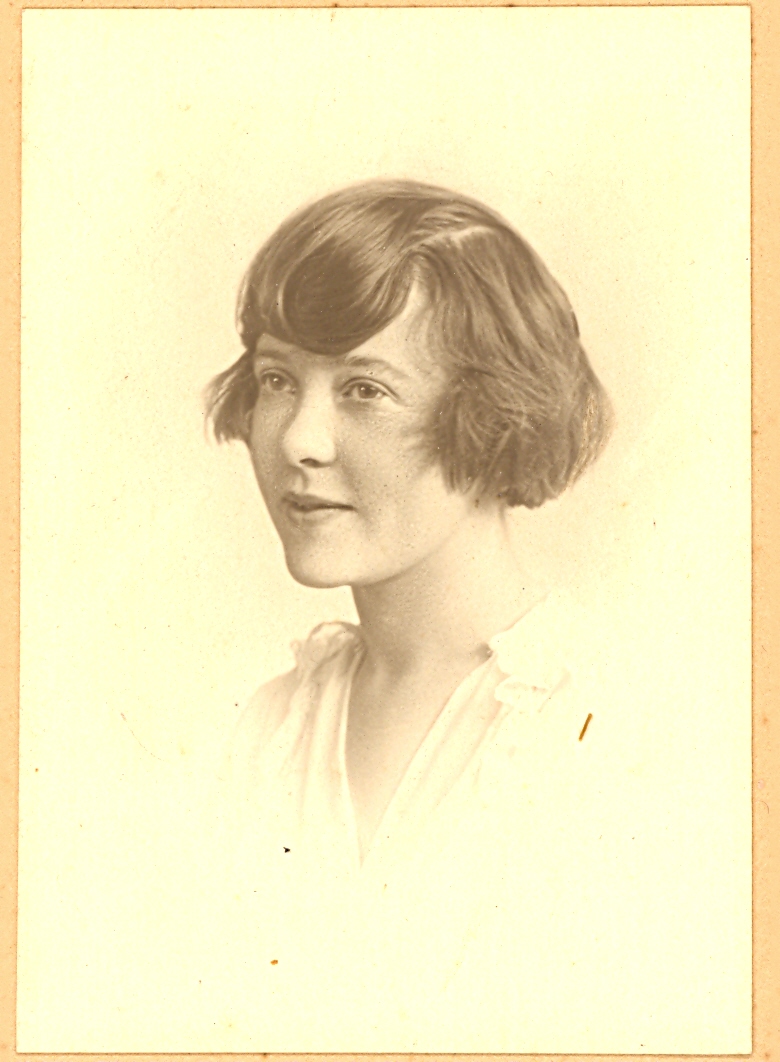
Rhona Katherine Rowe as a young girl
Rhona was the youngest of the three Rowe girls, and took after her mother Alice rather than Howard. This meant that she and her daughter Cecil were untainted by the genetic condition Osteogenesis Imperfecta, much to their benefit. She was, according to family tales, a very charming young woman who enjoyed the good things in life. You can see her here, in her youth, looking very sweet and pensive. She married Herbert Guy Dunning who ran a garage in St Leonards called Dunning Marriott and Smith. She and Guy lived a more extravagant lifestyle than her two sisters, and Guy was much disapproved of by Ganna and Mum, being rather too "hail fellow well met" in their view; prone to borrowing money and not paying it back. This was borne out after he died and Cecil took over his affairs; the business was deeply in debt. I remember her saying "I always wondered whether Daddy had another family somewhere - otherwise where on earth did all that money go?"

Rhona and Ethel published their novels at very similar times and I always pondered how much they were in competition  with one another. Rhona's first novel Stephen Sherrin came out in 1932, and the central character is a tender portrait of their father.

Stephen is a doctor in a small town in England, with a deep concern for the poverty in which some of his patients are living. His wife is dead and his two daughters, from whom he feels estranged, live with their smart young friends in London. The story moves between Stephen and his daughters, contrasting the rather shallow lives of these two London girls, all cleverness and appearances, with his own quiet but deeply felt devotion to helping those around him and appreciating their more human values.  It also focuses on a friend of Stephen's, an old man who is dying, and who is responsible for three young grandchildren whose adventures punctuate the comings and goings of the adults. Her writing is more sensual than her sister's; the books contain long passages describing the natural surroundings, often elaborately personified, which reflect and echo the thoughts of the characters. The novel also portrays a completely unconscious snobbery, which chimes with family comments about Rhona. There is an assumption of the superiority of the central characters and the ignorance and superstition amongst those poor with whom they come into contact. The house servant who cares for the old dying man is described as being "dirty shiftless and lazy, but her heart was in the right place", yet this woman does everything for the old man for no pay, just her board and lodging. Modern readers would balk at this, and also perhaps at the lack of action and excitement. I thought it a beautiful read; her attention to the motivations and feelings of the characters I found very engaging, and Stephen's heartfelt concern for his patients and his friends drew me to him as a character. At the end of the novel he makes the momentous decision to pass his practice over to his young assistant and fulfil a long held desire to travel "before it was too late. Before he got old and bitter". he takes himself off to Tilbury docks to "walk up the gangway to that great, magnificent boat and be carried smoothly over the seas - to what?" I wonder if Rhona here was releasing her lost father, who died when she was just fourteen, into a better place of freedom and fulfilment.

This is a short novel, I read it in the space of a day, and enjoyed it a great deal. Perhaps that reflects my sense of entering a very familiar space with a familiar cast of characters and attitudes - a family space in fact. I have since read her next publication, The Spring Begins; very risqué indeed for its time, but more of that later!

Friday, 4 April 2014

Nearly home again

I'm at the end of a three week break, my final week being spent with my Aunt Cecil in rural Oxfordshire. Those who pop by here regularly will have met her before, but here she is sitting by the river Thames, about to tuck into coffee and chocolate tiffin. This image, I hope, captures her sweet smile and marvellous sense of fun, quite undiminished by dementia.


I take pictures so that, when we get back home, she can see where we've been and what we've done, her memory being truly absent. It was she and my grandmother who inspired me to stitching many years ago, both being fine needlewomen. The skill has been passed down the family from my Great Grandmother Nanya's generation (and no doubt those who came before her), and Cecil talks of Aunt Annie and her exquisite smocking. I wish some of it had survived, but would guess it was needed to earn money. Aunt Annie lived with Nanya, who had been widowed in 1914, with three daughters in their teens to support and no means of income beyond their wits and feminine skills. They moved from Ireland to England in 1921'ish; their location chosen by the legendary pin placed in the map with eyes closed.

Coming from a family who have condensed into just me, Cecil and my daughter Jen this side of the water, I treasure those family tales and the opportunity to spend time with Cecil and share our joint past. On this visit I took a collection of old photos to show her. They have all come to me, as Nanya lived with my grandmother at the end of her life; I also have, and treasure, the letters she and my Great Grandfather wrote to one another through their courting days (a project for my retirement). Cecil was very anxious that I label all those images so "those that come after" know who they are. It got me thinking about the values we place on things. I know who those precious few blurred faces belong to; some of them I met, some I know because of our shared family tales, to me they are real people with lives and loves and interesting characters. Yet if Jen has children and brings "grandmotherhood" back into this diminishing family, these dear souls might be of little or no interest - just dated images in sepia and black and white. This is true of so many things that get handed down, their value is simply to those who know the who and why. Once those people have gone, what is to be done with them? I don't know the answer, but do recall collections of Victorian photos that we hold in the reference library I used to work in. We kept them without knowing anything of who they were, simply because they were old. I often wondered what was the point, but couldn't countenance throwing away images that were a window on somebody's past, albeit anonymous. What think you?

Tuesday, 11 June 2013

were you afraid of elastic bands?

This was a question I nearly managed to ask my daughter today.

I was having a conversation with her about the elements of fragility in my family that were part of "normal" life in the world I grew up in. We all have osteogenesis imperfecta to a greater or lesser degree, inherited from my great grandfather. This can result in desperately brittle bones, from which thankfully I've been spared. However, my childhood (as an only child) was liberally sprinkled with little incidental alarms like

"don't lean over the arm of the chair like that!!! Auntie Connie cracked a rib doing just the same"

"I was just picking a book up Mum!" 

No matter, in an extremely small family, having four "very breakables" in three narrow generations does tend to lead to a particular family sensibility. Living with both my mother and grandmother, and only them, tended to distill this aura of impending calamity - I won't even begin to dwell on the dentist horror stories! So, life was expected to be painful, to involve broken bones in all directions and, for a rather small child, this made elastic bands - yes even the innocuous elastic band (remember the incendiary hot water bottle) a source of some disquiet. Yes, I confess, I was afraid of elastic bands! They might flick you in the eye, slap their nasty, smarting little rubber selves against your fingers, snap with a sudden and alarming twang! I avoided them when at all possible. However, I have to confess to dissolving into giggles before making it through my question to my daughter.

Being afraid of elastic bands is, surely, too ridiculous for words?

Friday, 28 December 2012

Tools

primary couching!
The objects that I use when I'm stitching are all redolent of the past, linking me physically to my younger self and to my immediate female forbears.

From mum I get three things that I made for her over time; a needle case I made in primary school, in Petersfield, where we lived before Dad died. This holds my quilting needles, patiently waiting for the next time I have some free time to practice some hand quilting.

Then there is the lace trimmed needle cushion with a heart at its centre, made from a kit in a monthly needlework magazine I bought back in the eighties when such things were all the rage. It sits here with the pin cushion, which may have come from Ganna, or possibly Nanya, I'm not sure how old it is.

needles and pins cushioned

The most recent gift was another needle case I made for her from a pattern in Candace Bahouth's Medieval Needlepoint; this tends to hold a mix of mostly big needles, including tapestry needles. I made a similar one for my Aunt Cecil, which she still uses.


now which one holds the needle I need?
My white needle case which holds all my embroidery needles does come from Ganna. Most of my needles also come from several generations' collections, as do the pins. My great Grandmother (Nanya) and her family moved from Southern Ireland to Liverpool in about 1869. Family tradition has it that her father, having been a Methodist Minister, lost his faith after the death of six of his eleven children in one of the frequent bouts of childhood illness that we are, blessedly, spared in these days of modern medicine. On arriving in Liverpool, they seem to have set themselves up in the drapery business and Cecil can still remember "Aunt Annie", Nanya's youngest sister, working "the most beautiful smocking" in order to earn some money.

Many of these things I can remember sitting in the top drawer of Ganna's bookcase, along with the fabric scissors and pinking shears, several yard of bias binding in various colours, wooden cotton reels and a variety of dubious looking things that were of use in repairing fierce elastic undergarments! This bookcase drawer was the designated repository of needlework tools from time immemorial. Such are the elements of family mythologies. When I use them, they include me in this elemental connection; that of mother to daughter through generations, each passing tools to the other, gleaning the good on the way and discarding the worn out, shaped by a deep philosophy of frugality, because of the War; because of the Troubles; because we have all looked after our own in some way or other. In a very female dominated family, each generation from Nanya's mother through to me, have shared a living space when one or another had need of help, and so these things get handed down because house contents blend, rather than the sort of mass sorting and sifting that goes on when one generation downsizes moves into care of some sort, when there has to be a drastic pruning. One makes space both for loved person, and their loved things. I have no idea whose fingers these thimbles have protected in the past, but, when I use them, I know that I share a deep and indelible link, as I too ease the needle through fabric that I stitch.


Monday, 18 July 2011

Mindful Ironing

I’m not much of a one for ironing, but I had some sheets that had to be washed – sheets I’d found tucked away in a drawer in Mum’s flat, The were stained, but had evidently been put away after a good laundering, compressed but perfectly ironed, rust marked and rather stuffy. I washed them in a good hot wash, tumble dried them (it’s been raining a LOT) to a perfect dampness, then ironed them mindfully. That is I paid attention to what I was doing, savouring the rising steam, enjoying the feel of hot cotton under my fingers getting smoother and smoother, letting my body get into a gentle rhythm of ironing, rather than dashing at it because “it’s got to be done”. Once you find the swing of a task, you do it quicker and better anyway. While I ironed I remembered.

The last time I ironed sheets was with Mum, in the “up in the eyrie” top floor that was her flat in our building. So I remembered that. I remembered her courage in the face of a body whose bones were crumbling within her, while her bright blue eyes still smile dot light up a room. Remembered the fun we had at times, even though other times were difficult.

The sheets bore labels saying “English Lady” and “Horrockses Linen”, which spoke of days gone by, one declares itself to be Egyptian Cotton. One was laundry marked – “Lomer”. Now they are single sheets, and the name Lomer was my grandmother’s (Ganna ) surname  once she married my grandfather, Gerald Hugh. Here they are on their wedding day in St Leonards on Sea, Sussex.

Gerald Hugh Lomer
Here is Gerald,in his uniform, helping with the gardening in the garden at Arklow, where she grew up. He an English soldier in a Southern Irish town at the time of the troubles, keeping the peace. He met her as the family put on evening entertainment for the soldiers; Dr Rowe’s three daughters with piano, violin and voice. She Ethel, the daughter of the town apothecary – known as Dr Rowe, at a time when armed men could be found skulking through the ground floor rooms, while you stayed upstairs, silent, ‘til they had gone. So I remembered them too.

Alice Constance and Alice Katherine Rowe
Then I recalled how, when first married they had a double bed. This, Auntie Connie, Alice Constance Rowe, and their mother Alice Katherine, declared incondusive to the good health and strength of the newly weds. They strongly advised twin beds for a good night’s sleep. Astonishingly, the newlyweds complied with family wishes and twin beds were bought, hence the single sheets for a newly married couple.

Then I remembered further back, to the time when Alice Katherine, four years widowed, aged came across to St Leonards on Sea, England, with her three unmarried daughters, from Arklow, County Wicklow, on the whim of a pin placed, with eyes closed, onto a map of southern England. Why choose such a curious means of deciding when she had a brother in Liverpool, who had six girls of his own – known collectively as “The Frodshams”. Perhaps because said Gerald Hugh was a son of the south, having been born to a family in Southampton who had been “county solicitors for generations”.

So I ironed, and remembered: remembered talking of all these things with Mum, who had talked of them with Ganna, who came across the Irish Sea. And the remembering was good, the ironing done in fine company. For such is the passage of family myth.

Wednesday, 4 May 2011

more grandmothers gifts

I am gradually sifting and sorting "things", and thought I'd share a few more precious bits that have come to me, handed down through the generations. Some I found in the past, some have come more recently on Mum's death. They are little fragments of lace and embroidery about which I know nothing. I have treasured many of them for years, tucking them away in a drawer, wrapped in acid free paper to try and ensure they don't deteriorate, though I have to confess that the little embroidered bag was once home to my marbles! I have no idea of their age, but suspect they are mostly Victorian. I do know that my great grandmother's family moved from Ireland to Liverpool in about 1869. My great great grandfather had been a Methodist Minister, travelling all around southern Ireland preaching. He lost his faith after the deaths of six children from illness in a very short space of time. Once in Liverpool the family seem to have set up as drapers, and are recorded as such in the census. My Aunt recalls her Aunt Annie doing the "most beautiful delicate smocking" on dresses, and teaching her the skill; my grandmother embroidered, knitted and worked crochet lace; Mum knitted and sewed and my Aunt is a very skilled needlewoman. I like to think that some of these things were worked by family hands, I am happy to feel that I carry on that tradition in some small way. 


Here are just a few of the treasures.


Wednesday, 27 October 2010

What do Grandmothers leave behind?

Well, mine left me a wealth of things,

her novels, published in the thirties and fifties

Howard Rowe at the far left, was my great grandfather - Nanya's Husband.
The six novels to his left are by his daughter, my grandmother

and strange little ditties like this

Wiggle Waggle Man

There was a little man
And he dressed all in brown
He raced and he ran,
Right round the town

Catch me if you can
            Said the Wiggle Waggle Man

Up came all the people
Chased him round the town
Chased him to the steeple
There he laid him down

When they came up roaring
The little man was … snoring!
He winked a bright blue eye
And jumped into the sky

Catch me if you can
            Said the Wiggle Waggle Man

It would be recited, by her, later by Mum, with the greatest of glee and the most sparkling blue eyes.

One suspects the glee is of Irish origin and comes from

Nanya
I have no idea where Wiggle Waggle Man comes from - it might be an "Irish'ism" - there were a number of them.

Saturday, 18 September 2010

Why Grandmothers?

Perhaps because I find myself  for the first time in my life without a grandmother anywhere in my domestic space. The loss of Mum has taken my daughter's grandmother from us. 

My grandmother, Ganna,  and me
My own grandmother looked after me after my father died when I was seven. She was a jewel and much loved. She told me tales of George Penny, who routinely fell out of a little girl's pocket, to roll n the street and find an adventure. Then later, the most wonderful made up games where we jointly narrated a story together as though we had heard all from a third person and were actually part of the world in which this was taking place. Of course in the tales a young girl was for ever getting up to mischief! She was also gentle but utterly firm in her discipline, never raising her voice, but somehow ensuring one knew what the right way to behave was. She died in my 21st year.


My Mum and Jen
And now we have lost Mum, who gave my daughter her own tales of the imagination. Old 'Arry with his awful cough, the fish and chip shop. She too was a special soul, with such a vivid blue gaze that you always felt that her delight in seeing you was absolute. A very special gift.
Nanya - Alice Rowe, nee Atkins

Then of course there was Nanya, the Irish artist, my great grandmother whom I never knew. She would come in from her garden querying why "none of you girls" had made supper. She had been communing with the garden fairies I guess. Her paintings hang in my house, her sister forever poised wistfully at a spinet, Courtown Woods ringing to the sound of three little girls playing on the bridge.

So, I am feeling the loss of these women. And am aware that now I am the repository of family myth and culture. A condensed trickle of tales, edited by time and made warm with love.