
Hidden things

Buried secrets

Secret flows


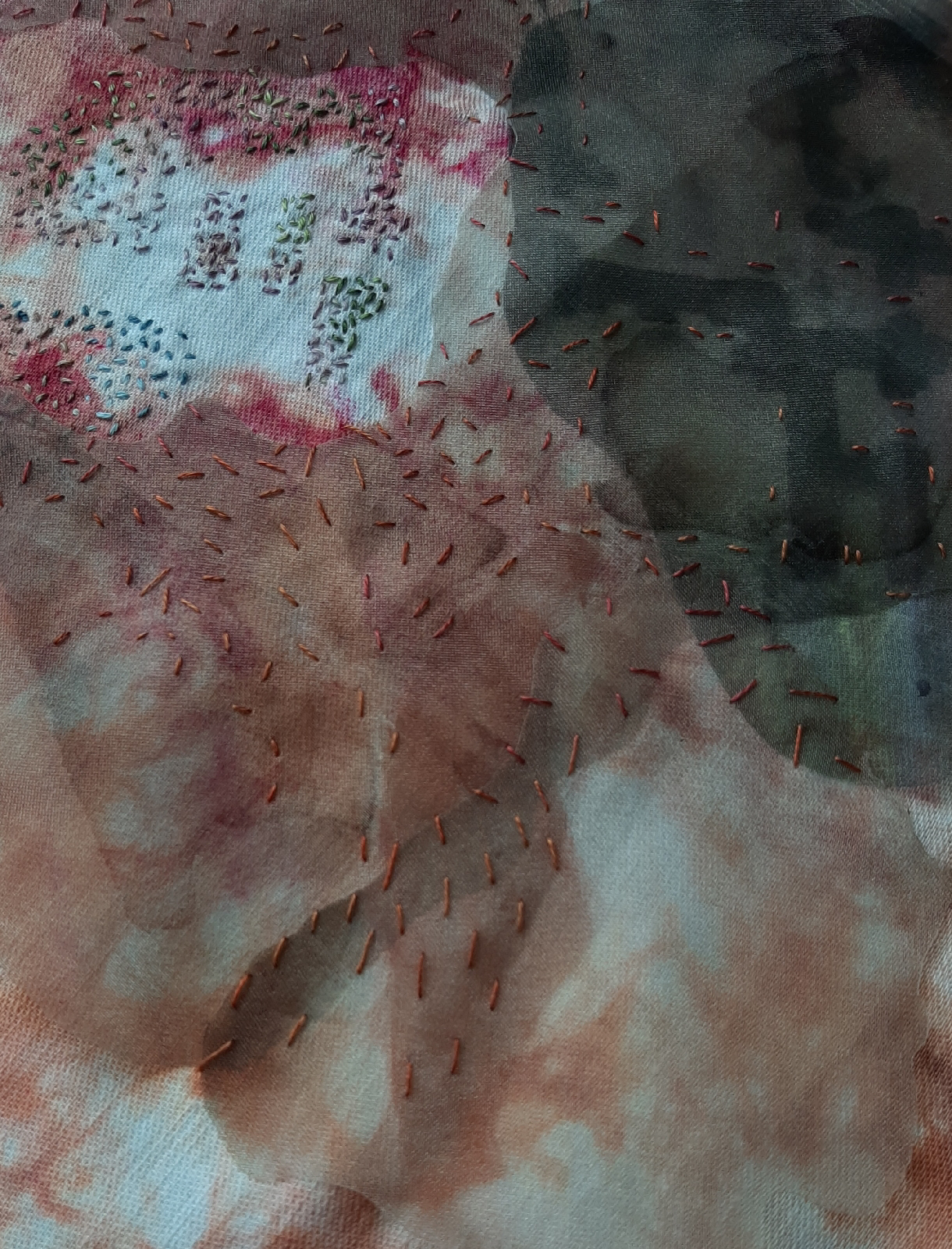


So I think I’m done stitching, keeping it simple. I rather like this deep green silk as a potential frame for the image

I know I am annoyed at the wrinkles in the underlying calico - shoddy preparation. I can’t iron them out any further because that encourages more bubbling in the organza across the sky, the first layer which I couldn’t avoid when Mistyfusing down.

One notion, once the green silk is attached to the embroidery, would be to mount the whole on a box canvas of appropriate size, wrapping the silk round to the back. The key question now is - wide frame or narrow?
Which is a theme appropriate to working with transparents, which can evoke ...
Layers of landscape - the view from my bedroom in coloured organza cut with a soldering iron and fused to a base layer of calico. Two layers of machine stitching done, just the foreground to work out now. It is intimidating me!


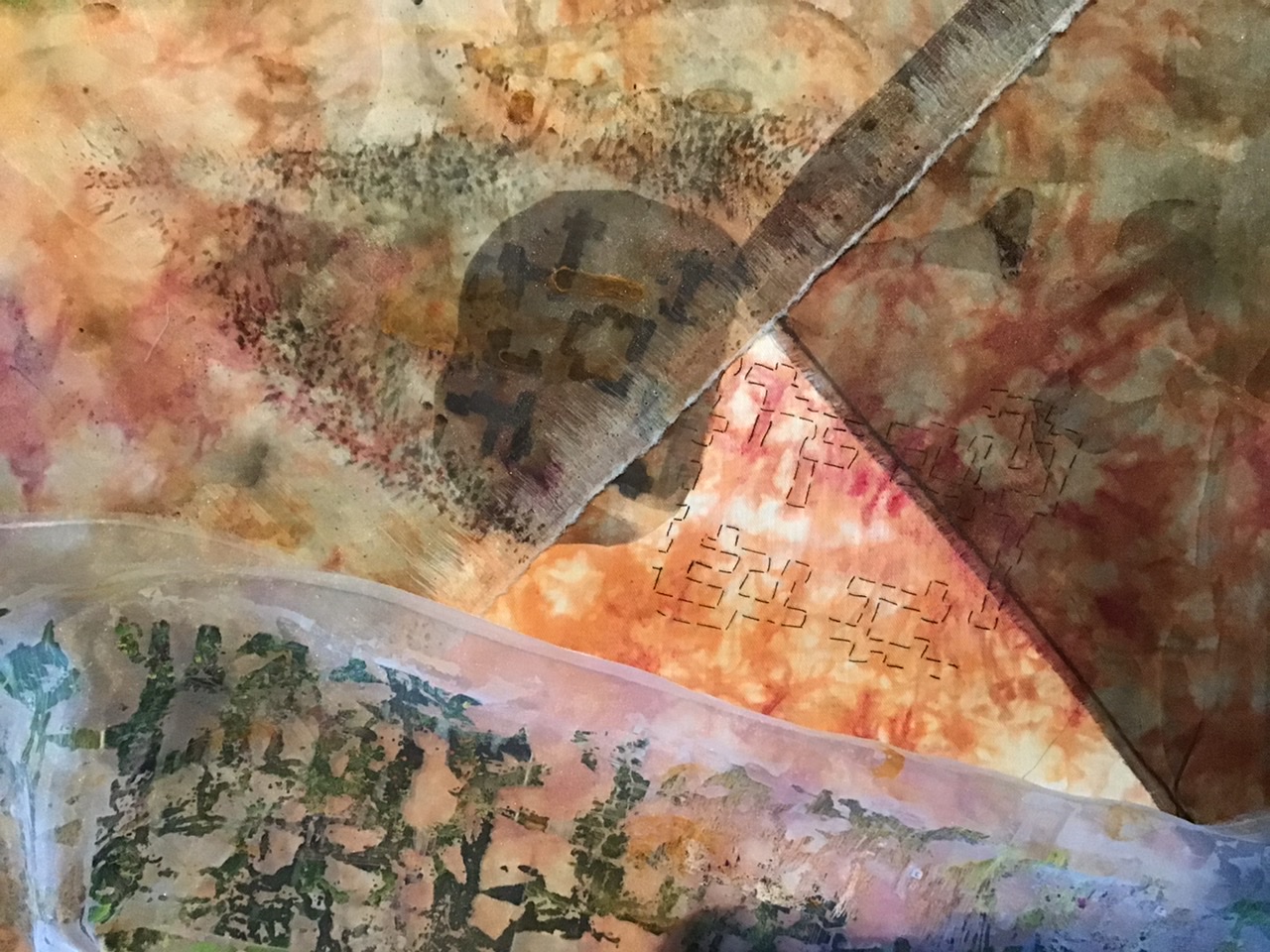

And maybe reveal those layers of habitation

My stitching and thinking today accompanied by Low
And the Oni Wytars Ensemble being Byzantine. There’s variety for you
I very often have Mesopotamia in the back of my mind when exploring with Studio 11 experiments - currently in how transparent fabrics can ben coloured and the potential they hold.
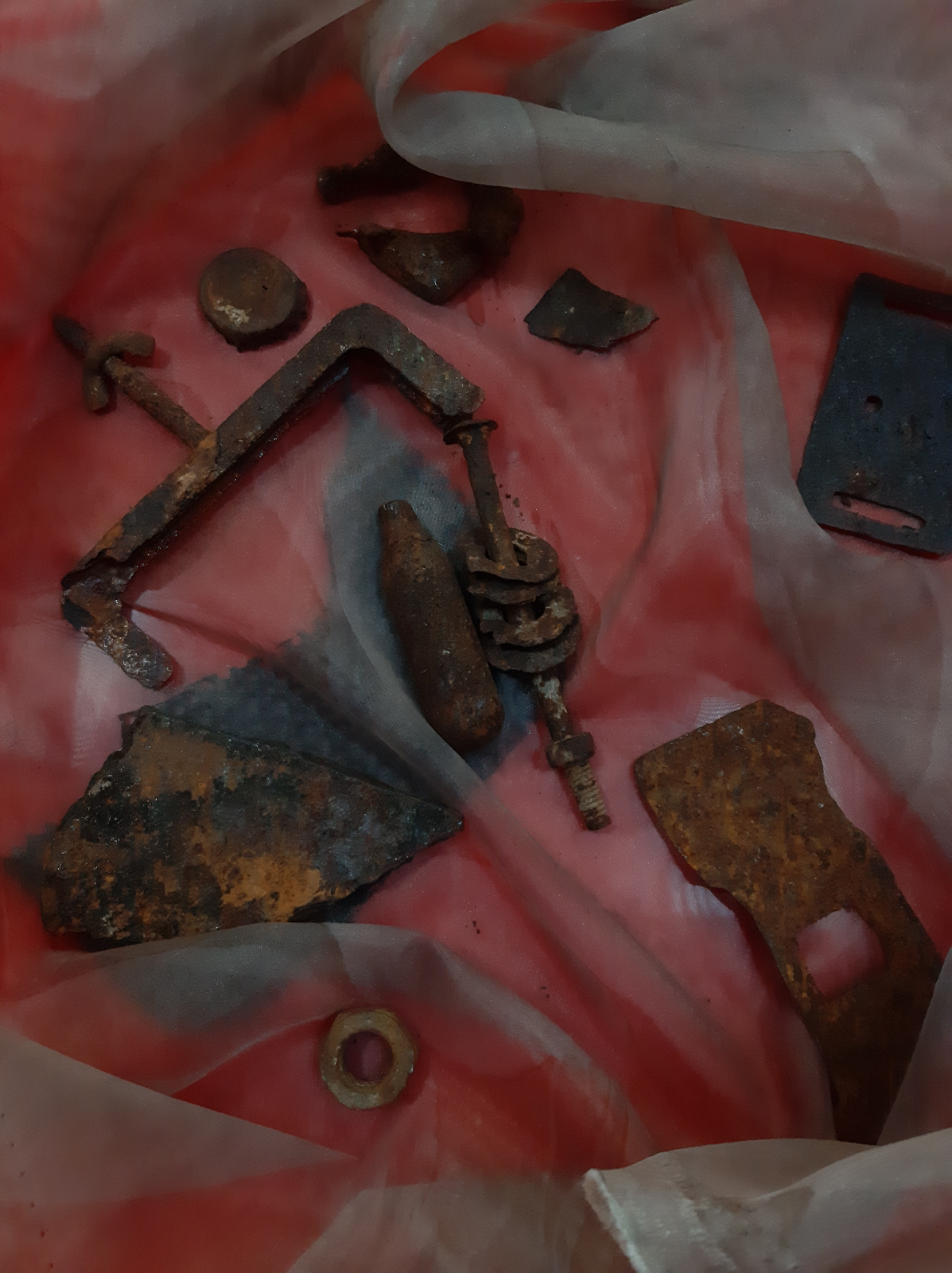
An assemblage is a group of objects brought together from a site which typify that site, or a particular period.
This is an assemblage of things old and new which may help me say something about Mesopotamia and history with textiles.
Most recently I created a stencil which which I used with a lamination technique to apply paper to some organza I had coloured as part of the transparent experiments we have been doing. The stencil was based the floor plans of several of the temple layouts at Eridu, the oldest of cities according to the Sumerians, where sweet water was discovered, site of the Abzu. The transparent is laid over some hand dyed fabric from an earlier class I took with Christine, sort of desert’ish. Though now I wonder if I should try something blue beneath it, for water. And whether I might not cut it up and use parts of it in different things, rather than as one piece.


I have been thinking about what skills were key to the development of civilisation in Mesopotamia, and one, of course, is weaving, without which we have neither baskets, nor linen shifts, nor tapestries. So I have been experimenting with the cordage technique, learnt on and Alice Fox workshop at Studio 11 using grass from the garden, fibres from yucca and phormium (New Zealand Flax), and some wool roving I bought, to create “thread” of sorts. The blue is the roving, twisted during a recent Studio 11 zoom session.

I like the way the colours work with this fabric, but the “thread” might also be useful with some of the other recent transparents experiments. Or perhaps I'll twist some more

The fabric is, again from an early workshop, using the wax resist technique to evoke the sort of patterns one finds in for example, pottery with scratched patterns, of rock carvings. Here assembled, to see how they might mingle with some linen thread I bought from “somewhere”.

And here, another assembled group of transparents - fine voile coloured with acrylic inks, walnut ink and rust dyed




 While I'm stitching, I'm also working out how to catch this tender fabric down without ruining the translucent quality of the textile. There's also the direction of the grain to consider. Sometimes, with the black piece, I had to stitch down in both directions to prevent the organza pulling out. I used two strands of thread as that seemed to be about the right weight, and I wanted to concentrate on colour without the distractions of other textures. there's enough texture in the organza. There's also very little chance of hiding the start of the stitch with each thread, so I made a feature of it, crossing the stitches and finishing on the front with a French knot to secure the initial stitches.

 Now I've moved to stitching on white backing fabric. I considered using a shiny rayon thread for texture, but decided that it was adding nothing, so changed to navy stranded cotton, two strands. The stranded cotton, with its easy texture and willingness to bend makes the stitching much quicker, and is, I think, fine in this context. The glisten of the organza likes the muted, not quite black of the stitches. As the stitching progressed it developed a changing rhythm depending on the lay of the fabric. As I layered more and more on the backing fabric the stitches had to evolve, becoming one long stitch, with a tying down thread across the centre at right angles - I think it's a proper stitch of some sort, must check. I had to do this as the varying layers and overlaps couldn't be tied down using my original ordered little stitches I started with. At the end I lengthened the pieces of organza and gave them a wavy pattern, to move right away from the neat texture of the first part. My daughter sees a tulip in this bit - I just see scrumptious colour, though this image is a bit more in the blue scale than the actual fabric


 The French knots worked well, but for the last one I thought a little bright pink laid work cross, tied down in the centre with a single stitch was more appropriate (trust me, I'm not normally a pink person!), as there are 11 layers altogether! I also tried to keep my backside neat - if you'll pardon me!

