Showing posts with label slow stitch. Show all posts

Sunday, 6 December 2020

growth and green

I have been adding some green growth to my layers test piece. The river brings growth, and we harnessed that growth for our own purposes back in those Mesopotamian days to extraordinary effect. In the distance, space marked out for a fragment of royal inscription. I was amused, when picking up my test cuneiform stitching to judge the size of that space, to find myself turning it the right way up - which tells me the stitching has, at least, taught me a bit about how to view cuneiform :-)


Then there is this, one of many reels of, for the most part unusable thread, having aged to fragility, that I have inherited from mother, grandmother, aunt and probably great grandmother. This was probably produced in wartime, a delightfully informative website tells me.


isn't the green delicious


I'm using it in a piece we did with Cas Holmes, a delightful teacher and artist, whose work I have admired for many years. The workshop, run over two sessions, focused on how we could blend momigami, "very squashed" paper, and textile scraps, in a piece with both hand and machine stitch. It was so enjoyable, in particular because she was teaching us via Zoom sessions, which bring their own challenges. The first was in part about preparation of the papers we had selected, by crumpling and kneading them in our hands until they loss their stiffness and became more fabric like - this is the momigami element. She encouraged us to layer these with scraps of fabric, pinning them to a calico backing, then stitching them loosely down using expressive stitches that worked with the underlying strata. In the second session she showed us how she uses machine stitch over the initial stitch layer, painting into the fabric with thread, creating texture and highlights, turning the piece over to stitch from the back to add elements of less purposeful stitch. Throughout both sessions she also talked to us about the design process, using her own work to show us examples of how the layers come together. Here she is talking about her piece "In Great Grandmothers' Shadow".

So far, I have got to here, a sort of landscape, with sort of buildings, and a ground layer to divide the space. 

As you'll see I've not reached the machining stage yet, and the paper element of this is so fragile that I suspect it will disintegrate once I start. For Cas that is a good thing; something she uses in her work and I can see its potential. But for this bit of stitching, I'm not so sure - which probably means I really should, and learn from moving beyond my inhibitions. For now I have just done hand stitching, and am happy with the result, though I feel it needs a bit more. I enjoyed the tactile nature of the paper, the difference in sound both as the needle and thread pass through, and the sound and feel as you handle it, skin rubbing against different fibres. I may well explore more, another way of layering.

I hope your stitching week has been good?

Saturday, 14 November 2020

stitching cuneiform

Seems to lend itself to fly stitch. I find myself wanting to make the stitching as decorative as possible, along with representing the cuneiform; enjoying the patterns made by the cuneiform shapes. I allow myself to turn my fabric through 90 degrees, as the scribes might have turned their tablets, pressing stylus into clay.


I wonder about those Babylonian ladies, stitching mottos into their loved ones' garments: spells of protection, charms to ward off evil. Is this the stitch they might have used?

And because Rachel enjoyed my seaside, yesterday's walk gave me this


Friday, 1 November 2019

Helpmeets for stitching

Because my good friend and fellow Embroiderers' Guild member Steph and I are running some supported stitch sessions locally, I have been thinking more about how we use aids to stitching and why; I thought I'd share them with you here. 

First and foremost is comfort. Most of us have aches and pains of some sort or another, having reached the age where we have the privilege of doing our own thing, following our star to some extent, rather than being subsumed by the rest of the family's needs. Then of course there is light and the ability to see.

By preference my favourite spot is here, in my grandmother's chair ("that's the Bergere Chair Kath" I was always told, though I suspect it isn't!). I have cushions and a quilt for comfort, south facing natural light, a warm radiator nearby and Cecil's tables to my right and left. I have the magnifier with it's ring of light, and my "giraffe" - the floor stand which holds my embroidery frame, I love this, though it can be a bit picky about whether it stays put in terms of its neck and knees! When you look at the frame, you can see it is one of those with clip over half tubes of plastic on a tubular plastic frame.


On the fabric held within the frame I have a needle park, held on by a magnet on the back of the cloth,  and a thread card (excuse the unintentional advert), recycled biscuit packaging. On the back the number and brand of thread is noted on each hole. This way the skeins can stay at home, or in the basket - less likely to become a tangle then.


If you were looking over my shoulder this is what you'd see, Mesopotamia under magnification, though not quite at satellite image detail. You can see here the way the frame can be used to hold fabric that is wider than the capacity of the frame. Not RSN tight by any means, but I'm not working to RSN standards.


And close up we have Sippar, the twin cities each with it's own temple, tucked in by the Euphrates to the left, downriver from Khafajah and Tell Asmar (Eshnunna). The Tigris is there too, coming in from the right. We are coming down from the rain fed alluvial plains of Upper Mesopotamia, where to a large extent there was enough rain each year to support agriculture. Now we are nearing the southern plains where no agriculture was possible without extensive canal systems for irrigation,


Sunday, 20 October 2019

A real treat

For four days last weekend, I had the pleasure of attending a workshop led by Eszter Bornmisza, hosted by Studio 11 as part of Christine's programme of "re-treats". She always has inspiring textile artists, and I have been on several over the years. This one was called "Captured in Nets" and was a marvellous introduction to the techniques Eszter uses to craft her beautiful artworks. If you've not seen them, pop over to her website to have a look. If you have seen them in person you will understand how evocative they are; ethereal, yet firmly grounded in the townscapes that are her primary theme. Eszter was a generous, patient and supportive tutor and we learnt a great deal. In addition to nurturing and broadening my textile skills, the four days gave me an even deeper appreciation of her art, and of the time, skill and meticulous planning involved in each creation.

Our first day was an introduction to net making with soluble fabric, machine stitching into it to create a web that, once the fabric has been dissolved, will hold itself together. This is harder than it sounds as you have to make sure that wherever your stitching goes, it is tied in with what has been before, otherwise bits will fall apart. I found the first day challenging. In part this was because my Janome was misbehaving. Once I'd  popped home and returned with the Bernina; my preferred machine for embroidery (but heavy to move about), the rest of my time was undisturbed by machine failure. Having not done much machine embroidery for a long while; my shoulders and upper back were tense and intensely painful, my stitching unruly. However, I managed a couple of samples, and began to understand more about its creative potential.

Here, my various samples at the end of the sessions in the studio


And the thought processes that brought it all about - with retrospective notes


A preparatory drawing inspired by Eridu, exploring the pattern of temple spaces and how continuous line might all hold together


stitch and imagery,


lace and thread, boundaries and mounds


The second day also had its difficulties; I stitched my forefinger - breaking the machine needle as I snatched it away. A loud bang, a sharp pain and a few minutes of feeling rather peculiar followed, but the studio had plasters and there was more stitching to be done. I still felt I wasn't sure what I was supposed to be doing but, following instructions, managed to produce a couple more samples and felt happier by the end of the day.


Inspired by Nirvana; a different sort of layer, that of family myth, nestled at the edge of the Rother, home to childhood dreams


and what to do with the spaces removed?


Then Babylon, drawing on an ancient map; imagery printed out several days before the workshop and pondered on


the reverse of the embroidery makes a more powerful statement - lesson learnt


By day three things were looking up, the accumulation of techniques was beginning to make sense, and I was starting to see where they might apply to the projects I am working on at my regular Studio 11 sessions. More samples were made, more stitching was done, more bobbins were cleared of thread and at end of play, a very enjoyable meal out, organised for us by Christine at a local hostelry. We began with making voids, mending them, bridging gaps. Organza carved out with a soldering iron, mended with Islamic pierced window grilles in mind, same region, later culture, more layers of history. The cutout pieces were also captured in a net with additions


Here, working with painted clingfilm and very pink organza. As I stitched I was thinking about the growth enabled by Abzu, the life giving water; marshlands, foliage, ripples, grasses waving


Flowers and leaves strewn across gaps in the fabric, supported by a web of stitching. The flowers were hand stitched into a piece of soluble fabric with chain stitch, then pinned to the base fabric, the leaves simple knots in a piece of thread.


Finally there was the "bring it all together and make a larger piece" day. So we put all we had learnt into practice on our chosen design. In my case this was based around a satellite view of Nineveh - drawn from my Mesopotamia ruminations. Here a portion of Nineveh, the hill of Kuyunjik nestled in a bend of the Khosr River, on the outskirts of Mosul


Not anywhere near finished yet, there is still much stitching of nets to be done, suggestions of cultivated land at the top, soluble fabric to be washed away, but an encouraging start. I managed to do enough to know how to complete it, and will make time to do this, which will be a huge pleasure.

So, a marvellous and inspiring few days amongst friends old and new exploring thread, stitch, time and ideas to create something fresh. I feel I have learnt  techniques that chime with my thoughts about Mesopotamia; history, layers of time and layers of man made artefacts/marks on the earth. Techniques I can hopefully exploit in my own way to move forward with my explorations of what creating textile art is all about.

Thank you Eszter and Christine for a very inspiring retreat. Definitely a real treat.

Thursday, 29 August 2019

Confluence

Follow me now down the Diyala river, past Tell Asmar, those twelve little souls, hidden away in the dark for millennia, their eyes gazing beseechingly in the house of their God


Past the fields where grows the grain to feed those gods


To the point where the Diyala melds with the Tigris, and it and the Euphrates come their closest on their way to the alluvial plains where civilisation found wings


Saturday, 24 August 2019

Rivers flowing

Mesopotamia is flowing slowly along

Down the Euphrates, splitting and rejoining as the land allows


At the confluence of the Tigris and the Greater Zab, where Dur Sharrukin, Nineveh, Nimrud and Assur sit


the  Lesser Zab river, flowing in below Assur


and still further down, the Tigris and Euphrates joining and flowing past Isin, Uruk, Larsa, Ur and Eridu, magical names


All the land fed by water, cultivated by man,


And, from many years ago a different kind of river, flowing through a quiet Sussex wood, over the edge and into the past.


Forewood waterfall - found at the back of the shed, still stretched onto the drawing board. Acrylic paint must be tasty to someone


Wednesday, 3 July 2019

Dye and stitch and sometimes both

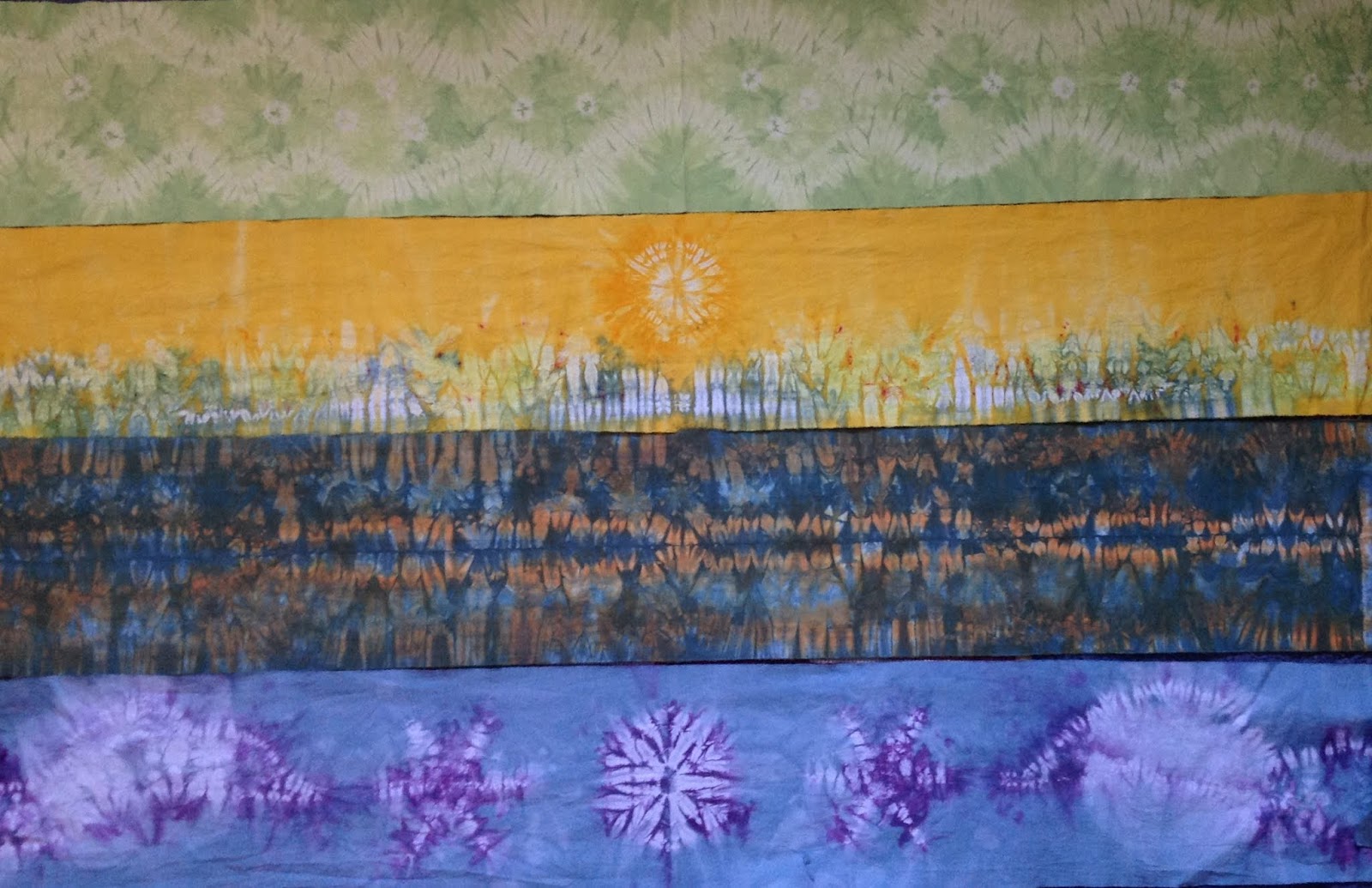
So a little free time focus and some fun with the dyepot. These below a set of fabrics variously manipulated in shibori fashion, stitched, pleated, folded, bound, crumpled.


Dyed with synthetic indigo, flushed through with a wash of petrol green towards the end - I enjoy playing with the parameters of what and when. The colours not quite right here, but you get the idea.


Then in a plastic tray, this scrumptious srcumpledness. Again, shibori stitched, dyed bright yellow a few days ago, then extra colour flooded in as a second process


And here it is unwrapped and blended together with three other bits of cloth from those long ago sheets. Some of my experiments in my first year or two with Christine top and third, second and fourth dyed very recently to complement. I intend spreading them out a bit onto a backcloth so each can have its own voice, but still be part of a whole


And the cities begin to grow in Mesopotamia - 


Assur, capital of the Assyrian Empire the latest to manifest as we flow down the Tigris, Dur Sharrukin, Nineveh and Nimrud nestled in the confluence of the Greater Zab and the Tigris


Monday, 17 June 2019

Focus

Yes, focus, I could really do with more!

I have been absent from here for some time, just being busy really. I have several projects on the go - never giving quite enough time to any of them, but hoping to get more than one thing finished by giving each at least some time. So there is the Mona Lisa project with my Embroiderers' Guild group. We have chopped her up into 25 rectangles and have each taken one to work on with whichever technique we feel suitable. I have her forehead. Just about to start cutting out organza shapes to get the colour of her skin before stitching that and finishing her hair.


Then there is my Mesopotamia project at Studio 11 - very slow stitch, but I am thinking about it all the time; how to express what catches my interest about the subject, how to be creative with ideas as well as images in stitch and cloth. The two rivers, Tigris and Euphrates are gradually flowing down the hanging I'm working on at the moment.


and towns are popping up along the way - in this case, Dur Sharrukin, Nineveh and Nimrud


Also, there is my patchwork - that monthly class which a little group of us are attending where we are learning all the basic skills in a nine patch quilt with borders. Just the borders and quilting to do now!! Only a little bit behind!!!


And recently I acquired,  or perhaps took over responsibility for the most wonderful piece of English Paper Piecing, a Grandmother's Flower Garden quilt, part finished, left to a friend by her godmother. The friend feels she can't finish it so it has been sitting on the top of her wardrobe making her "feel guilty" for the past 13 years.  It is double bed size, and I have fallen in love with it.


There are odd edges that need finishing before I can get to grips with how to proceed. There are also lots more hexies to be cut and stitched round the templates, template papers to be removed from the completed bits of piecing, flowers to be pieced and decisions to be made.


Such inventive fussy cutting.

I have no idea how long finishing will take, but it's a daily bit of quiet stitching that does my soul good.

On top of all that, I am now part way through a ten week course on the history of Mesopotamia - part way through and falling behind! Falling behind because we have been away for three long weekends in the past seven weeks, doing very enjoyable family things with my dear heart's family. This last weekend we were in Kassel for a very joyful wedding. The weather was toasty, the sun shone, the corn poppies were blooming


and the church roof threw back the light to the sky


Then this post popped into my side bar of places I enjoy.

How to have more focused hours in your day

Wonderful advice, but will I take it?

Life is full.