Showing posts with label Cecil. Show all posts

Monday, 12 May 2025

Spring indeed Begins

If you read here at all you will know that I take great pride in the fact that both my grandmother (Ganna) and her sister (Rhona) had novels published, first in the 30s and then, after the war, in the 50s. I have written about them before here and here.

The British Library have marvelous initiative where they are republishing novels by "forgotten" women writers. To be republished the novels have to illuminate women's lives at the time they were written, and have at least one female protagonist.  There are all sorts of wonderful names that I remember from my early days working in the library, and from my grandmother's shelves: writers like Norah Lofts and Elizabeth Von Arnim. It is a "curated collection of novels and anthologies by female authors who enjoyed broad, popular appeal in their day". I am thrilled to say that my great Aunt Rhona, Ganna's younger sister, has joined this throng of voices. In April I received a package of 6 paperback volumes of The Spring Begins, which was republished that month. The three main female characters are all, in some way, moving towards their own sexual experiences, but from very different perspectives. It is the novel about which Rhona's rather staid Methodist Aunt said "Rhona is very clever, but I hope her next book will be different." I'm not sure she felt that awakening sexuality was a "nice" subject for her niece to be writing about! 

I have here to give a shout out to the rather wonderful Simon Thomas, keeper of the equally wonderful blog StuckinaBook (and what better place to find oneself stuck?) who has been the chief mover and shaker in getting Rhona's book republished. He declared it his "favourite read of this year", having come across its virtues being extolled on Furrowed Middlebrow's also rather wonderful blog. Without Simon and Scott's enthusiasm The Spring Begins might never have seen the light of day again. Thank you both gentlemen for your praise of my Great Aunt's book, it has given me untold pleasure.

I drafted a "pen portrait" of Rhona for the British Library to draw on for the very brief bio on the novel itself. I include it here for any curious readers who might want to know more about who Rhona was.

Rhona Catherine Dunning, born in June 1900 in Arklow, County Wicklow, was the youngest of three daughters of Howard Colman Rowe and his wife Alice (nee Atkins). Her father, a practicing pharmacist in the town, was politically active, a supporter of women’s rights and also a writer, having worked for Kier Hardie, writing articles for the Labour Leader newspaper when living in England. Alice was a very talented amateur painter and their daughters, Connie, Ethel and Rhona, lived quite a free life for girls of the time, roaming the town and countryside or wandering down to the beach, often accompanied by the family’s maid. Rhona was the most robust of the three girls, her sisters both being affected by brittle bone disease, inherited from their father. This may have given her more of a sense of her own strong physicality, which permeates her writing.

A charming child listening to the sea on the shores of Arklow

The family grew up Protestants in a Catholic country. My grandmother Ethel (Rhona’s sister, and  also a published author) remembered gangs of little boys chasing them down the Arklow roads shouting “proddy woddys”. Their maternal grandfather was a Methodist Minister, and in later life all three sisters became involved with, and devoted to Christian Science. It formed a significant element of their life as a family. Letters between the sisters, and my mother’s diaries all reflect a life lived with varying levels of spirituality. I think Rhona was considered the frivolous one by her sisters, which paints a picture of a fun person, but Christian Science certainly played some part in her life, as I recall copies of Science and Health in her daughter Cecil’s house when I cleared it after her death.

A portrait photograph of a sweet faced young woman

Howard died in 1914 of heart failure, aged just 44.  Losing their father affected all three girls deeply and is reflected in Rhona’s novel Whatever the Heart Appoints. The central character, a girl of eleven whose father has been absent as a prisoner of war, declares with great joy

“I have been without my father for years and years … tonight we are going to meet again and I shall know everything about him“

Alice tried for several years to keep the business afloat, but this wasn’t possible for a widowed woman in conservative Ireland. It was the time of the Troubles and, on finding a Sinn Feiner with a drawn gun hiding out in their home one night, Alice decided she and her girls needed to move to a safer place. A map of England was brought out and, with her eyes closed, Ethel, the middle sister, popped a pin into the map on St Leonards on Sea, Sussex. Somehow a property was located and they moved there in 1921, along with Alice’s sister Annie. The girls were then 25, 23 and 21. 

Looking rather exotic in her velvet dress in the garden

All the girls had to find some kind of employment as there was no money and Alice rented rooms out to “paying guests”. While her elder sisters were musical, Rhona found work as a secretary in a local garage, Dunning Marriott and Smith. Love soon blossomed between Rhona and Guy, the son of the garage owner. They married in 1923 and had one daughter, Rhona Cecil Grace, known always as Cecil, in 1925. Rhona and Guy had a slightly precarious existence, moving several times in Sussex and Hampshire, due to problems with Guy’s businesses, and money was often short. Rhona wrote novels and numerous short stories for women’s magazines under various pseudonyms – I recall Cecil saying that sometimes all the stories in a particular edition had been written by Rhona under different names. Her writing both supplemented the family income and provided her with an outlet for her creativity. She would write every morning for several hours, and then go for a walk on the seafront with Cecil in the afternoon to plot the next sections of the story. She was also very fond of imagining the lives of people around her when, for example, taking afternoon tea in a cafĂ©. She and Cecil would speculate on who their fellow tea takers were and what their lives might be like. Rhona published five novels in all, from 1932 to 1952, one less than her sister Ethel, who was also publishing during the same time period. I would image there was some rivalry between the two. 

Rhona was a lively and flirtatious character, rather glamorous, deeply loved by and loving of her husband, enjoying company and outings in the family car, great fun and described by her niece as easy going with a sweet intense voice. My one clear memory of her is when, while staying with her and Cecil as a child, I found her standing in the bedroom wafting her arms and hands to and fro. Mystified, I asked what she was doing. “drying my nail varnish darling” was the reply, which speaks of her sense of glamour. 

With her beloved husband Guy

Guy died in 1964 and Rhona moved to live with her daughter Cecil in Henley on Thames, where Cecil was working as secretary for the Brunner family of Grey’s Court, and later custodian of the house when it was transferred to the National Trust. They lived in “the Keep” part of a group of associated buildings just behind the main house. 

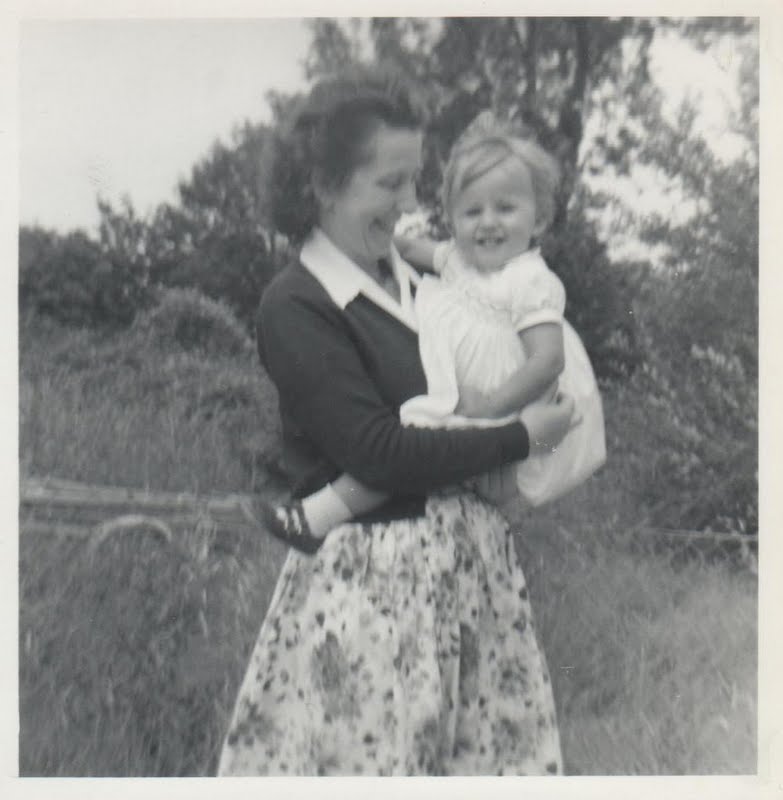
in later years, chic as ever, with Cecil

Sadly, over time Rhona developed dementia as a result of a bang to her head, becoming increasingly confused. Eventually, after her mother wandered out to where Cecil was showing people round Grey's Court and invited everyone to tea, Cecil had to take the difficult decision to move her into a care home where she died in 1975. 

So that is my Great Aunt Rhona, novelist and warm and glamourous soul, now republished for a fresh generation of women. Cecil would have been immensely proud to know that one of "Mummy's" books had found its way into the world again. My mother, on the other hand, would have felt that her "Mummy's" books should also be republished: in fact, should have been republished first. That sisterly rivalry most certainly extended to their daughters!

I have, of course, passed one of Ganna's novels, For Flute and Piccolo, on to the relevant people to see if the British Library might consider republishing her story of women's lives and concerns. I give a brief outline of this here, if you would like to know more. You can image how over the moon I would be if they said "yes"!

Thursday, 23 February 2017

A loss

Cecil getting ready for her 80th birthday party

Those of you who visit here will have met my Aunt Cecil. Sadly she passed away two weekends ago; sadly because I will miss her a great deal, but for her it was an easy departure, no long illness, just a very brief stay in hospital and a quick end. I was so grateful for that; she was happy to the last, I had visited her in her care home the day before, was with her in the hospital for most of that day and feel that it was an ending to be envied, since we all have to go one way or another. 

She was a geat inspiration to me in so many ways; her love of stitching and gardening; her enjoyment of her many small dogs, always two at a time, always known as "fourfoots"; her forthrightness and above all her graceful acceptance of the restrictions that age brought her. Her two most oft repeated sayings were "well, I just go with the flow" and "as my father said, 'make the best of what you've got while you've got it'". She lived up to both of those with a smile and a cheery waive of her hand, and those who cared for her so very well in her final years at the Normanhurst all said what a pleasure she was to have there, never complaining and always cheerful. I hope I can live up to that if I ever reach the ripe old age of 91

"91?? I don't believe it!!!"

She was a treasure

Cecil with her beloved dog Tatters, the first of many, on Hastings beach


Saturday, 1 October 2016

Her ladyship's trousers

I have been making myself a pair of linen, wide baggy trousers using salvaged linen from Aunt Cecil's home. Beautiful smooth sheets, taken in for repair, the job never done. They are thin in places, but there's still plenty of fabric, I love the way it feels. 

Why her ladyship's? Because they originally belonged to the family that she worked for for many years.


So, these trousers, the linen underdyed a soft bright green, with flashes of magenta to tone it down and restrain too much gaudiness. 


Waving
The inital intention was more complex, but I am simply dip dyeing them, with five lines of shibori stitching drawn up nice and tight, just above the hemline.

I flooded a wash of magenta again, then after five minutes a swoosh of deep turquoise, lemon and black. I've been practicing on another piece from here, the pole wrapped piece. I will incoporate my experiments with the other bits from here at some stage.

Here one is pinned against the leg as a sort of example - see how I used the beautifully hemmed top of the sheet as the trouser hem ...


Monday, 24 August 2015

An Adventure

When my Mum and her cousin, Aunt Cecil were children and young women they often had the pleasure of staying with their Aunts Connie and Harry out on the flatlands which surround Rye. They had a holiday cottage there, in fact a couple of holiday cottages, tucked away by the river Rother, nestled amongst the fields where sheep nibbled their way over the land and cows ruminated in the long grass. These were pre and post war times, when milk was collected from the farm in a pail, and the cream pulled off the top of the milk as it settled in a wide flat pan; no pasteurisation, just lovely milk fresh from the cow. Connie and Harry, as mentioned before, were a lesbian couple, very daring for those days, who found refuge in this peaceful place and delight in having their two nieces and other family members to stay. My great grandmother Nanya certainly stayed there, she painted the view down the river in 1924


my grandmother Ganna and grandfather Gerald stayed there, and Gerald was woken one night by the sensation of his sheets being slowly pulled down the bed by some invisible force; no-one was actually there. The two girls, sometimes together and sometimes separately, might sleep out under the stars, be chased across the field by an enthusiastic cow, 

Letter from Mum dated May 1940
or visit the farmer when one of the dogs had puppies. They watched our aeroplanes battle the Germans high above the levels during the war; Cecil slipped into the river just as she was about to leave to go back home, muddying her best shoes and frock much to her Mum’s annoyance; one day when they had been out picking blackberries, the kitchen being out of bounds because their Aunts were holding a religious meeting there, they washed the sticky juice from their hands in the toilet pan! Health and Safety hadn’t been invented and they both seem to have survived.

The two cottages were called Sedges and Nirvana. Sedges was their first summer holiday home; Nirvana was built later by Harry, not literally you understand, but she organised the builders and had the materials brought up from Rye Harbour via the Rother.

Connie and Harry outside Nirvana

This was Connie and Harry’s happiest place named, perhaps, for the way it afforded them a refuge from society’s disapproval, release from the problems of the world, a space of sanctuary, where they could just be themselves. This was in the days when Radclyffe Hall’s novel The Well of Loneliness was declared obscene by a British court and ordered to be destroyed, so their relationship could have brought them a lot of censure.

Connie and Harry cycling across the fields

Both my Mum and Cecil always spoke of Nirvana as a place set apart from the world, where they could be cheerful children and young women, staying with their much loved aunts for a time, before being sent back to school or work. I have pictures of Mum there as late as the 1950s so it had a central place in their lives for a long time. The name was in my mind before I ever understood that it was related to Buddhist philosophy – Nirvana was in the summer lands where Mum and Cecil had been happy with Connie and Harry, I accepted it as part of the fabric of their lives.

Cecil had her 90th birthday last Monday and she and I went out for lunch together, and sat in the garden later, enjoying the sunshine and stroking the cats. However Jen, my lovely daughter, had wished to celebrate Cecil’s birthday as well, so it was agreed that we’d go out together on Saturday for fish and chips in Rye and a trip down memory lane to Iden Lock. We duly drove out to Rye and enjoyed our fish and chips, then travelled on through the town and out the other side. As we approached Iden Lock (completed in 1808) Cecil became more and more delighted. We got out of the car and decided to walk as far as she felt she could manage, on what was a very hot day. Nirvana is set well back from the road along a track that runs between the Rother and farmland. I had no expectation that we’d get very far, but wanted her at least to be able to look across the fields to the places she and Mum had been so happy. As we walked carefully along, Jen and I taking an arm each for support, I suddenly thought – there are no “Private” signs on this track, nothing to suggest that I shouldn’t bring the car along, and if we use the car, we can take her right to the end, to where Nirvana is.

Now the original Nirvana has recently been replaced by a rather lovely wooden property. Jen and I discovered this in June, as we had been out to remember Mum on the fifth anniversary of her death – we scattered her ashes in the river there in 2010, releasing her in the best place we could think of, to be absorbed back into the Earth. I’m sure that breaks some nonsense regulation somewhere, but our family has never been much for rules and regulations. We met a very nice lady there in June, who told us a bit about the new building, and to whom we related the history as we knew it. She was a friend of the owner and said she would let him know, I promised to get in touch as she was sure he'd be interested in our story. As the car wobbled its way down the track this time, I realised that there was someone standing just by the house. We drew to a halt and I approached him with apologies for disturbing his peace, explaining that Cecil was in the car, for he was the owner of this new Nirvana. I had hardly finished my apology before he said, with much enthusiasm, “oh, I’ve been hoping to meet her!” Making us welcome he invited us into his home and allowed Cecil to sit for a while as, between us, we told him what we could of the history as we understood it. Fierce cows and puppies were mentioned, wartime evacuation and collecting milk from the farm. Mums final resting place was offered as an explanation of our presence, along with those long ago days of summer happiness. The current owner was charming, despite the fact that his friends were arriving to have an afternoon picnic and swim in the river. I did my best to ensure that we didn’t outstay our welcome.

On our way home Cecil kept exclaiming, again and again, “oh I have had a lovely time”. She has a great capacity for enjoyment, but this was a special day for her and Jen and I were overwhelmed by how much better our trip had been than we might have imagined. Cecil will have no memory of what fun we had, her memory retains almost nothing for more than an hour or so, but we know that she had fun, and will always remember that we had a great adventure with her in these late years of her life. Thank you James for sharing Nirvana with us.

Saturday, 21 June 2014

A great change

I'm sorry, I have been absent from this blog for more than a month now, partly because I have been so tired coming home from work that there has been no energy to spare for thinking and posting. Also, I have been faced with the unenviable task of finding a care home for my dear little Aunt Cecil. Her carer, who has been a wonderful help to her over the past almost four years, has always said that she will let me know if she feels that Cecil is getting past the point where care at home is sufficient, and she feels now that this is the case. So I have trawled the local care homes, both on line and in person to select somewhere that, I hope, will provide her with company, security and not too much of a sense of being in an institution. I'm trusting that my choice will work for her, so went up last Wednesday to see her and discuss the next steps. She, with her usual pragmatic view, expressed both dismay and anxiety, but says she "must just go with the flow". This has been her philosophy for the past five years, since she was robbed of her short term memory by whatever it was that sent her in this direction. I admire her hugely for such fortitude, as it is quite obvious that she finds the whole thing immensely frustrating, having been an independent lady for all of her working life, which lasted, in some fashion, until 2003 when she was 78. The next few months will be hard for both of us. She will have to adjust to moving, and I will have to work out how to get her here in one piece along with what little furniture there will be room for, then deal with the rest of her house contents. It is very sobering to see a life reduced to what will fit in one room, to know that she will no longer be able to rummage through drawers, finding fragments of her past, or wander round the rooms she las lived in for the past 25 or more years. Each room of the homes that we live in contains something that defines who we are, things we have chosen to keep, for aesthetic or sentimental reasons, or from practical necessity. To be faced with leaving the bulk of that behind is bad enough, but I'm very aware that, with little memory to speak of, she will be placed in a state of permanent confusion initially, and am hoping that she will be able to adjust to her new circumstances. I feel that I am both rescuing her and condemning her, but the sad process of ageing brings such necessary accommodations. Having watched this happen to the three women who have been closest to me, my mother in law first, then Mum, now Cecil, it leaves me sometimes with a genuine dread of what lies ahead. 

On a more cheerful note though, having left Cecil on Friday lunchtime in the kind hands of her carer, I stopped off at Grey's Court on my way home. It was such a lovely day, and I wanted to spend some time there taking photographs for her. She worked there from 1969 until she retired and continued to be involved there until Lady Brunner, the owner, died in 2003. I was delighted to meet the current estate manager, who remembered Cecil being there to help her ease into the job. She had been told by those who worked there that Cecil would be easy to recognise, as she looked just like Mrs Tiggywinkle, an apt description which made me laugh with delight.

 I have a number of memories of visiting her there, both on my own and with Mum and my Grandmother. It is a beautiful property, so if you are ever In the area do take the time to go there. Here are a few pictures to give a taste of its delights.


The front of the house, with its lovely facade of mellow brick and stone, grounded by the green lawn and background trees. No photography is allowed in the house, as the contents still belong to the family, but inside is full of fascinating things; beautiful plastered ceilings; needlework and porcelain; books, furniture, portraits of the family and of Lady Brunner's friends from her days in the theatre. She was the granddaughter of Sir Henry Irving, studied acting in Oxford and London, and appeared on the stage and in a silent film, before marrying Sir Felix Brunner in 1926. The house still has a very domestic feel, having been beautifully restored, but also kept very much as it was the the family lived there.


Above and below are two views of The Keep, which was where Cecil lived when I visited her. The large building in the left foreground houses the donkey wheel which was used to draw water for the house. The turreted part below housed the kitchen in which Cecil made great trays of cakes for the tearooms.


The Cromwellian, below, which sits on the opposite side of the lawn We were allowed to sleep here on one visit;  I was quite I sure that the room I had been allotted was haunted and so refused to sleep there. As I went round the house on this visit I had a feeling that the patchwork quilt I might have slept beneath was on display in the guest room!


The beautiful gardens, which are a delight at any time of year


The rose walk, a paradise of delicious scent


The archbishop's maze, installed in 1980. You can read about its inception here, a rather lovely tale of spirituality translated into form


The wonderful wisteria walk, full of green shadows and gnarled twisty branches, lovely even when there are no flowers, but I would imagine quite sublime when in full bloom


I felt rather wistful wandering about with thoughts of Cecil's long assiciation in the back of my mind. For me, Greys will always be associated with her, and with memories of my visits there, which I treasure as a rare privilege in what was otherwise a very ordinary childhood. Before I left, I treated myself to delicious coffee and cake in the tearooms, in honour of her.

You'll find more information on the National Trust website if you fancy a visit. I'd recommend it.

Friday, 4 April 2014

Nearly home again

I'm at the end of a three week break, my final week being spent with my Aunt Cecil in rural Oxfordshire. Those who pop by here regularly will have met her before, but here she is sitting by the river Thames, about to tuck into coffee and chocolate tiffin. This image, I hope, captures her sweet smile and marvellous sense of fun, quite undiminished by dementia.


I take pictures so that, when we get back home, she can see where we've been and what we've done, her memory being truly absent. It was she and my grandmother who inspired me to stitching many years ago, both being fine needlewomen. The skill has been passed down the family from my Great Grandmother Nanya's generation (and no doubt those who came before her), and Cecil talks of Aunt Annie and her exquisite smocking. I wish some of it had survived, but would guess it was needed to earn money. Aunt Annie lived with Nanya, who had been widowed in 1914, with three daughters in their teens to support and no means of income beyond their wits and feminine skills. They moved from Ireland to England in 1921'ish; their location chosen by the legendary pin placed in the map with eyes closed.

Coming from a family who have condensed into just me, Cecil and my daughter Jen this side of the water, I treasure those family tales and the opportunity to spend time with Cecil and share our joint past. On this visit I took a collection of old photos to show her. They have all come to me, as Nanya lived with my grandmother at the end of her life; I also have, and treasure, the letters she and my Great Grandfather wrote to one another through their courting days (a project for my retirement). Cecil was very anxious that I label all those images so "those that come after" know who they are. It got me thinking about the values we place on things. I know who those precious few blurred faces belong to; some of them I met, some I know because of our shared family tales, to me they are real people with lives and loves and interesting characters. Yet if Jen has children and brings "grandmotherhood" back into this diminishing family, these dear souls might be of little or no interest - just dated images in sepia and black and white. This is true of so many things that get handed down, their value is simply to those who know the who and why. Once those people have gone, what is to be done with them? I don't know the answer, but do recall collections of Victorian photos that we hold in the reference library I used to work in. We kept them without knowing anything of who they were, simply because they were old. I often wondered what was the point, but couldn't countenance throwing away images that were a window on somebody's past, albeit anonymous. What think you?

Thursday, 29 November 2012

Cecil's Quilt

Just a quickie, I've just realised I've not shown you Cecil's lap quilt now it's finished - how remiss!!

Here it is - the front
and the back
I'm amused to notice this fabric covering a cushion in the current series of "I'm A Celebrity" - which is unwitting testimony of the fact that I'm watching it! I don't watch a lot of telly, but it is such fun, and a good way of chilling after a day at work - usually with stitching in hand for the ad breaks. I refuse to watch them, and mute the sound when they come on; a tad eccentric perhaps, but why should I slavishly allow myself to be cajoled by "Them". it's much more peaceful to quietly stitch away while the goggle box flickers in the corner of the room - and have you never noticed how the sound is always louder when they're on?

Hope Cecil likes her quilt. I'll report back after Christmas.

Sunday, 19 August 2012

Cecil's Saga

Cecil is my Aunt, or more properly my first cousin once removed. She lives in the delightfully named Felix Lodge in a little village in the heart of the Home Counties. She stood as my godmother when I was a baby, is the only remaining strand of this part of the family apart from myself and Jen on this side of the water, and has always been an inspiration to me. She never married or had children, much to her sorrow, and worked at a variety of jobs during her life. She rose to the challenge of paying off all her father's debts when he died, leaving her and her mother bankrupt, and cared for her mother as dementia took hold, for as long as work allowed. Her final job was a custodian to one of our country's beautiful National Trust properties, Grey's Court, where she initiated one of the first tea rooms at a National Trust house, drawing great trays of delicious smelling cakes from her Rayburn to sell to guests. I had the pleasure of staying with her many times as a child and young adult, thrilled to be sleeping in "the Keep" one of the cottages in the complex that made up the Grey's estate, which was her home until she retired. She is that sort of middle class Englishwoman who are the backbone of  country life across the land - a keen member of the WI, active in the church, an arranger of flowers and mender of vestments, helper of friends and organiser of good works. When we celebrated her 80th birthday I was deeply touched by the number of her friends who told me what a kind and caring person she was, how often she'd helped others and how much she was appreciated and how little she expected for herself. This attitude might be sneered at now, derided as some sort of submission to an outdated expectation of woman's role.  In a culture more interested in individual rights, gripped by a consuming desire to have all, altruism seems to have gone out of fashion. I think that is a rather sad thing; it makes people unthinkingly unkind and seems to have brought a hard, uncaring tone into our lives. If we don't care for each other, who else is going to do so?

Here Cecil is, with her mother, me and my dear little mum, on one of our get togethers with each other, when I was somewhat smaller than I am now!

Last week I went to visit and help her celebrate her 87th birthday. She is getting old, her short term memory is gone, as I've mentioned before, and life is often difficult for her, despite having a very fine carer called Phyl, who comes in daily during the week to help out with the practical and to bring some fun, stimulation and interest into her life.

What do you give someone who is 87, who has all the things about her that she needs, and whose life is closing in? Well, Cecil has always been a very fine needlewoman. She and my beloved Ganna inspired my to stitch in my youth and she has always taken a great interest in what I've made over the years. Her house is decorated with a number of lovely bits of embroidery done by her with delicate and varied stitches, beautifully executed. She made me dresses as a child, and also clothed my doll, Amanda Jane, including this rather fine rose pink outfit with matching hat!

Well, Phyl, during one of the many "sortings out" that happen from time to time, came across a piece of embroidery that Cecil did when she was 23. It was done as part of a course she went on - sadly she can't remember quite what the course was, but they had evidently been tasked with some autobiographical stitching. So she created Cecil's Saga, a beautifully worked piece of stitchery which includes little vignettes of her life - or rather what small part of she'd lived up until then. I brought this home with me some months ago, delighted that it had been found and thought, "now, what can I do with this lovely cloth"?

As her birthday approached, realisation dawned. Of course; the obvious answer! What gives pleasure to those whose present is dimming? Thoughts of the past, that "other country" which comes and goes in our minds and has, in part, made us who we are. So, knowing of a rather good picture framers in Hastings who have done lovely work for me before, I took it along to consult. Of course they could frame it, what frame would I like? what mount? what size? I left it with them, in pleased anticipation, and when we collected it I was really delighted with the result. The framing was lovely and the mount really sets off the muted colours of the cloth it is stitched on. I brought it to her home wrapped in the Tie Dye quilt which both protected it and was taken to show and amuse in it's currently unfinished state. The cloth was carefully raised, like a stage curtain at the beginning of the play until, voila, the whole could be seen and the spreading smile and exclamations of surprise from her were just marvelous. The gift had worked, she was thrilled, here she is, holding it proudly, with one of her finest knowing smiles!


And, here, since it is rather large, are some of the details so you can appreciate their character and whimsy


Joining up toward the end of the war, moving from civvies to uniform. On the day war was declared "Daddy said, 'well, we'll have to get you back to school my girl'", so she was evacuated with her school from home and family in Sussex, down to the rural West Country. Then, when she was too old to be at school any more "Daddy said, 'come one Totty, time to get you in the army'". So Totty did as she was bid and joined up - terrified, but also glad to have her freedom and a comfort to other young recruits who'd never been away from home before


Commemorating the Battle of Hastings. Hastings had been home before the war as her grandmother (Nanya to me), and three daughters had moved there from Ireland in 1921 after Sinn Feiners, pistols at the ready, creeping though the house in the night, made staying in Arklow less than attractive.


 A delightful little group with their bicycle - Cecil couldn't remember their significance

and Great Aunt B with her cat.

The picture, as you can see, is rather large, and I was a bit worried as to where it might fit in her very small cottage. However, we found the perfect spot here


It is just inside her sitting room door, ready to greet her each morning as she gets up and takes her cup of tea there to sit and read the paper. I'm sure she and Phyl will spend time looking at it, talking about what each image represents, visiting the past and happy times. If you look just past her head, you'll catch a glimpse of the other gift I brought with me - an angel sun catcher with the word PEACE dangling below in rainbow colours, to hang on her conservatory door. I felt it was a good thought with which to start the day.

So thank you Phyl, for finding this gem and bringing it to my attention; thank you Empress Art of Hastings for giving it such a lovely frame, and thank you Cecil for always being the best Godmother and Aunt I could have wanted.

Saturday, 26 February 2011

Memory

I have been thinking a lot about memory recently. In the past 14 years I have watched three close members of my family succumb to one sort of memory loss or another. The first was my mother in law, who was brought down by Alzheimer’s disease some time in the 1990’s. Then in 2005 my mother had a very bad fall, from which the essence that was her never quite recovered. A few years later her cousin, my dear Aunt Cecil had some kind of mini stroke, and is now classed as having dementia, whatever that term is supposed to mean. In each case there has been, as one effect of these afflictions, a loss of short term memory.

This loss of day to day memory affected those dear souls in a variety of ways. For my Mother-in-Law the Alzheimer’s gradually robbed her of the ability to be rational. We moved her to live with us, “us” at that time being my ex husband, my daughter and myself. By then, for her there really were “monsters under the bed”, not in the sense that she felt there were strange creatures waiting to grab her ankles as she went to her rest, but that the whole world was out to get her. She was by nature not a trustful woman, and as the disease took hold, that distrust was intensified by her profound anxiety. She would spend hours looking for her things, convinced “that bloody bitch has took it all”. Another activity would be a desperate hunt for whatever it was she was “just going to do” – her drive for hard work and useful activity hadn’t died, she simply didn’t know what it was she was supposed to be doing any more. No attempt at distraction could override this need to be useful, yet she became incapable of undertaking any activity as she could never remember what it was she was supposed to be doing. Her days were spent in restless anxiety until the disease progressed to the point when all awareness was gone and we had to place her in care.

My aunt Cecil, known to my Facebook friends as the Kidmore End Fairy since that is where she lives, also has memory problems. They started in 2007 when she was 82 and had some kind of happening in her head which left her bereft of short term memory. She finds this both frustrating and frightening, in particular since her own mother succumbed to memory problems after a bash on the head. Cecil is a tremendous character, full of stories, since her mother, like Ganna, was a writer, yet sadly bereft of children since she never married. She reminds me of the Queen, both in her manner and her way of speaking. She worked, for the majority of her adult life, for the National Trust as custodian of Grey’s Court and secretary to its owners. In place of children, Cecil has always had dogs, and I recently had to drive up to stay with her as one of her dogs was to be put to sleep. Part of my role in this was to constantly reassure her that she was doing the right thing; with no recall of the vet’s diagnosis, given the previous week, she was sure that it must be done, but not sure why. The deed was done with great kindness and delicacy by the vets, as Jamie sat in her lap. 


After they had gone, I took Cecil out to lunch to "take her mind off things". Already the fact of his absence was receding from her awareness. I had to leave that evening, and I wondered as I drove home, how often during the following days, she might start up to look for him, only to realise at some point – how long would this take? – that he was gone. I went to see her again last week, this time for a trip to the solicitors to sign her will. We drove into Henley, had a very pleasant day and were treated to a delightfully humorous vignette by said solicitor’s son, who works with her. Again, by late afternoon all memory of the trip had gone, the laughter we had shared at a young man's antics was inaccessible to her. While this means that every time I take her to Henley her delight is new, as she’s sure she’s not been there for “at least a hundred years”, that delight soon fades as the experience can’t be revisited in the fullness of time. Her days are deprived of the pleasure of recollection and also, presumably, of any sense of existing within a sequence of events.

My Mum’s memory loss seemed to be combined with a dreadful inertia. After her fall, from which she emerged with multiple skull fractures amongst other injuries, I thought we’d lose her, but her tenacious spirit won through and she sort of recovered. I moved her to be with us; by happy coincidence the flat above mine came available. However, some vital essence that was her had gone.  She stopped doing things, while having no memory that nothing had been done. This, combined with a very vivid form of daydream, resulted in such problems as convincing her to eat. She would be quite sure that she’d cooked and eaten a large meal, and so had no appetite for food. Her poor little frame got thinner and thinner, yet I could not convince her to do more than nibble at the meal I had prepared for her. She would forget that I had been with her each day until I went upstairs. I would be greeted by the blazing light of her pleasure at my arrival, shining out of her blue blue eyes, as though each appearance was utterly unexpected. Rarely aware that I was with her many times during each day, a sense of having been deserted would trouble her. She knew that there was something deeply wrong, we would talk about her condition and sometimes a deep feeling of dread would overcome her. She would look at me with a sort of hopelessness and say “I’m frightened”, yet not understand why. Friends would visit and she would enjoy their company a great deal. She had what her mother called a “gift for friendship”, her pleasure in people was intense, as sometimes was her ire if crossed! Yet in those hours she inevitably spent alone while I was at work, she could not review these visits and happy conversations to glean more pleasure from them, they were gone.

My dear little Mum died last year, and the loss of her, of whom I think daily, is also in a way a loss of memory for me. She was the repository of our family history, not in the genealogical sense, but in the form of family myth and a sense of shared experience. I can no longer ask her to remind me of what my father said on such and such occasion – nor relive the shared delight of my great grandmother’s maid, exclaiming on the “striped ass” - a zebra, shambling down Arklow High Street when the circus visited. Granted my childhood wrongs are no longer visited on me either, but the sense of a void, where family companionship was once, is profound. I am an only child, so there is no one else to recall these vignettes with, just silence.

These thoughts on memory and its function in our lives come to me often, in particular as I have read and pondered a great deal about mindfulness, in the Buddhist sense. As I understand it, it is about letting go of all distractions and living wholly in the present, which is the only time and space we can be certain of. Our past is gone, our future a mystery, the present is here and now. In placing ourselves in that present, experiencing it to the full and releasing ourselves from the endless cycle of thought that traps us elsewhere, we are advised that we can find freedom from anguish and suffering; our yearning for something other than the lives we have will abate. I can accept this intellectually, it makes perfect sense to me and I try to live my life as best I can with an awareness of the value of now. Yet watching these poor souls suffering in their forced relinquishing of thoughts of recent things, I feel that our time spent revisiting recent events, conversations, happenings is central to our sense of being. We cannot thrive, nor move logically through our lives without thoughts of who and what and where. Without them, are we not abandoned souls, crying in the darkness?