Showing posts with label Ganna. Show all posts

Saturday, 30 December 2023

things with meaning

I come from folk who save things. This could be called hoarding, but perhaps, for us, it is more about keeping connections alive. My grandmother, mother and I all experienced sudden loss of a parent/husband, coupled with the loss of our home environment in which that loved person once existed.

In Ganna's case, she and her two sisters lost their father when they were teenagers. In my case I was seven. Our respective mothers then had to reconstitute their lives without their husbands and with dependent young people. In Ganna's case, she and her sisters came from Ireland to St Leonards on Sea, leaving their old lives behind ands starting again. In my case, Mum and I had to up sticks and move to Hastings from our happy life in Petersfield. She went back to full time work and life went on, because that was what one did in the sixties, no grief counselling or even a sense that it was needed. I cannot imagine how hard that was for her. As life has continued, even those two loved women have become lost to me.

I wonder whether these losses have meant that remnants of that old life take on an almost talismanic power; keepers of the past. As long as these curtains, our dining table, that chair are here, then the past, which includes that lost loved one, isn't entirely gone. The article has known their touch.

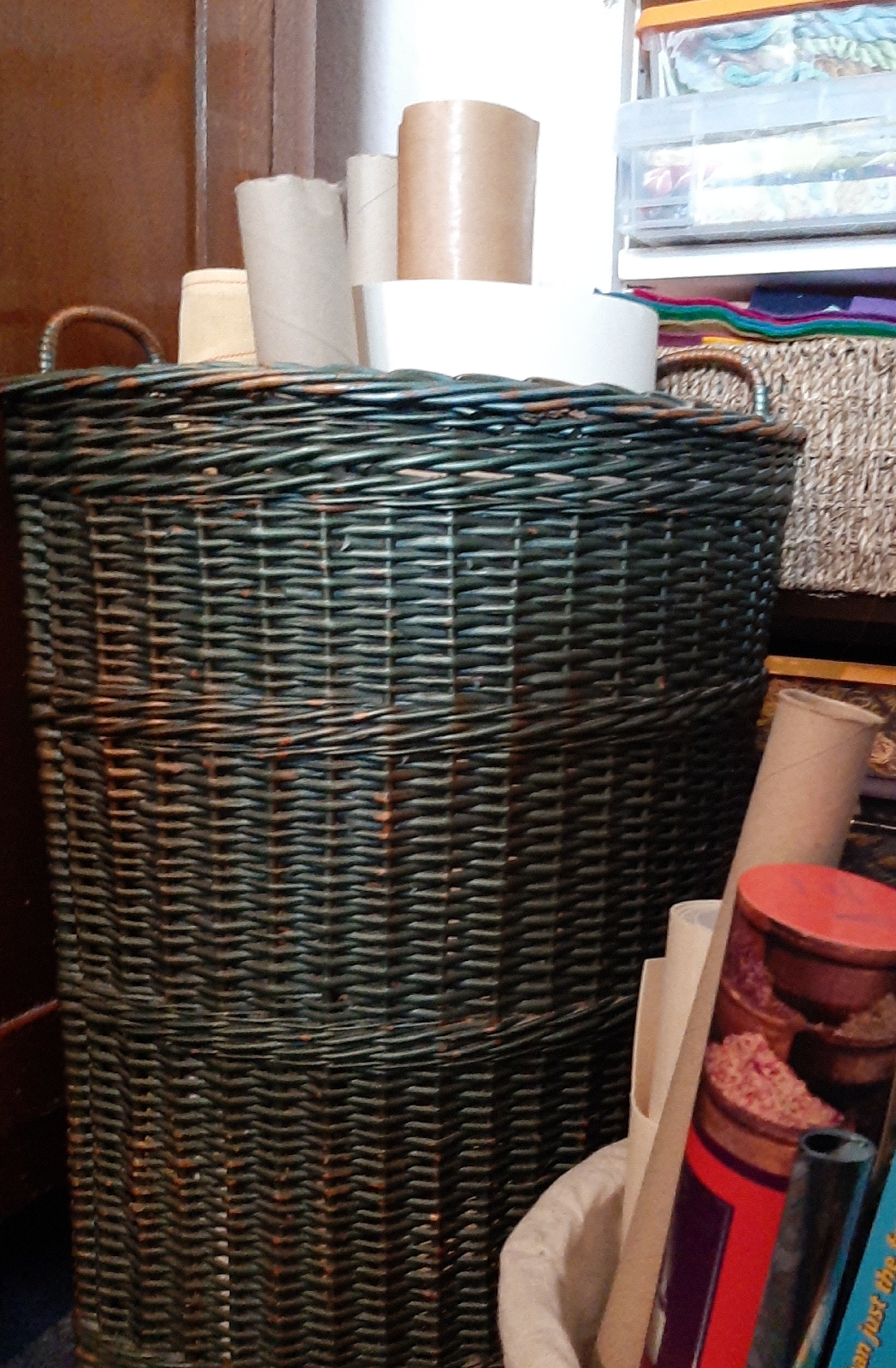
There is a laundry basket: wicker, worn, much used. It may well be 90 years old, bought when Ganna was first married in the 1920s. In recent years the wicker ties holding the lid on have  creaked a greeting to me each time I pop another piece of laundry in. I have known it for most of my life. Recently, the final tie holding lid and basket together died. The lid became a separate entity.


I sensibly, if a little wistfully, ordered a replacement. The replacement arrived, but the old basket remained in the way, for weeks. I couldn't face ditching it! Then a thought occurred. I store upright things in my craft room, cardboard rolls, baking parchment, rolls of needlepoint canvas and the like. The basket is the perfect height to hold them.

So now a muddled corner has more clarity, the bigger muddle surrounding it has been rationalised. But most importantly, I sill have that battered, venerable old basket, which existed in different bedrooms through loss and moves, still with the touch of Ganna's and Mum's hands captured in its weave.

I expect I should have just broken it up and burned it, or taken it to the tip.

I'm glad I didn't ...
 

Sunday, 13 June 2021

Things - keeping and relinquishing

Over on Kindred of the Quiet Way Pen is spending this year reducing the number of things in her home. She has done this before, and is deeply committed to the idea of walking lightly on the earth and leaving as little behind as she can when she leaves it. She is a person who lives her beliefs and her faith with deep sincerity. I have known her since I was a teenager; she is a dear soul and I respect her ideas, finding them both thought provoking and sometime quite challenging. The theme of minimalism is one she has returned to again and again; it is something that allows her to lead a frugal life and be at peace with herself. Many years ago she recommended a book called Nothing Left Over by Toinette Lippe, which I have read, and will re read as it contains much wisdom. There is a huge appeal in reducing ones things to the bare minimum, and I have considered it often. However, this is not quite how my life has evolved. 

My great grandmother Nanya had three girls but I am the last person (not counting beloved daughter) in that line of our family. As such, my domestic space contains the distillation of multiple homes refined by multiple house moves. As I walk through the rooms my glance falls on all sorts of things which speak to me and to each other. 

Little treasures from Mum's childhood, kept so carefully by her.

This quizzical cow with his broken ear, guarded by a rather fine dachshund, which came from Cecil; dachshunds were her speciality, though hers were always long haired.

A glass bowl, given to Cecil on her retirement by her National Trust employers. It has an image of both the house she lived in when she worked for them at Grey's Court and, on the far side, Felix Lodge, her home until I had to move her to be in care near me. I stayed in both places often, and remember the kitchen in that octagonal tower and the delicious cakes she baked in the range for the tearooms there.

There are these two lovely bits of pottery; the bowl made by my mother's Californian cousin Ellen, descendent of Nanya's brother; the little mug made by Ellen's dear friend Inez. They sit on Ganna's desk recalling two holidays taken there when I was a teenager.

This delightful image which, I believe, was painted by Howard. A moment's canine mayhem triggered by a frisky cat. 

And books, books, books. What would one expect from someone who worked in the library for forty years, and whose family wrote and treasured books above many other things. Some here are mentioned by Mum in her diaries - it feels rather special to read of her being given them, and then find them still on my shelves. 

I could show you more, but this post might never end. All these things live in my study - there are other rooms (she said darkly)!

So, what of minimalism?

When I read about it, as I say, it has a huge appeal. It carries with it connotations of liberation, non consumerism, lightness of being. And yes, I think all those things are possible, even likely when you relinquish things. But then I think about the conversations my family things have with each other. Those two pieces of pottery, still happily together, though the folk who made them have gone. The little gathering of Mum's treasures which enchanted me in my childhood. I think of the way that, in nature, when things accumulate, there is always growth of some sort, even if that growth is simply the rotting down of waste (in the compost heap for example) to provide food for something else. I see in the garden how, if I don't clear the leaves and dust, the weeds spring up with delight, or the way emerald moss cushions the cracks in the pavement. I notice how the leaves gather at the foot of the trees, feeding them and the forest creatures as they blend back into the soil. I watch the blanket weed in the pond and know that its growth is absorbing nitrates that would otherwise create an imbalance; the pebbles on the beach which allow sea kale and mallow to colonise. There is a richness and potential in abundance, a raft of possibilities and opportunities.

So, perhaps for me, the way of minimalism, while appealing, is not one I will take. I recognise that, for some folk, the act of relinquishing is a path to clarity and peace. But I enjoy the memories that all these objects bring me; the way they enrich my life. I know that those loved folk are always here in my heart, but specific thoughts are triggered by each object, rather than a general sense of what was past. And, on a more philosophical note, I wonder if the eight year old little girl who lost her Daddy, her home and the whole context of her life, is not still nestled in my soul somewhere, reassured by the knowledge that at least not everything is gone.

Sunday, 14 June 2020

Ten years

Ten years ago today my dear little Mum left this earth. This morning Jen and I sat together in my garden and raised a cup of tea in her memory. We both feel grateful to have had her in our lives. She was a wonderful Mum, though not always an easy person, and was a delightful Gran to Jen, known always as Granny Rose, because her name was Rosemary. I printed out a couple of extracts from her diaries for Jen, just to bring her close again and we sat crocheting and knitting and drinking tea, exactly the sort of thing Mum would have shared with us had she been here.

Mum with her Mum, my Ganna
Mum and Dad in their courting days


Mum and Jen in 2003
So, a little bit of that extract which is so exactly Mum, with her ability to recall conversations in detail and her tendency to not "suffer fools gladly" - she could be a harsh judge of folk at times, yet unshakably kind and generous with most. She was 16 when she wrote this in 1942

"To change from the sublime to the ridiculous Mrs Lambert was talking to Mummy over the fence the other day and she has for some time wanted to find out if Mummy has registered to find out her age. She is in collusion with Mrs Harpur. Mrs L says that she has registered which is a lie because for one thing she is no more 42 than I am, for another she told Daddy the day after that she hadn’t registered because it was so full and would she be out to jail and then about 3 weeks after told Mummy that she had gone in there and told the woman that she wouldn’t wait, and of course the woman obeyed her. There’s swank for you! Anyway I am leaving my story. She suddenly said to Mummy “My dear I have my calling up papers, have you yours?”. Whereupon Mummy said “No”. Actually she hasn’t got to register until next month but she wasn’t going to give anything away to Ruby to Mrs Harpur to Cheam. Then the fair lady said “Ah I know why you haven’t got them, because you haven’t registered – have you registered?” This was all done in a high pitched excited voice and is very rude because it is the equivalent of asking a person their age which isn’t usually supposed to be in the best of taste. So truth telling Mummy said “No” and quickly added “not for firewatching” Mrs L “But my dear I don’t mean firewatching I mean the ordinary registration” so Mum said “Oh yes Mrs Lambert” whereupon a steady gaze ensued. Where Mrs L goes wrong is that she makes such silly mistakes like saying that she had all her calling up papers when she couldn’t have even registered for firewatching as it hasn’t come in. Some women are silly."

We enjoyed that

Thursday, 14 June 2018

updated yarn

A yarn can be something that you knit or weave or even stitch with, or it can be a tangled tale with twists and turns and little diversions along the way.

The first meaning is obviously what the image below is all about. Yes, a little while ago I treated myself to some lovely Noro yarn, on sale in a very fine wool shop near where I live, which was closing down. Both my loss and my gain. Then a couple of weeks ago I went out with beloved daughter to buy a dress for her for our wedding, and was lured into buying yet more yarn, as one is from time to time. 

I felt it only right that the less recent purchase should be knitted up first, so here is the knitting in progress, along with the pattern.


I have to say, I don't think I'll look anything like as fey and girlish in my version, but (and this is very important to me) the cardigan will be symmetrical across the front, not all skew whiff like the illustration in their pattern book. I have puzzled over this for some time; why oh why are all Noro patterns knitted up all any old how in relation to the (absolutely beautiful) colour changes in the yarns? A brief bit of research online found me this little gem of a phrase from the "blurb" on their website.

"Harmonize natural unevenness, asymmetric pattern and complex color to portray the beauty of the nature. Taking sufficient time to dye and yarn natural flavors and tenderness of materials to preserve their original characters"

Well - apart from the delighfully idiosyncratic translation from the Japanese, I guess the "asymmetric pattern and complex colour" explains the lack of symmetry. But when did you last see an asymmetric butterfly, or flower, or bird's wing pattern, or tabby cat's stripes? 

Nope, just can't be doing with all of that. My cardigan will have, I hope, perfectly matched colour changes across the front and the sleeves, which will give me great satsifaction. Yes that does require hunting through the remaining balls to find the one which starts as near as possible to the end of the previous one, and cutting out the excess but I can use that up in the collar, so no waste there! And what satisfaction when I finally sew it all together and the colour bands flow across my imperfect body in perfect symmetry!!

So, to my second yarn, the tale of the Damn Bloody Mouse - known as DBM hereafter. Yes, there is a link with the following pictures I promise.

We have two lovely cats, Rum and Raisin, who have shared our lives for the past ten or so years. We love them dearly, and feed them far too many biscuits but they are cats, and they do what cats do; catch things. Rum's catches ususally get crunched up on the lawn, though occasionally they are brought in for consumption overnight, with little bits left by the Man's chair in case he's peckish in the morning. Raisin, however, is a bit more squeamish. Once the excitement of the chase and catch is over, he's not quite sure what he should do with this poor wriggling furry thing. So in he comes clattering through the cat flap, a scurry, a yowl or two, and I rush into the kitchen to find a mouse (DBM) cowering under the dresser (where all good mice should hide) and a grumpy fat cat doing his best to get under the dresser. A cat and mouse impasse. I removed the cat, and found things to block up the ends of the dresser so that DBM couldn't escape. However, DBM had escaped already, to hide beneath the bookshelf in the sitting room. Aha, I thought, I can block up the wavy front esdge of the bookshelf with "more things", heavy enough and malleable enough to fit under the wavy bits and leave one small space for DBM to come out. The one small space was, of course, cleverly adapted with a humane mouse trap, baited with rather nice nuts and chocolate biscuits. No problem I thought.

Two days later, having sat each morning listening to little mouse scrabbles, and thinking, "oh, he'll be out soon, tidily captured in the mouse trap" I came down to find that two of the "things" used to block all exits had been wriggeld through and there was no DBM any more. And, to add insult to injury, DBM had been very grateful for the nice feast I'd supplied him, easily accessed by nibbling through the soft corduroy cover that ennables wheat packs to be heated up in microwaves before being applied to sore necks. Perhaps not my best choice for a mouse barrier!

So what does this have to do with the pictures below?

Well, for the next two nights I was awoken several times by little scrabbles and scuttlings in my bedroom. Ye Gods, I thought, DBM has found it's way upstairs and is negotiating the maze of boxes and whotnot under my bed. This is definitely Not Good. The first task, obviously, was to buy more humane mouse traps; the second to move all the boxes out from under the bed, then crawl about, with no thought of dignity, with torch and long poky thing to find the whereabouts of the DBM.

What did I find? A great deal of dust; a pen I'd lost; a single sock; a bookmark; an empy pack of aspirin. I also reacquainted myself with the precious contents of these many and various boxes: old writing cases belonging to Ganna and Mum, stuffed with letters, diaries, account books and the like; a complete handwritten draft of one of Gannas novels, along with the typewritten version that Mum did for her to send to the publishers; a small suitcase with a set of old reel to reel tapes which I know have all of us (me, Mum, Dad, Ganna and Grandad) talking many many years ago in Petersfield when Dad was still alive and playing with his new Grundig tape recorder. And this very fine collection of rug yarns, complete with the canvas (3' x 6') and a handwritten list of the amounts of every yarn there. 


Some were easy - just count the drums and you know how many pieces you've got, but I had a vision of Mum sitting and patiently counting out 929 pieces of green, 482 pale pink, 33 dark blue, 2 khaki ...... as all those below were just small remainders, carefully packed into plastic bags to keep them safe.


They have sat there I'd guess, for the best part of the last 40 odd years, kept for "one day" when she would have time to make the next rug. One day never came - it often doesn't, so here they still are, awaiting a hand and a design to make the best use of them, along with the list of amounts, and calculations of how many pieces would be needed to fill that canvas.


But what of the DBM? Not a sign, not the merest twitch of a whisker, nothing. But still, occasionally, I hear a little scratch and scrabble in the middle of the night. Not in my room, no no, in the walls of my room. I assume the wretched creature has found its way in somehow, and is now searching the fabric of the house for more tasty morsels. All we can hope is that a) it doesn't start trying to eat the wires, b) it finds its way outside somehow, without encountering an enthusaustic feline on its journeys and c) it does so very soon, as I'm rather tired of sleeping with one ear cocked just in case it finds its way onto the bed!!

Beatrix Potter children's illustration of mouse family iin bedroom with dolls for Two Bad Mice


Sunday, 18 October 2015

A little bit about Ganna

This blog has a URL that includes the word "Ganna". Those of you who are regular visitors here may have gathered that she was my maternal grandmother. I've been putting together a page here that gives a little bit of background on those people who form part of my past - without whom, in fact, I would not have been formed at all.

If I was a clever blogger I would not give you a link to just the little bit I've written about Ganna. However, I don't have the skills, though I'm sure it is possible, so if you'd like to know a bit more about a woman who was very formative in my life, who introduced me to embroidery, who played the piano like a concert pianist and who brought me up from the age of eight, click on the link to "Grandmother and others" up at the top and scroll down until you find her picture.


Tuesday, 19 February 2013

Look on the Fields and others

I'm sorry, it has been ages since I've written anything. In part this is because I ran into a "problem",which turned out to be me not noticing hat there was a size limit on Picasa albums .... Aha! so that's what that funny error message means when my photo uploads fail. You'd think I'd have twigged that, having at least some sort knowledge of computers and the like.

What else have I been doing? Dyeing cloth, planning City and Guilds , doing practical design exercises, stitching shadow work in between times and reading. Oh, and going to work! Some of my reading has been of Ganna's novels. These are the three I have read since my last post.

Look on the Fields was published in 1935, a year after Barney's Bend. Here is the cover, once more a lovely Rowland Hilder image.
It was, as I recall, the novel she felt had worked the least well, though for me it is a delight because it paints such a clear portrait of her family. At it's heart are three children living in Ireland, who welcome their cousin into the family. She is a fragile soul, who reminds me of Aunt Connie - Ganna's eldest sister, who was the most brittle boned of the three girls. In this story, her ankle is crushed in an accident - in reality, Connie's ankle was trodden on by a horse and was thereafter, twisted and weak. At the heart of the family are their mother, who watches the comings and goings of her household with patient amusement, and their their father, a gentle dreamy man who is the small town's dispensing chemist, as was my great grandfather in Arklow, where they grew up. She paints such a clear picture of this little seaside town, with it's groups of donkeys trotting down the high street at market time, and the ever present sea shushing at the shore... she touches on religion and on Ireland's struggle for independence; it was something she experienced fist hand as a young woman, and was part of the reason they left Ireland, the other being the death of her own gentle, dreamy father in 1914.

Grey Geese is also set in Ireland, near Arklow, but out on the plain beneath the blue brooding hills, that change with the weather. It concerns the way in which family hatred can twist a family for generations. It also has overtones of the political background, but is more concerned with the relationship between a young woman, widowed by the political struggle, her three children, and her father. He chimes with a previous character in Barney's Bend; both have a spiteful nature, that mocks all around it and manipulates others. She writes of the difficulties of poverty in a small 1930's Irish town, the standing forever to the back of the queue in the main shop, where each knows the others' business; waiting until all have been served, and the Widow has privacy to beg.

These were all written before the Second World War, in 1934/5/6 when my mother was a child. Then came the war, and a gap in both time and the progress of life. 

By 1952, when the next novel appears, Ganna had looked after, then lost her own mother, my mother was grown, England had been through hell and people had struggled on. Her later novels were written, and set, in England, where she had moved in 1921 as a newly engaged young woman. They center around similar people, but in a different world. For Flute and Piccolo was her last novel, published in 1955. I am saving the intervening two because one is my favourite, and because I realised that I'd not read this one.

This novel is set in a town that feels a little like Hastings, but Hastings of the 1950's where church bells still toll through the quiet of Sunday afternoons. We are moving in small town polite society, where all business is known and nothing interrupts weekend tennis at the club. Again, the story is of families, and how the various characters interact with each other. One, a rather dowdy woman is the long time wife of the eldest son of the family. Near the middle of the novel she experiences the latest of what are obviously a string of failed pregnancies; we see her hope and delight when she knows she is pregnant, and feel her numb despair as the pregnancy fails once more. I know that Mum, Ganna's only child, was herself conceived after multiple miscarriages, a phantom pregnancy and the stubborn resistance of my grandfather, who wanted no children. As I read this novel, I asked myself how much of her own experience flows in her description of this woman's, always seemly, suffering. The novel, which is in part about the coming of age of the two youngest family members, also portrays the very delicate and gentle relationship between the (once more widowed) mother of the family, and a man who was a childhood sweetheart, and is once more in her life. As with her other novels, the thing that is valued above all else, is kindness, the same kindness that was at the heart of my childhood.

Monday, 7 January 2013

Barney's Bend


Just now, for obvious reasons, lots of people are full of their plans for the New Year; new starts, old starts revisited, infinite ways to be better, more resolute - which is of course the etymological root of these resolutions. I've always found resolute rather hard - I can manage steady, stoic, enduring, dogged, but the minute I try to be resolute I find the inner nag who sits on my shoulder saying "Aha! we know where that leads don't we? You just can't manage it, you've tried before and you know you always fail" so my resolve shrivels and creeps away to some quiet corner, all hunched and woebegone, and my seasonal portion of self defeat takes up residence in its place.

So, this is not a resolution, but it is a hope. I'd like to read through all of my grandmother's novels, one by one, this year. To spend some time with them, with her, to see what she has to say. I have read them before, several times; they have been with me all my life, since they were written long before I was born. She wrote in part for pleasure, in part because she came from a literary and artistic family, but also to supplement my grandfather's income with enough extra to ensure that they could send Mum to a fee paying school. She was a very delicate child, breaking bones at the slightest knock or tumble, a trait she shared with her mother, her aunt and her grandfather, who bequeathed us some faulty genes. So Ganna wrote to ensure that her one beloved daughter could go to a school where there was less rough and tumble, less danger of damaging activities.

Her first novel was called Barney's Bend; that's its cover up there, with illustration by Rowland Hilder. Because I know our history, I know that it is set in Arklow, County Wicklow, which is where she grew up. Mum and I went there together some twenty years ago, so I recognise the geography. It is decidedly not a "modern" novel. There is no exciting action in exotic locations, no guns or knives or violently dismembered bodies graphically described, no sex, licit or illicit. I do read novels like those as well, so am not saying that with a moue of disapproval, but Ganna's novels are simple ones, about people and what makes them tick. Make no mistake, when I say simple, I don't mean simplistic or lightweight. She was a deep thinking woman, and one with profound beliefs, but her writing, in this novel, centres around a small Southern Irish town in the early part of the 20th Century, where cars and motorbikes were a rarity, where donkeys were traded at the monthly fair, where the evening light came from the sky or from fire, lamp or candlelight. Her characters are finely drawn, but their concerns are those of ordinary life, not of earth shattering events or heroic feats. She writes of daily incidents drawn with such, to my mind, exquisite observation, that their true meaning is shown.

Most of us live quiet lives, we don't holiday frequently in exotic places, indulge in passionate and sexually athletic affairs, or find ourselves caught up in intricate and convoluted events, involving foreign spies or slightly psychotic loners, with mystical powers of deduction. To be sure, novels like this can take us out of ourselves, they are perhaps the modern day equivalent of the myths and legends told by winter firelight in times past. But tales like that take us away from ourselves, to fantasise about what life would be like if only ... Barney's Bend is about a small group of farming folk, whose lives are intertwined, and about the consequences for one another of the things they do. It is about what matters in love and in life, about what is of value. The characters' thoughts are described, so we understand their motives and their actions. They do nothing earth shattering, and because of this, one is drawn into their world in a very genuine way; they are recognisably human, and their human failings are those we share. To my mind, and I do know I am biased, the novel encapsulates something very precious, the realisation that our lives are driven by what we think as much as by events; that because of this it is important to be true to ourselves, and those around us; important to be aware that we are responsible for what we do, we can bring good or bad into the world, each thought, each action has a definite and concrete value in reality. This makes it all sound rather preachy; believe me, I can't stand preachy. Her writing is so deft, so painterly in it's descriptions, so grounded in her understanding of motive and so evocative of human lives lived, that she reveals how this life, this here and now, is very real, and very precious. I love this book, just as I know I loved it when I last read it, and the time before. I am conscious that this is a gift given, to know her mind, and to understand her remembered wisdom, even though she is no longer with me.

Friday, 21 December 2012

Couching.

Which is a word rather like couchant, which comes from the French word for lying down, which has a particular meaning for me as it appears in one of Ganna's novels, spoken about the sight of a headland, rather like. Beachy Head. This headland is in Swanage, know there as Ballard Down, I have a tinted photograph just outside my bedroom door.

The novel is called Glory Down. I have read it several times, but so long ago now I can't remember the detail. I'm off for a couple of weeks over Christmas, and might read it then.


Working notes in Ganna's handwriting


But I digress. Couching. Using stitch to apply thread, or other, to a ground material, in this case the piece I've already used for the laid work.

I had been over in Eastbourne, and wandered into the little mall beside the station, looking for things to couch down. There's a little embroidery shop there, which always has something a bit out of the ordinary. I brought my treasures home, and, unpacking them, thought to look for what else I might have tucked in a drawer or two! I came up with these.


Then I thought to look further, what else might I couch down? A piece of fabric from a dyeing experiment, some fragments of Mum's dresses from. My scrap box, a vivid bit of turquoise, all repurposed fabrics, stitched to a charity shop find damask napkin which served as ground for the laid work.


Then I started stitching down the dyed fabric and did a little what if, which I am just starting to understand after following Jude's Blog for some years now? What if I bring the needle up and put it down within the profile of the strip of fabric?


A slight ripple in the fabric, which could be exaggerated but here is just held in with some turquoise fly stitches, their tails lengthened to accommodate the narrowness of the fabric.


I also discovered one has to have a full stop, or the fabric will flip up in an ungainly way!

Here some French knots and a little nine patch to echo the one in the centre hold everything in place, and stop the fabric from fraying any further. A little bit of fray brings out that lovely contrast between warp and weft.

Here, the same technique with the same thread gives me a flower garden, and allows a bit more of mum's dress to show behind the flower fabric.

I did my best to continue the colour theme from the central piece of stitching, it must have some common theme to pull it all together, colour seems a good start.
I also try to use an elbows length of thread, as advised by Barbara, more or less, depending on the thing I'm stitching, the change colour - so what follows can contrast entirely, so long as it works with the colour theme and with what's being stitched down.n

Friday, 18 May 2012

something for Her Majesty

Our regional challenge - note how I just casually drop in the "our", when in reality I'm such a new girl! Anyway, the regional challenge for the local Guild is to produce a piece of wearable art for the Queen's Jubilee. We, that is the members, are creating a series of  sort of "slips"; separate bits of embroidery, on a street party theme, to be carefully stitched to a dress that is being loaned to us for the project. In the past slips were on canvas, usually on a horticultural theme and made to be applied to hangings. We'll display our contribution, along with those of the other groups in the south east, and will be judged on the grand regional jamboree day out.You'll remember last year's was my somewhat whimsical Beezeyeview which does at least mean I've been a member for nearly a year, since that was for last year's challenge. I have been tasked with producing an ice cream dish with three scoops, some wafers and a cherry on top! The design has been provided along with clear instructions on how to proceed.

I've hunted down some fabrics in the right colours, and made a start with the dish. I did a couple of trials on some spare fabric - very useful as they helped me understand how the stitching would react with the fabric and allowed me to adapt the way I was going to work..

Talking of being helped to understand - my advice - please take it - don't include your finger in the piece you're stitching on the sewing machine, it's very unhelpful!

Anyway, inspired by the glitzy piece I did for Brodie, I thought a little celebratory sparkle might be in order since this is for a Jubilee celebration, so I've very carefully done a bit of reverse applique. First I got the fabric all pinned down, marked and tacked so I knew where I was going.

Then I stitched round the lines, first with straight stitch to stabilise the fabric, then with zig zag satin stitch to create an edge to cut against. Then I cut away the green fabric from the front, inside the diamond stitching.

Then I needed something to back the organza and bring our its glamour, a bit of a scrap I found while rummaging in Hastings Old Town recently - the best place to rummage I have to say. I stumbled upon a delightful shop, run by a delightful lady, with all sorts of scraps and bits of lovely fabric. She asked me what I was going to do, when I got home, with the little hoard I was clutching to my chest. "Probably take it out and stroke it" was my reply! I'll have to go back and tell her that a little bit became part of a Jubilee embroidery.

Anyway, where was I? Yes, I tacked this to the back of the piece, turned it over and stitched round the diamonds again and voila! A diamond cut green glass sundae dish ..... if you squint carefully!

I think I'll go round the outline with buttonhole stitch - I can almost recall Ganna teaching me how to do it - very useful for cutwork table runners, tray cloths, napkins and "dressing table doilies" ! It will allow me to cut the pieces out, so they can be assembled and fixed in pace with vilene on the back.

I'm also going to add some more embroidery to the stem and base, with perhaps a bit more of that exciting turquoise that reminds me of peacocks feathers.

Then there's the blobs of ice cream to do! Oh, and the wafers, and the cherries which I am going to try and do with free machine embroidery over soluble film to see if I can achieve something like a stitched badge, with perhaps a couple of silver beads of dew on the surface, and scattered across the ice cream. I'll use a scrap of salvaged silk to fill the in betweens. Hope I get it finished in time - it is jolly good fun doing something to a brief.
As I work, I sit at Mum's little kneehole desk, which she bought in her just post war youth. It used to house her typewriter, the source of countless letters to friends and loved ones; letters full of good humour, little rhymes, concern for and interest in all the various people around her. The ratatat tat of her fingers as they flew over the keys were the backdrop to my childhood. She bought it with wages earned shorthand typing in a dingy London Office, all the while longing to study music and play her beloved piano.

Monday, 18 July 2011

Mindful Ironing

I’m not much of a one for ironing, but I had some sheets that had to be washed – sheets I’d found tucked away in a drawer in Mum’s flat, The were stained, but had evidently been put away after a good laundering, compressed but perfectly ironed, rust marked and rather stuffy. I washed them in a good hot wash, tumble dried them (it’s been raining a LOT) to a perfect dampness, then ironed them mindfully. That is I paid attention to what I was doing, savouring the rising steam, enjoying the feel of hot cotton under my fingers getting smoother and smoother, letting my body get into a gentle rhythm of ironing, rather than dashing at it because “it’s got to be done”. Once you find the swing of a task, you do it quicker and better anyway. While I ironed I remembered.

The last time I ironed sheets was with Mum, in the “up in the eyrie” top floor that was her flat in our building. So I remembered that. I remembered her courage in the face of a body whose bones were crumbling within her, while her bright blue eyes still smile dot light up a room. Remembered the fun we had at times, even though other times were difficult.

The sheets bore labels saying “English Lady” and “Horrockses Linen”, which spoke of days gone by, one declares itself to be Egyptian Cotton. One was laundry marked – “Lomer”. Now they are single sheets, and the name Lomer was my grandmother’s (Ganna ) surname  once she married my grandfather, Gerald Hugh. Here they are on their wedding day in St Leonards on Sea, Sussex.

Gerald Hugh Lomer
Here is Gerald,in his uniform, helping with the gardening in the garden at Arklow, where she grew up. He an English soldier in a Southern Irish town at the time of the troubles, keeping the peace. He met her as the family put on evening entertainment for the soldiers; Dr Rowe’s three daughters with piano, violin and voice. She Ethel, the daughter of the town apothecary – known as Dr Rowe, at a time when armed men could be found skulking through the ground floor rooms, while you stayed upstairs, silent, ‘til they had gone. So I remembered them too.

Alice Constance and Alice Katherine Rowe
Then I recalled how, when first married they had a double bed. This, Auntie Connie, Alice Constance Rowe, and their mother Alice Katherine, declared incondusive to the good health and strength of the newly weds. They strongly advised twin beds for a good night’s sleep. Astonishingly, the newlyweds complied with family wishes and twin beds were bought, hence the single sheets for a newly married couple.

Then I remembered further back, to the time when Alice Katherine, four years widowed, aged came across to St Leonards on Sea, England, with her three unmarried daughters, from Arklow, County Wicklow, on the whim of a pin placed, with eyes closed, onto a map of southern England. Why choose such a curious means of deciding when she had a brother in Liverpool, who had six girls of his own – known collectively as “The Frodshams”. Perhaps because said Gerald Hugh was a son of the south, having been born to a family in Southampton who had been “county solicitors for generations”.

So I ironed, and remembered: remembered talking of all these things with Mum, who had talked of them with Ganna, who came across the Irish Sea. And the remembering was good, the ironing done in fine company. For such is the passage of family myth.

Wednesday, 18 May 2011

mindful body

One of the things I keep thinking about,and feel I could blog about, is living this life of mine, in which I have to manage constant pain. Because that is simply how my body is. I can't remember having no pain in my body, ever, though I know I must have as a child. 

We have a genetic condition in the family, which we inherit from Howard C Rowe, my great grandfather.

Howard C Rowe

In most of the slim strand of women descended from him, it manifests itself in very brittle bones.

My lovely Mum,
Mum with Dad in their youth
 dear Ganna, my second mother, once Dad was gone
Ethel H Lomer, nee Rowe
Great Aunt Connie, whom I barely remember, but whose strong personality lingers in family tales
A Constance Rowe
all had this life inhibiting fragility. They fell, they broke. Simple as that.

I and my daughter Jen, who is 25 this year, are the lucky ones, we don't break. But we do hurt. If we jarr our bodies, we often injure muscle or tendon and that takes forever to heal. If we leapt slightly awkwardly as children, we tore, or bruised really badly. For years I have been restricted to nothing faster than brisk walking pace, I know a muscle may tear if I move more quickly. But our bones don't break, which is a Good Thing.

And I still have dreams about running!

This does mean, though, that we hurt most of the time. Not screaming agony type hurt - though occasionally it gets a bit exciting, just nagging, every move you make, grinding sort of hurt, day by day, in all the usual suspect places. So we have to manage it. I try, each day, to keep part of my focus on moving in ways that minimize the damage. I try to hold this focus not in a life restricting way, but accepting that there are things I simply should try to avoid doing. I absolutely exclude gardening from this list of things, but I garden very carefully, as I've talked about before!

There are also things that I, that anyone can do, to support this fragility. I took advantage of training offered by the local physio department on using core muscles to support bad backs. I listened and carried the advice away into life, not enough admittedly, but some. I focus on supporting movement with those muscles, as often as I am mindful to. Simple things like getting out of a chair, tying a shoelace, benefit from this sort of focus: from remembering to cradle the back carefully with those muscles, just before you move. Things which we often do mindlessly, I try to be mindful of.

The mindful bit comes from Buddhism, from the writings of various good souls much wiser than me, and is about recognizing the value of being alive, and trying to use the hours, minutes, seconds, that we are truly awake to, in a meaningful, life affirming way. remembering that even though your back is really, really sore, there are still good things to notice about simply being alive!

I could ramble more about this - I'd rather not preach - but I may return to it from time to time.

Wednesday, 11 May 2011

Visiting Ganna

I love this image, partly because those who are in it, and the presence behind the camera, are all gone, but also because this was the one that wasn't accepted - a little breeze must have flurried its way up the front steps, corralled by the houses, and you can see my very tactile delight in it, as it tosses my hair. In a second picture we are all "properly" posed, but this one has life in it. We would have been visiting from Petersfield, probably the trip that gave me my first sighting of the Long Man.
 The dress Mum is wearing is now part of that "first quilt top".

Saturday, 12 February 2011

front garden thoughts

Last week two very nice men built me a front garden. They are Ray and Dan of Rotherview Nurseries, just North of Hastings.

It has gone from this rather bleak shingle desert


to this


We’ve known them for some years, our old home being two doors down from Dan’s. They build us a lovely pergola, patio and path in the old place, with alpines tucked in here and there round a strange little rockery we made from large pebbles and odd bits of Victorian groyne collected one by one from the beach. 

This was where the golden yew lived, at the end of the path to the ponder spot.


This time more planting was needed. We planned it together, combining those plants I  had propagated from the old place with plants from the nursery, Ray having skilfully teased out of me what I wanted from the vague ideas in my head – “well sort of flow’ey with colours ranging from red to purple”, while Dan provided added suggestions.

The garden is south facing, the only really sunny spot so far, as the back is so shaded by the house. I want to catch the light, as I have indoors, but this time with plants. There are grasses to waft in the breeze and shimmer through much of the year, a weeping silver birch, one of my favourite trees, low growing plants to spill over the wall facing the house and a wisteria in a huge pot that I hope will ramble over some trellis and provide a wall of soft purple when it finally flowers. I so look forward to it all growing to maturity.


 My lavender cuttings were just about enough to provide a hedge right across the front, where I hope it will spill through the black picket fence and delight passers by with its scent and texture. Here they are all lined up.

Just now it looks rather empty as the plants are all little and are waiting to put on their spring/summer splendour. I can't wait!

I do feel very strongly that the front garden is the bit you share with the world – it’s not so much there for show, in a look at me sense, rather a collection of flowers, textures, scent and colour that you give to the people around you. When I was still at school, I often walked the 3 miles or so home when the weather was good. The walk started up on a high point to the North of Hastings called The Ridge – a final sweep of the South Downs before they merge into the Weald of Kent. The view from up there was wonderful, so as I walked, with my schoolbag bag clasped heavy in front of me, I swooped and swam in mind, out above the rooftops over the far sparkling sea to Beachy Head. Then as my route flowed down the hill, I walked through seventies suburbs with heather, azalea, birch and well tended lawns until it levelled out onto a busy bit of main road where the houses hid behind high fences to shelter from the noise. Once past that I dipped down again, the road meandering along the side of Alexandra Park  and through time from the thirties right back to Victoriana. This was where I lived, sheltered on front by the park, and behind by a steep hill of allotments and scrub where, in the thirties/forties my great aunt’s companion kept a mushroom farm. Through all this urban part of my walk, I would watch front gardens; some scruffy and weedy with unkempt edges, or no edges at all; some beautifully, almost artificially manicured, with green moss free lawns mown to within an inch of their lives and the odd gnome. In between these extremes were those gardens with blowsy irises or beautiful trees that attracted me, gave me pleasure. These I watched through the year as I walked past them until, at last, I would dip down yet again, crossing the park to reach home. There Ganna would be waiting for me since, for much of the time, Mum was out at work. I loved those gardens, they allowed my mind to disengage from school, where I always felt out of place, to drift for a while in dreamland, until I had to reengage with the curious world I lived with at home, quiet and sedate and, now I look back on it, from another time period entirely.