If you read here at all you will know that I take great pride in the fact that both my grandmother (Ganna) and her sister (Rhona) had novels published, first in the 30s and then, after the war, in the 50s. I have written about them before here and here.

The British Library have marvelous initiative where they are republishing novels by "forgotten" women writers. To be republished the novels have to illuminate women's lives at the time they were written, and have at least one female protagonist. There are all sorts of wonderful names that I remember from my early days working in the library, and from my grandmother's shelves: writers like Norah Lofts and Elizabeth Von Arnim. It is a "curated collection of novels and anthologies by female authors who enjoyed broad, popular appeal in their day". I am thrilled to say that my great Aunt Rhona, Ganna's younger sister, has joined this throng of voices. In April I received a package of 6 paperback volumes of The Spring Begins, which was republished that month. The three main female characters are all, in some way, moving towards their own sexual experiences, but from very different perspectives. It is the novel about which Rhona's rather staid Methodist Aunt said "Rhona is very clever, but I hope her next book will be different." I'm not sure she felt that awakening sexuality was a "nice" subject for her niece to be writing about!
I have here to give a shout out to the rather wonderful Simon Thomas, keeper of the equally wonderful blog StuckinaBook (and what better place to find oneself stuck?) who has been the chief mover and shaker in getting Rhona's book republished. He declared it his "favourite read of this year", having come across its virtues being extolled on Furrowed Middlebrow's also rather wonderful blog. Without Simon and Scott's enthusiasm The Spring Begins might never have seen the light of day again. Thank you both gentlemen for your praise of my Great Aunt's book, it has given me untold pleasure.
I drafted a "pen portrait" of Rhona for the British Library to draw on for the very brief bio on the novel itself. I include it here for any curious readers who might want to know more about who Rhona was.
Rhona Catherine Dunning, born in June 1900 in Arklow, County Wicklow, was the youngest of three daughters of Howard Colman Rowe and his wife Alice (nee Atkins). Her father, a practicing pharmacist in the town, was politically active, a supporter of women’s rights and also a writer, having worked for Kier Hardie, writing articles for the Labour Leader newspaper when living in England. Alice was a very talented amateur painter and their daughters, Connie, Ethel and Rhona, lived quite a free life for girls of the time, roaming the town and countryside or wandering down to the beach, often accompanied by the family’s maid. Rhona was the most robust of the three girls, her sisters both being affected by brittle bone disease, inherited from their father. This may have given her more of a sense of her own strong physicality, which permeates her writing.
A charming child listening to the sea on the shores of Arklow

The family grew up Protestants in a Catholic country. My grandmother Ethel (Rhona’s sister, and also a published author) remembered gangs of little boys chasing them down the Arklow roads shouting “proddy woddys”. Their maternal grandfather was a Methodist Minister, and in later life all three sisters became involved with, and devoted to Christian Science. It formed a significant element of their life as a family. Letters between the sisters, and my mother’s diaries all reflect a life lived with varying levels of spirituality. I think Rhona was considered the frivolous one by her sisters, which paints a picture of a fun person, but Christian Science certainly played some part in her life, as I recall copies of Science and Health in her daughter Cecil’s house when I cleared it after her death.
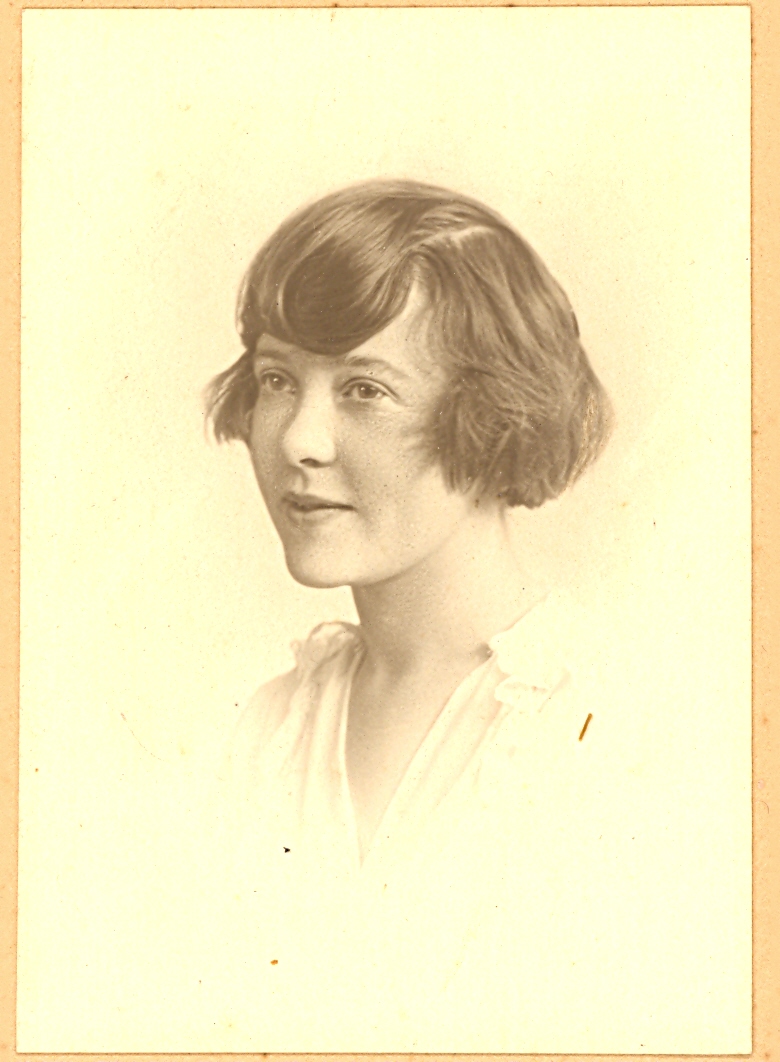
A portrait photograph of a sweet faced young woman

Howard died in 1914 of heart failure, aged just 44. Losing their father affected all three girls deeply and is reflected in Rhona’s novel Whatever the Heart Appoints. The central character, a girl of eleven whose father has been absent as a prisoner of war, declares with great joy
“I have been without my father for years and years … tonight we are going to meet again and I shall know everything about him“
Alice tried for several years to keep the business afloat, but this wasn’t possible for a widowed woman in conservative Ireland. It was the time of the Troubles and, on finding a Sinn Feiner with a drawn gun hiding out in their home one night, Alice decided she and her girls needed to move to a safer place. A map of England was brought out and, with her eyes closed, Ethel, the middle sister, popped a pin into the map on St Leonards on Sea, Sussex. Somehow a property was located and they moved there in 1921, along with Alice’s sister Annie. The girls were then 25, 23 and 21.
Looking rather exotic in her velvet dress in the garden

All the girls had to find some kind of employment as there was no money and Alice rented rooms out to “paying guests”. While her elder sisters were musical, Rhona found work as a secretary in a local garage, Dunning Marriott and Smith. Love soon blossomed between Rhona and Guy, the son of the garage owner. They married in 1923 and had one daughter, Rhona Cecil Grace, known always as Cecil, in 1925. Rhona and Guy had a slightly precarious existence, moving several times in Sussex and Hampshire, due to problems with Guy’s businesses, and money was often short. Rhona wrote novels and numerous short stories for women’s magazines under various pseudonyms – I recall Cecil saying that sometimes all the stories in a particular edition had been written by Rhona under different names. Her writing both supplemented the family income and provided her with an outlet for her creativity. She would write every morning for several hours, and then go for a walk on the seafront with Cecil in the afternoon to plot the next sections of the story. She was also very fond of imagining the lives of people around her when, for example, taking afternoon tea in a café. She and Cecil would speculate on who their fellow tea takers were and what their lives might be like. Rhona published five novels in all, from 1932 to 1952, one less than her sister Ethel, who was also publishing during the same time period. I would image there was some rivalry between the two.
Rhona was a lively and flirtatious character, rather glamorous, deeply loved by and loving of her husband, enjoying company and outings in the family car, great fun and described by her niece as easy going with a sweet intense voice. My one clear memory of her is when, while staying with her and Cecil as a child, I found her standing in the bedroom wafting her arms and hands to and fro. Mystified, I asked what she was doing. “drying my nail varnish darling” was the reply, which speaks of her sense of glamour.
With her beloved husband Guy

Guy died in 1964 and Rhona moved to live with her daughter Cecil in Henley on Thames, where Cecil was working as secretary for the Brunner family of Grey’s Court, and later custodian of the house when it was transferred to the National Trust. They lived in “the Keep” part of a group of associated buildings just behind the main house.
in later years, chic as ever, with Cecil

Sadly, over time Rhona developed dementia as a result of a bang to her head, becoming increasingly confused. Eventually, after her mother wandered out to where Cecil was showing people round Grey's Court and invited everyone to tea, Cecil had to take the difficult decision to move her into a care home where she died in 1975.
So that is my Great Aunt Rhona, novelist and warm and glamourous soul, now republished for a fresh generation of women. Cecil would have been immensely proud to know that one of "Mummy's" books had found its way into the world again. My mother, on the other hand, would have felt that her "Mummy's" books should also be republished: in fact, should have been republished first. That sisterly rivalry most certainly extended to their daughters!
I have, of course, passed one of Ganna's novels, For Flute and Piccolo, on to the relevant people to see if the British Library might consider republishing her story of women's lives and concerns. I give a brief outline of this here, if you would like to know more. You can image how over the moon I would be if they said "yes"!