Showing posts sorted by date for query cecil. Sort by relevance Show all posts

Monday, 12 May 2025

Spring indeed Begins

If you read here at all you will know that I take great pride in the fact that both my grandmother (Ganna) and her sister (Rhona) had novels published, first in the 30s and then, after the war, in the 50s. I have written about them before here and here.

The British Library have marvelous initiative where they are republishing novels by "forgotten" women writers. To be republished the novels have to illuminate women's lives at the time they were written, and have at least one female protagonist.  There are all sorts of wonderful names that I remember from my early days working in the library, and from my grandmother's shelves: writers like Norah Lofts and Elizabeth Von Arnim. It is a "curated collection of novels and anthologies by female authors who enjoyed broad, popular appeal in their day". I am thrilled to say that my great Aunt Rhona, Ganna's younger sister, has joined this throng of voices. In April I received a package of 6 paperback volumes of The Spring Begins, which was republished that month. The three main female characters are all, in some way, moving towards their own sexual experiences, but from very different perspectives. It is the novel about which Rhona's rather staid Methodist Aunt said "Rhona is very clever, but I hope her next book will be different." I'm not sure she felt that awakening sexuality was a "nice" subject for her niece to be writing about! 

I have here to give a shout out to the rather wonderful Simon Thomas, keeper of the equally wonderful blog StuckinaBook (and what better place to find oneself stuck?) who has been the chief mover and shaker in getting Rhona's book republished. He declared it his "favourite read of this year", having come across its virtues being extolled on Furrowed Middlebrow's also rather wonderful blog. Without Simon and Scott's enthusiasm The Spring Begins might never have seen the light of day again. Thank you both gentlemen for your praise of my Great Aunt's book, it has given me untold pleasure.

I drafted a "pen portrait" of Rhona for the British Library to draw on for the very brief bio on the novel itself. I include it here for any curious readers who might want to know more about who Rhona was.

Rhona Catherine Dunning, born in June 1900 in Arklow, County Wicklow, was the youngest of three daughters of Howard Colman Rowe and his wife Alice (nee Atkins). Her father, a practicing pharmacist in the town, was politically active, a supporter of women’s rights and also a writer, having worked for Kier Hardie, writing articles for the Labour Leader newspaper when living in England. Alice was a very talented amateur painter and their daughters, Connie, Ethel and Rhona, lived quite a free life for girls of the time, roaming the town and countryside or wandering down to the beach, often accompanied by the family’s maid. Rhona was the most robust of the three girls, her sisters both being affected by brittle bone disease, inherited from their father. This may have given her more of a sense of her own strong physicality, which permeates her writing.

A charming child listening to the sea on the shores of Arklow

The family grew up Protestants in a Catholic country. My grandmother Ethel (Rhona’s sister, and  also a published author) remembered gangs of little boys chasing them down the Arklow roads shouting “proddy woddys”. Their maternal grandfather was a Methodist Minister, and in later life all three sisters became involved with, and devoted to Christian Science. It formed a significant element of their life as a family. Letters between the sisters, and my mother’s diaries all reflect a life lived with varying levels of spirituality. I think Rhona was considered the frivolous one by her sisters, which paints a picture of a fun person, but Christian Science certainly played some part in her life, as I recall copies of Science and Health in her daughter Cecil’s house when I cleared it after her death.

A portrait photograph of a sweet faced young woman

Howard died in 1914 of heart failure, aged just 44.  Losing their father affected all three girls deeply and is reflected in Rhona’s novel Whatever the Heart Appoints. The central character, a girl of eleven whose father has been absent as a prisoner of war, declares with great joy

“I have been without my father for years and years … tonight we are going to meet again and I shall know everything about him“

Alice tried for several years to keep the business afloat, but this wasn’t possible for a widowed woman in conservative Ireland. It was the time of the Troubles and, on finding a Sinn Feiner with a drawn gun hiding out in their home one night, Alice decided she and her girls needed to move to a safer place. A map of England was brought out and, with her eyes closed, Ethel, the middle sister, popped a pin into the map on St Leonards on Sea, Sussex. Somehow a property was located and they moved there in 1921, along with Alice’s sister Annie. The girls were then 25, 23 and 21. 

Looking rather exotic in her velvet dress in the garden

All the girls had to find some kind of employment as there was no money and Alice rented rooms out to “paying guests”. While her elder sisters were musical, Rhona found work as a secretary in a local garage, Dunning Marriott and Smith. Love soon blossomed between Rhona and Guy, the son of the garage owner. They married in 1923 and had one daughter, Rhona Cecil Grace, known always as Cecil, in 1925. Rhona and Guy had a slightly precarious existence, moving several times in Sussex and Hampshire, due to problems with Guy’s businesses, and money was often short. Rhona wrote novels and numerous short stories for women’s magazines under various pseudonyms – I recall Cecil saying that sometimes all the stories in a particular edition had been written by Rhona under different names. Her writing both supplemented the family income and provided her with an outlet for her creativity. She would write every morning for several hours, and then go for a walk on the seafront with Cecil in the afternoon to plot the next sections of the story. She was also very fond of imagining the lives of people around her when, for example, taking afternoon tea in a cafĂ©. She and Cecil would speculate on who their fellow tea takers were and what their lives might be like. Rhona published five novels in all, from 1932 to 1952, one less than her sister Ethel, who was also publishing during the same time period. I would image there was some rivalry between the two. 

Rhona was a lively and flirtatious character, rather glamorous, deeply loved by and loving of her husband, enjoying company and outings in the family car, great fun and described by her niece as easy going with a sweet intense voice. My one clear memory of her is when, while staying with her and Cecil as a child, I found her standing in the bedroom wafting her arms and hands to and fro. Mystified, I asked what she was doing. “drying my nail varnish darling” was the reply, which speaks of her sense of glamour. 

With her beloved husband Guy

Guy died in 1964 and Rhona moved to live with her daughter Cecil in Henley on Thames, where Cecil was working as secretary for the Brunner family of Grey’s Court, and later custodian of the house when it was transferred to the National Trust. They lived in “the Keep” part of a group of associated buildings just behind the main house. 

in later years, chic as ever, with Cecil

Sadly, over time Rhona developed dementia as a result of a bang to her head, becoming increasingly confused. Eventually, after her mother wandered out to where Cecil was showing people round Grey's Court and invited everyone to tea, Cecil had to take the difficult decision to move her into a care home where she died in 1975. 

So that is my Great Aunt Rhona, novelist and warm and glamourous soul, now republished for a fresh generation of women. Cecil would have been immensely proud to know that one of "Mummy's" books had found its way into the world again. My mother, on the other hand, would have felt that her "Mummy's" books should also be republished: in fact, should have been republished first. That sisterly rivalry most certainly extended to their daughters!

I have, of course, passed one of Ganna's novels, For Flute and Piccolo, on to the relevant people to see if the British Library might consider republishing her story of women's lives and concerns. I give a brief outline of this here, if you would like to know more. You can image how over the moon I would be if they said "yes"!

Thursday, 2 February 2023

spring begins

In amongst the leaves of last year, and the rather soggy soil from recent regular rains, there are signs of pleasure to come in the garden.

I am always surprised and delighted by these little cyclamen, which seem to realise they should stay small beneath one of my slow trees. 


These snowdrops are in quite deep shade, but still are beginning to show their delicate white petals.


while these, nearby but getting more light, have gradually developed into a lovely clump over the past ten years; slow and steady


I love the soft furry leaves and clear colours of pulmonaria, which come in so many shades of blue and pink


Hellebores take time to clump up, but I have high hopes for these in the coming years, especially if they also set seed and bring us more variations on the hellebore theme


The greater periwinkle is only a recent addition, but the flowers are so long lasting and the variegated leaves bring a bit of brightness beneath a camellia


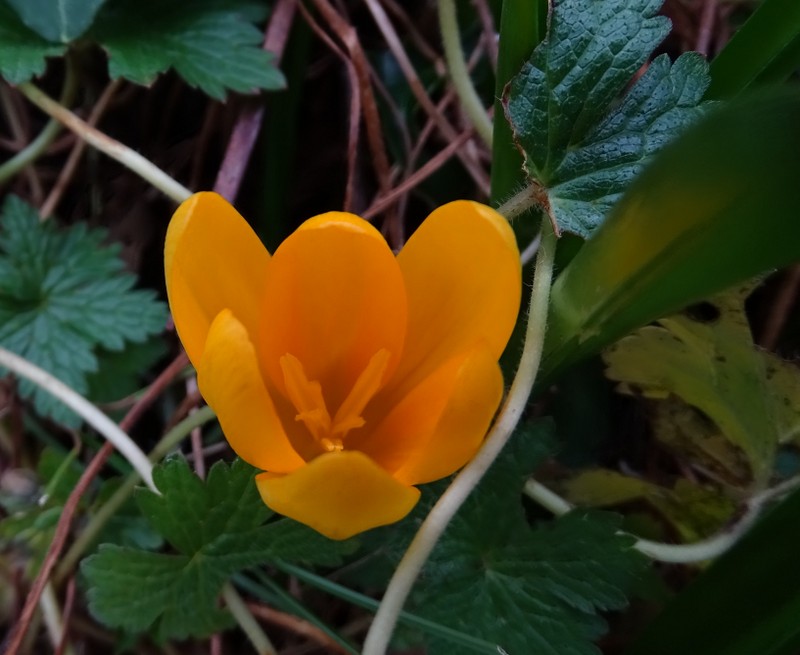
a shy crocus beside some steps


and in the front garden the bright eyes of winter jasmine


the first primroses netting the sunlight


and another clump of snowdrops by the weeping birch, which came from Cecil's garden, so always remind me of her

How is your garden growing?


Thursday, 27 January 2022

An Unusual Wedding

 I have spoken about my Great Aunt Connie before; of the three Rowe sisters she was the one who neither wrote novels nor had children. She sits in my dim memory as a sweet faced woman with a very crooked ankle, broken in childhood and never properly healed. 

Perhaps that memory comes more from this photograph than my experience, though I know we met several times when I was a child and I'm sure I have an image of her limping down Lower Park Road towards the home she shared with "Harry". Connie and Harry have been a couple in my mind for all of my life but their coupledom was most unusual for their times.


Connie, was the first of the three daughters of Alice and Howard, my great grandparents. She was born in May 1896 in Birkenhead where her parents had been married. 

Some time in the next year or so the family moved to Arklow in County Wicklow, both Alice and Howard being Irish by birth. Howard, a qualified chemist, suffered from brittle bone disease, and was to die, aged 44, when Connie was just 18. Unable to keep the family business going, Alice and her three daughters, Connie, Ethel and Rhona, moved to St Leonards in 1921. All the girls found some kind of work and Connie, always the most physically fragile and spiritual of them also found inner sustenance with an organisation called the S.S.K.T.P. (the Society for Spreading the Knowledge of True Prayer), an offshoot of the Christian Science movement. It was here that she met Harry; baptised Evelyn Cowland. 


Evelyn Annie Muriel Cowland was born in London in September 1890, the only child John William Cowland and his wife Annie. 

Evelyn Cowland

The family moved to Hastings after 1891, initially to All Saints Cottage in the Old Town, but then to Lower Park Road. Sadly John William also died young, in 1894, aged just 42. Evelyn was a striking young girl, but at a relatively early age delighted in dressing and presenting herself as a boy She was known by her nickname, Harry. 


Harry being a boy


One can only imagine the joy these two women found in each other; both had lost their fathers tragically young, both were interested in the "New Thought" ideas of the S.S.K.T.P. and Christian Science and both were close to their widowed mothers, existing in a very female world.

The classic Hastings image - lovers at "The Seat"

A Warschawski Studios portrait photo of the couple

Their relationship blossomed and Alice, having prayed for years for a girl husband for her, since she felt she would never survive the rigours of childbearing, determined that her oldest daughter should not be deprived of a wedding. A ceremony was arranged for them, in the mid 1920s, in the back garden of Alice’s house in De Cham Road, going by the pictures, with Ethel and Rhona as bridesmaids. 

Rhona, Harry, Connie and Ethel in their finery

Here they are, Harry looking very dapper in a suit and the three girls dressed all in white with appropriate bouquets in each hand. Connie and Harry went off on honeymoon in their car, 

driving out to Iden Lock, just outside Rye, where they rented a summer cottage by the River Rother, called Sedges. This proved too small as Ethel and Rhona provided them with nieces, and family visits increased in size, so Harry arranged for Nirvana to be built, having the raw materials brought up from Rye by barge. 

Nirvana

Those nieces, my Mum Rosemary and my Aunt Cecil spent many happy times there with Connie and Harry. In their letters from holidays in Nirvana, Harry is always referred to as “he” and indeed, in pictures from the time, one might assume that this couple were man and woman. 

They lived all their lives in Lower Park Road, Harry embarking on a variety of  ventures including running a mushroom growing business from the land behind the houses. I remember the drying chimneys and concrete floors of the growing sheds still being visible when I was a child, playing behind the house I too was eventually to live in.

Harry and Connie cycling by the river Rother

Their relationship, and Harry’s unusual wardrobe would have been notable at the time they were married. The author Radclyffe Hall published her novel of lesbian love “The Well of Loneliness” in 1928. Judged obscene by the English courts, it caused a furore and was banned for thirty years in the UK. Connie evidently wrote to Hall at the time, expressing sympathy and telling her of their own life. Hall’s response, in January 1929 includes this lovely sentiment

“Your letter has made me very happy because it is always something to know that a few inverts [lesbians] are understood, you are fortunate indeed in having such a mother, and your friend and you in having each other. I wish you all possible happiness” 

A poignant response when one considers that Hall’s own relationship with her mother was deeply toxic, and probably a source of great sadness to her. 

Connie and Harry did indeed have around 40 years of happiness together, sharing a loving life, both in Hastings and Nirvana, and nurturing their two nieces when they came to stay. Connie died in September 1966 and Harry followed her four years later in 1970, by which time I and my Mum, having lost my Dad, were also living in Lower Park Road with Ethel, my “Ganna”. We were to inherit Connie and Harry’s home, so I grew to adulthood there feeling those spirits around me, nurtured by a sense of their presence hovering somewhere in the interstices of time. 

In a small footnote, Nirvana, which I also visited as a child, was eventually demolished and became the subject of a Grand Designs in 2015, when a new property was build there. James Strangeways, the owner, was kind enough to allow me and my Aunt Cecil to visit so she had the pleasure, aged 90, of seeing the place where she had spent so many happy childhood days with Connie and Harry, transformed into something new for the future.


Sunday, 27 June 2021

Open delight

We had such an enjoyable day yesterday welcoming folk to our garden for the first time. I kept a rough five bar gate record of the day and counted 254 folk who came and chatted and wandered about. It was such a pleasure to see them all.

Here's how it looked at the end of the day as the pond fell quiet


the cat chaps reclaimed their space


Phil's Corner captured the evening sunlight


and Woll watched on from his perch under the yew tree


as the flowers caught the light


and this morning the rain washed it all and made it shine


speckling the leaves of a little rose which started its life in Cecil's garden in Kidmore End, planted out from its pot this year, adding to the "garden as memory" element which I love in this space

Sunday, 13 June 2021

Things - keeping and relinquishing

Over on Kindred of the Quiet Way Pen is spending this year reducing the number of things in her home. She has done this before, and is deeply committed to the idea of walking lightly on the earth and leaving as little behind as she can when she leaves it. She is a person who lives her beliefs and her faith with deep sincerity. I have known her since I was a teenager; she is a dear soul and I respect her ideas, finding them both thought provoking and sometime quite challenging. The theme of minimalism is one she has returned to again and again; it is something that allows her to lead a frugal life and be at peace with herself. Many years ago she recommended a book called Nothing Left Over by Toinette Lippe, which I have read, and will re read as it contains much wisdom. There is a huge appeal in reducing ones things to the bare minimum, and I have considered it often. However, this is not quite how my life has evolved. 

My great grandmother Nanya had three girls but I am the last person (not counting beloved daughter) in that line of our family. As such, my domestic space contains the distillation of multiple homes refined by multiple house moves. As I walk through the rooms my glance falls on all sorts of things which speak to me and to each other. 

Little treasures from Mum's childhood, kept so carefully by her.

This quizzical cow with his broken ear, guarded by a rather fine dachshund, which came from Cecil; dachshunds were her speciality, though hers were always long haired.

A glass bowl, given to Cecil on her retirement by her National Trust employers. It has an image of both the house she lived in when she worked for them at Grey's Court and, on the far side, Felix Lodge, her home until I had to move her to be in care near me. I stayed in both places often, and remember the kitchen in that octagonal tower and the delicious cakes she baked in the range for the tearooms there.

There are these two lovely bits of pottery; the bowl made by my mother's Californian cousin Ellen, descendent of Nanya's brother; the little mug made by Ellen's dear friend Inez. They sit on Ganna's desk recalling two holidays taken there when I was a teenager.

This delightful image which, I believe, was painted by Howard. A moment's canine mayhem triggered by a frisky cat. 

And books, books, books. What would one expect from someone who worked in the library for forty years, and whose family wrote and treasured books above many other things. Some here are mentioned by Mum in her diaries - it feels rather special to read of her being given them, and then find them still on my shelves. 

I could show you more, but this post might never end. All these things live in my study - there are other rooms (she said darkly)!

So, what of minimalism?

When I read about it, as I say, it has a huge appeal. It carries with it connotations of liberation, non consumerism, lightness of being. And yes, I think all those things are possible, even likely when you relinquish things. But then I think about the conversations my family things have with each other. Those two pieces of pottery, still happily together, though the folk who made them have gone. The little gathering of Mum's treasures which enchanted me in my childhood. I think of the way that, in nature, when things accumulate, there is always growth of some sort, even if that growth is simply the rotting down of waste (in the compost heap for example) to provide food for something else. I see in the garden how, if I don't clear the leaves and dust, the weeds spring up with delight, or the way emerald moss cushions the cracks in the pavement. I notice how the leaves gather at the foot of the trees, feeding them and the forest creatures as they blend back into the soil. I watch the blanket weed in the pond and know that its growth is absorbing nitrates that would otherwise create an imbalance; the pebbles on the beach which allow sea kale and mallow to colonise. There is a richness and potential in abundance, a raft of possibilities and opportunities.

So, perhaps for me, the way of minimalism, while appealing, is not one I will take. I recognise that, for some folk, the act of relinquishing is a path to clarity and peace. But I enjoy the memories that all these objects bring me; the way they enrich my life. I know that those loved folk are always here in my heart, but specific thoughts are triggered by each object, rather than a general sense of what was past. And, on a more philosophical note, I wonder if the eight year old little girl who lost her Daddy, her home and the whole context of her life, is not still nestled in my soul somewhere, reassured by the knowledge that at least not everything is gone.