We have been deluged by snow! Nothing like as bad as some of my blogging friends in the States, but still, for this usually balmy corner of Southern England, it's quite startling to see great gusts and sweeps of snow fly past the window, and bank up against the doors
Wol is huddled in his cage looking disconsolate - for a creature who started his life in Zimbabwe it must be rather chilling
The well with its varied guardians is gradually getting humpier and humpier
there are ripply icicles developing as the fine snow streams past
and snow patterns cling to the bricks as the catkins shiver in the wind
the courtyard pink is looking rather lovely against all the white, and I'm hoping all the plants will at least benefit from the soft blanket around their necks as the temperature drops to -2 degrees
though the little daffs in their pots are struggling to hold their heads up
The birds are very glad we provide them with extra food. I was amused by this blackbird, politely queuing while the starling, gobbles up the fat. However starlings don't really understand politeness or queuing; the hoodies of the avian world, they fight and squabble and peck and shout at each other, so poor blackbird flew off to another food source in the end, patience all used up.
I am very glad we provide them with food as well - it is a never ending pleasure to watch them come and go, all a flutter and busily bobbing about even in the snow, a privilege that I treasure
Musings on family, gardening, mindfulness, and life as it happens. You can find my stitch and textile musings at "An Elbow's Length of Thread"
Monday, 11 March 2013
Saturday, 9 March 2013
stitching
I've had a post about my textile adventures in draft for I don't know how long, but I seem to be too busy, or too tired to get it finished and posted! It's all about the bits of dyeing I've been doing, but I've done so much more since I drafted it that I can't face the updates!! However, in the realm of stitch I had another lovely workshop with the Embroiderer's Guild last weekend. This time with Wendy Dolan, who's work I really admire. It was a workshop in using architectural details as a source for stitching. We were instructed to bring some simple images to work from and a variety of toning fabrics and threads.
I took along a variety of photos, or rather prints of photos. Once we'd been shown some of Wendy's work and understood the way the embroidery was to be achieved, I selected this image - which I took back in the days of wet film photography - or at least, before I could afford digital. It is from a brief and much needed break in Oxford in the late winter of 2001.
The image is a window in Christ Church College, one of the many beautiful buildings that grace Oxford. I walked past it several times on my way to the Botanic Gardens, a glorious place for peaceful contemplation. I loved the way the stems and branches of the climbers seemed so intertwined with the building's character that they appeared to be somehow part of it, rather than an addition from Nature's bounty.
I had selected a variety of salvaged fabrics from one of my many rummages through remnant bins in various shops over the years. They were all soft furnishing fabrics, and I selected ones that seemed to chime with the idea of old buildings. A mixture of natural and synthetic fibers and various textures, as I recall they came from a lovely little shop called Fabric Design in Matlock Bath. I visit them each year as we break our journey to the Lakes, and always come away with a bag of remnant goodies!
The workshop was fascinating - it's always a pleasure to see an expert at work; makes one realise how much faffing about and stopping and starting is involved when you don't know what you are doing. The technique involved tracing off the main lines of the image; using the tracing to arrange small blocks of fabric roughly under the tracing paper and onto the foundation fabric, positioning the bits with regard to the image, but in a loose, abstract fashion. We then transfered the traced lines, in reverse onto some stitch and tear or heavyweight vilene, placed that on the back of the design (having stitched all the bits down first) and stitched the first draft, as it were, from the back. The the bobbin thread outlined the design. then we turned the fabric over and began to work up the design from the front. All very scary to a beginner, but seeing Wendy's finished embroideries showed what can be achieved.
This is my resulting embroidery so far - all machine stitched and not yet finished to my satisfaction, but a brave effort! I'm conscious that it all looks a bit crooked, especially when I see it like this, rather than in the flesh, but it pleases me and I'm very aware that I am a very beginner when it comes to machine embroidery. I shall probably stitch more, but not too much more as I don't want to overwork it. I'll certainly try another one now I understand the way it is done.
In the meantime, I'm also making a sketch book cover using some of the fabrics from my Studio11 experiments. We have a sketchbook project for City and Guilds this summer so I bought a sketchbook specifically for this - it seems fitting for it to have a cover made from fabrics dyed and embroidered by me. I'm half way through, and will post the finished results, hopefully before Monday when I go for my next class.
I took along a variety of photos, or rather prints of photos. Once we'd been shown some of Wendy's work and understood the way the embroidery was to be achieved, I selected this image - which I took back in the days of wet film photography - or at least, before I could afford digital. It is from a brief and much needed break in Oxford in the late winter of 2001.
The image is a window in Christ Church College, one of the many beautiful buildings that grace Oxford. I walked past it several times on my way to the Botanic Gardens, a glorious place for peaceful contemplation. I loved the way the stems and branches of the climbers seemed so intertwined with the building's character that they appeared to be somehow part of it, rather than an addition from Nature's bounty.
I had selected a variety of salvaged fabrics from one of my many rummages through remnant bins in various shops over the years. They were all soft furnishing fabrics, and I selected ones that seemed to chime with the idea of old buildings. A mixture of natural and synthetic fibers and various textures, as I recall they came from a lovely little shop called Fabric Design in Matlock Bath. I visit them each year as we break our journey to the Lakes, and always come away with a bag of remnant goodies!
The workshop was fascinating - it's always a pleasure to see an expert at work; makes one realise how much faffing about and stopping and starting is involved when you don't know what you are doing. The technique involved tracing off the main lines of the image; using the tracing to arrange small blocks of fabric roughly under the tracing paper and onto the foundation fabric, positioning the bits with regard to the image, but in a loose, abstract fashion. We then transfered the traced lines, in reverse onto some stitch and tear or heavyweight vilene, placed that on the back of the design (having stitched all the bits down first) and stitched the first draft, as it were, from the back. The the bobbin thread outlined the design. then we turned the fabric over and began to work up the design from the front. All very scary to a beginner, but seeing Wendy's finished embroideries showed what can be achieved.
This is my resulting embroidery so far - all machine stitched and not yet finished to my satisfaction, but a brave effort! I'm conscious that it all looks a bit crooked, especially when I see it like this, rather than in the flesh, but it pleases me and I'm very aware that I am a very beginner when it comes to machine embroidery. I shall probably stitch more, but not too much more as I don't want to overwork it. I'll certainly try another one now I understand the way it is done.
In the meantime, I'm also making a sketch book cover using some of the fabrics from my Studio11 experiments. We have a sketchbook project for City and Guilds this summer so I bought a sketchbook specifically for this - it seems fitting for it to have a cover made from fabrics dyed and embroidered by me. I'm half way through, and will post the finished results, hopefully before Monday when I go for my next class.
Thursday, 7 March 2013
a day of contrasts
Yesterday was a day of wonderful contrasts. In the morning, the sun was shining in amongst the clouds and spring breezes and during a quick wander in the garden I saw the first bumble bee of this year. He was bumbling busily, and buzzily about the early blooms, particularly taken by a hellebore we planted last year. I had hoped to catch him as he rummaged about it but he flitted off before I could take my picture. I love the way these rather shy, delicately coloured flowers are complemented by the steely silver, prickly leaves.

Two more hellebores are currently in pots on the patio, this one with it's bashful yet incredibly vivid rich pinky purple flower heads is another bought one; the one below comes as a seedling collected either from my dear one's daughter's garden, or from Cecil's cottage;
we have about 15 seedlings in various stages of growth, destined to be dotted through the garden in friendly groups to enjoy themselves and mix their genes with those we have bought. As ever, I love the idea that plants in our garden will speak to use both of themselves and of the people with whom they are associated - the garden as memory.
The crocuses were shining like golden stars in the grass, nestled at the feet of these daffodil stems, which have buds but not quite flowers as yet
Then there were the snowdrops. This one, with a tiny cyclamen just visible in the background, lives in a bed that I'm hoping to plant with a woodland feel. It's near the house, and I'm also planting primulas in a variety of colours, again in the hope they will self seed and interbreed, both with each other, and with the native primroses that are dotted about. I also have some snowdrops taken from Cecil's front garden, which I thought I'd lost, but which have overwintered in their pot, carefully husbanded down in the kitchen garden and are now nodding their heads on the patio along with the hellebores. They will be planted beneath a maple that Mum bought for me years and years ago, which has lived in a pot until now. I wanted to keep it with me through all of my house moves until I found the place where I knew I was going to stop. Last year it was given it's home in the soil.

So, a peaceful interlude in my morning's work.
Then, in the evening, we went to an event at the De La Warr Pavilion. We were given membership of this for Christmas and the tickets were offered free to members. It was a live performance of ISAM by Amon Tobin. I'd not heard of him before; it was not the sort of thing we'd have risked paying for as it was very much outside the good man's musical taste, though I had an idea what to expect, and expected it to be enjoyable. My dear daughter, rather indulgently, offered me ear plugs because - "it's going to be loud Mum" .... "yes dear"
It was, without a doubt, one of the most amazing gigs I've ever been to. A completely mesmerizing combination of sound, light and image, I cannot begin to describe it, but was on the edge of my seat almost the entire time. All I can suggest, is that you pop over to his website, or check out some of the clips on YouTube to get a brief taste of what it was all about. The music was the sort of sound that lodges deep in your chest, vibrates through your body and sends a shiver right through you from head to toes, and the images, projected onto a structure of white cubes, one of which housed him, took us through galaxies, past spaceships, firestorms, rippling water and tumbling blocks of colour and light. It was astonishing!
Two more hellebores are currently in pots on the patio, this one with it's bashful yet incredibly vivid rich pinky purple flower heads is another bought one; the one below comes as a seedling collected either from my dear one's daughter's garden, or from Cecil's cottage;
we have about 15 seedlings in various stages of growth, destined to be dotted through the garden in friendly groups to enjoy themselves and mix their genes with those we have bought. As ever, I love the idea that plants in our garden will speak to use both of themselves and of the people with whom they are associated - the garden as memory.
The crocuses were shining like golden stars in the grass, nestled at the feet of these daffodil stems, which have buds but not quite flowers as yet
Then there were the snowdrops. This one, with a tiny cyclamen just visible in the background, lives in a bed that I'm hoping to plant with a woodland feel. It's near the house, and I'm also planting primulas in a variety of colours, again in the hope they will self seed and interbreed, both with each other, and with the native primroses that are dotted about. I also have some snowdrops taken from Cecil's front garden, which I thought I'd lost, but which have overwintered in their pot, carefully husbanded down in the kitchen garden and are now nodding their heads on the patio along with the hellebores. They will be planted beneath a maple that Mum bought for me years and years ago, which has lived in a pot until now. I wanted to keep it with me through all of my house moves until I found the place where I knew I was going to stop. Last year it was given it's home in the soil.
So, a peaceful interlude in my morning's work.
Then, in the evening, we went to an event at the De La Warr Pavilion. We were given membership of this for Christmas and the tickets were offered free to members. It was a live performance of ISAM by Amon Tobin. I'd not heard of him before; it was not the sort of thing we'd have risked paying for as it was very much outside the good man's musical taste, though I had an idea what to expect, and expected it to be enjoyable. My dear daughter, rather indulgently, offered me ear plugs because - "it's going to be loud Mum" .... "yes dear"
It was, without a doubt, one of the most amazing gigs I've ever been to. A completely mesmerizing combination of sound, light and image, I cannot begin to describe it, but was on the edge of my seat almost the entire time. All I can suggest, is that you pop over to his website, or check out some of the clips on YouTube to get a brief taste of what it was all about. The music was the sort of sound that lodges deep in your chest, vibrates through your body and sends a shiver right through you from head to toes, and the images, projected onto a structure of white cubes, one of which housed him, took us through galaxies, past spaceships, firestorms, rippling water and tumbling blocks of colour and light. It was astonishing!
Saturday, 2 March 2013
When "I" arrives, show her the door!
An odd thing to say, in fact it sounds rather unfriendly really, but I find (oh drat there she is already) that so often, when we find ourselves thinking thoughts beginning with "I" there's bound to be a negative there somewhere. We have a disagreement with a friend - off we go afterwards thinking "if only I'd said ... that would have shown him"; we don't have these inner conversations when we have nothing more to add, only when we're trying to put ourselves in the right. Or we might be talking to someone about a problem they're having, "ah, if I were you I'd ...". But we're not them and however well meaning, we can't live their lives, only our own. Likewise, there are the little inner dialogues we have about ourselves; those imagined dramas in which we are central. We might ruminate over what we'd do, had we been involved in some terrible circumstance, the right thing of course, which saved the day; or we dwell on some frailty of our own, possibly physical "I'm so tired of hurting all the time", or perhaps psychological "I shan't try that, I'd be useless/a failure". Then there are the great plans we have for ourselves, those things we are going to do when, if, before, after. All the time we're thinking about them, well, we're not doing them, but we congratulate ourselves on the fantastic outcomes, in fact, sometimes we can become so pleased with ourselves that we actually forget that we've not done anything yet! It is a very human thing to do, and we live in a society that seems to encourage this more. The cult of celebrity is surely the most obvious manifestation of the importance of ME, while endless TV adverts tell us we're worth it, or persuade us that if we just had this car, or went on that river cruise, our lives would be wonderful. They place our neediness centre stage and assure us that this or that product will satisfy.
Hmmm, I'm not sure sure. I have a feeling that, each time we focus on this "I" that we so fervently believe in, we risk compounding life's difficulties. Those thoughts we have about what we'd have said to our friend or lover - surely these colour the next meeting; carry the disagreement deeper into the relationship, yet leave the poor soul no space to explain or defend. The well meaning advice is really more about us thinking we know best than about trying to understand that person's difficulty. As for all those inner dialogues; well, they really don't help at all do they? Those great plans and grand actions have a rather hollow ring, and can lead us to feel rather too pleased with ourselves, yet oddly empty. The misery dialogue focuses on just one aspect of the richness that is life, throws a gloomy shadow over our inner selves, leads us to believe that this pain, that frailty are the whole story of our lives, rather than a little part of them.
This isn't a new thought, I don't think I'm saying something clever here, or something that's not been said a thousand times before, by people more qualified than me to say it. It is at the heart of many philosophies, religions, self help books and counselling sessions. It's ubiquity shows how deep and lasting a quandary it is for we self aware animals. Yet we forget: time and time again we start the day with "I", placing this virtual mirror between ourselves and our lives, gazing into it with loving attention.
The path of mindfulness is, to my mind, a helpful way to move beyond this. It can seem like the same self obsession, watching the moments of one's day with loving focus, trying to be present in full at each opportunity life gives us. But the approach is quite different; it can help us notice when that "I" crops up and gently, kindly turn the tumbling mind to another route, one that looks outwards, free from self regard, seeing more of the life that is living, and less of the inward fantasies. It allows us to listen, really listen with our whole attention, rather than leaping mentally to the clever response we're preparing. It acknowledges the fantasy person we believe ourselves to be is just that, a fantasy, transient as dandelion seeds floating on the breeze.
It is not something I talk about, or write about often, that feels too preachy to me, and in my youth I seem to recall I was a rather preachy person; I hope I am wiser now. But I do try, each day, to look more and more out, and less and less in. I hope I am beginning to get the balance more on the side of life and living, I know I have a long way to go, but the journey is the important thing.
As for those ever longer advert breaks - well, when they turn up, I just hit the mute button, look away, and use the time for something better!
Hmmm, I'm not sure sure. I have a feeling that, each time we focus on this "I" that we so fervently believe in, we risk compounding life's difficulties. Those thoughts we have about what we'd have said to our friend or lover - surely these colour the next meeting; carry the disagreement deeper into the relationship, yet leave the poor soul no space to explain or defend. The well meaning advice is really more about us thinking we know best than about trying to understand that person's difficulty. As for all those inner dialogues; well, they really don't help at all do they? Those great plans and grand actions have a rather hollow ring, and can lead us to feel rather too pleased with ourselves, yet oddly empty. The misery dialogue focuses on just one aspect of the richness that is life, throws a gloomy shadow over our inner selves, leads us to believe that this pain, that frailty are the whole story of our lives, rather than a little part of them.
This isn't a new thought, I don't think I'm saying something clever here, or something that's not been said a thousand times before, by people more qualified than me to say it. It is at the heart of many philosophies, religions, self help books and counselling sessions. It's ubiquity shows how deep and lasting a quandary it is for we self aware animals. Yet we forget: time and time again we start the day with "I", placing this virtual mirror between ourselves and our lives, gazing into it with loving attention.
The path of mindfulness is, to my mind, a helpful way to move beyond this. It can seem like the same self obsession, watching the moments of one's day with loving focus, trying to be present in full at each opportunity life gives us. But the approach is quite different; it can help us notice when that "I" crops up and gently, kindly turn the tumbling mind to another route, one that looks outwards, free from self regard, seeing more of the life that is living, and less of the inward fantasies. It allows us to listen, really listen with our whole attention, rather than leaping mentally to the clever response we're preparing. It acknowledges the fantasy person we believe ourselves to be is just that, a fantasy, transient as dandelion seeds floating on the breeze.
It is not something I talk about, or write about often, that feels too preachy to me, and in my youth I seem to recall I was a rather preachy person; I hope I am wiser now. But I do try, each day, to look more and more out, and less and less in. I hope I am beginning to get the balance more on the side of life and living, I know I have a long way to go, but the journey is the important thing.
As for those ever longer advert breaks - well, when they turn up, I just hit the mute button, look away, and use the time for something better!
Tuesday, 19 February 2013
Look on the Fields and others
I'm sorry, it has been ages since I've written anything. In part this is because I ran into a "problem",which turned out to be me not noticing hat there was a size limit on Picasa albums .... Aha! so that's what that funny error message means when my photo uploads fail. You'd think I'd have twigged that, having at least some sort knowledge of computers and the like.
What else have I been doing? Dyeing cloth, planning City and Guilds , doing practical design exercises, stitching shadow work in between times and reading. Oh, and going to work! Some of my reading has been of Ganna's novels. These are the three I have read since my last post.
Look on the Fields was published in 1935, a year after Barney's Bend. Here is the cover, once more a lovely Rowland Hilder image.
It was, as I recall, the novel she felt had worked the least well, though for me it is a delight because it paints such a clear portrait of her family. At it's heart are three children living in Ireland, who welcome their cousin into the family. She is a fragile soul, who reminds me of Aunt Connie - Ganna's eldest sister, who was the most brittle boned of the three girls. In this story, her ankle is crushed in an accident - in reality, Connie's ankle was trodden on by a horse and was thereafter, twisted and weak. At the heart of the family are their mother, who watches the comings and goings of her household with patient amusement, and their their father, a gentle dreamy man who is the small town's dispensing chemist, as was my great grandfather in Arklow, where they grew up. She paints such a clear picture of this little seaside town, with it's groups of donkeys trotting down the high street at market time, and the ever present sea shushing at the shore... she touches on religion and on Ireland's struggle for independence; it was something she experienced fist hand as a young woman, and was part of the reason they left Ireland, the other being the death of her own gentle, dreamy father in 1914.
Grey Geese is also set in Ireland, near Arklow, but out on the plain beneath the blue brooding hills, that change with the weather. It concerns the way in which family hatred can twist a family for generations. It also has overtones of the political background, but is more concerned with the relationship between a young woman, widowed by the political struggle, her three children, and her father. He chimes with a previous character in Barney's Bend; both have a spiteful nature, that mocks all around it and manipulates others. She writes of the difficulties of poverty in a small 1930's Irish town, the standing forever to the back of the queue in the main shop, where each knows the others' business; waiting until all have been served, and the Widow has privacy to beg.
These were all written before the Second World War, in 1934/5/6 when my mother was a child. Then came the war, and a gap in both time and the progress of life.
By 1952, when the next novel appears, Ganna had looked after, then lost her own mother, my mother was grown, England had been through hell and people had struggled on. Her later novels were written, and set, in England, where she had moved in 1921 as a newly engaged young woman. They center around similar people, but in a different world. For Flute and Piccolo was her last novel, published in 1955. I am saving the intervening two because one is my favourite, and because I realised that I'd not read this one.
This novel is set in a town that feels a little like Hastings, but Hastings of the 1950's where church bells still toll through the quiet of Sunday afternoons. We are moving in small town polite society, where all business is known and nothing interrupts weekend tennis at the club. Again, the story is of families, and how the various characters interact with each other. One, a rather dowdy woman is the long time wife of the eldest son of the family. Near the middle of the novel she experiences the latest of what are obviously a string of failed pregnancies; we see her hope and delight when she knows she is pregnant, and feel her numb despair as the pregnancy fails once more. I know that Mum, Ganna's only child, was herself conceived after multiple miscarriages, a phantom pregnancy and the stubborn resistance of my grandfather, who wanted no children. As I read this novel, I asked myself how much of her own experience flows in her description of this woman's, always seemly, suffering. The novel, which is in part about the coming of age of the two youngest family members, also portrays the very delicate and gentle relationship between the (once more widowed) mother of the family, and a man who was a childhood sweetheart, and is once more in her life. As with her other novels, the thing that is valued above all else, is kindness, the same kindness that was at the heart of my childhood.
What else have I been doing? Dyeing cloth, planning City and Guilds , doing practical design exercises, stitching shadow work in between times and reading. Oh, and going to work! Some of my reading has been of Ganna's novels. These are the three I have read since my last post.
It was, as I recall, the novel she felt had worked the least well, though for me it is a delight because it paints such a clear portrait of her family. At it's heart are three children living in Ireland, who welcome their cousin into the family. She is a fragile soul, who reminds me of Aunt Connie - Ganna's eldest sister, who was the most brittle boned of the three girls. In this story, her ankle is crushed in an accident - in reality, Connie's ankle was trodden on by a horse and was thereafter, twisted and weak. At the heart of the family are their mother, who watches the comings and goings of her household with patient amusement, and their their father, a gentle dreamy man who is the small town's dispensing chemist, as was my great grandfather in Arklow, where they grew up. She paints such a clear picture of this little seaside town, with it's groups of donkeys trotting down the high street at market time, and the ever present sea shushing at the shore... she touches on religion and on Ireland's struggle for independence; it was something she experienced fist hand as a young woman, and was part of the reason they left Ireland, the other being the death of her own gentle, dreamy father in 1914.
These were all written before the Second World War, in 1934/5/6 when my mother was a child. Then came the war, and a gap in both time and the progress of life.
By 1952, when the next novel appears, Ganna had looked after, then lost her own mother, my mother was grown, England had been through hell and people had struggled on. Her later novels were written, and set, in England, where she had moved in 1921 as a newly engaged young woman. They center around similar people, but in a different world. For Flute and Piccolo was her last novel, published in 1955. I am saving the intervening two because one is my favourite, and because I realised that I'd not read this one.
Thursday, 7 February 2013
Granddad's Garden - for Charlotte
In granddad's front garden this evening there were ...
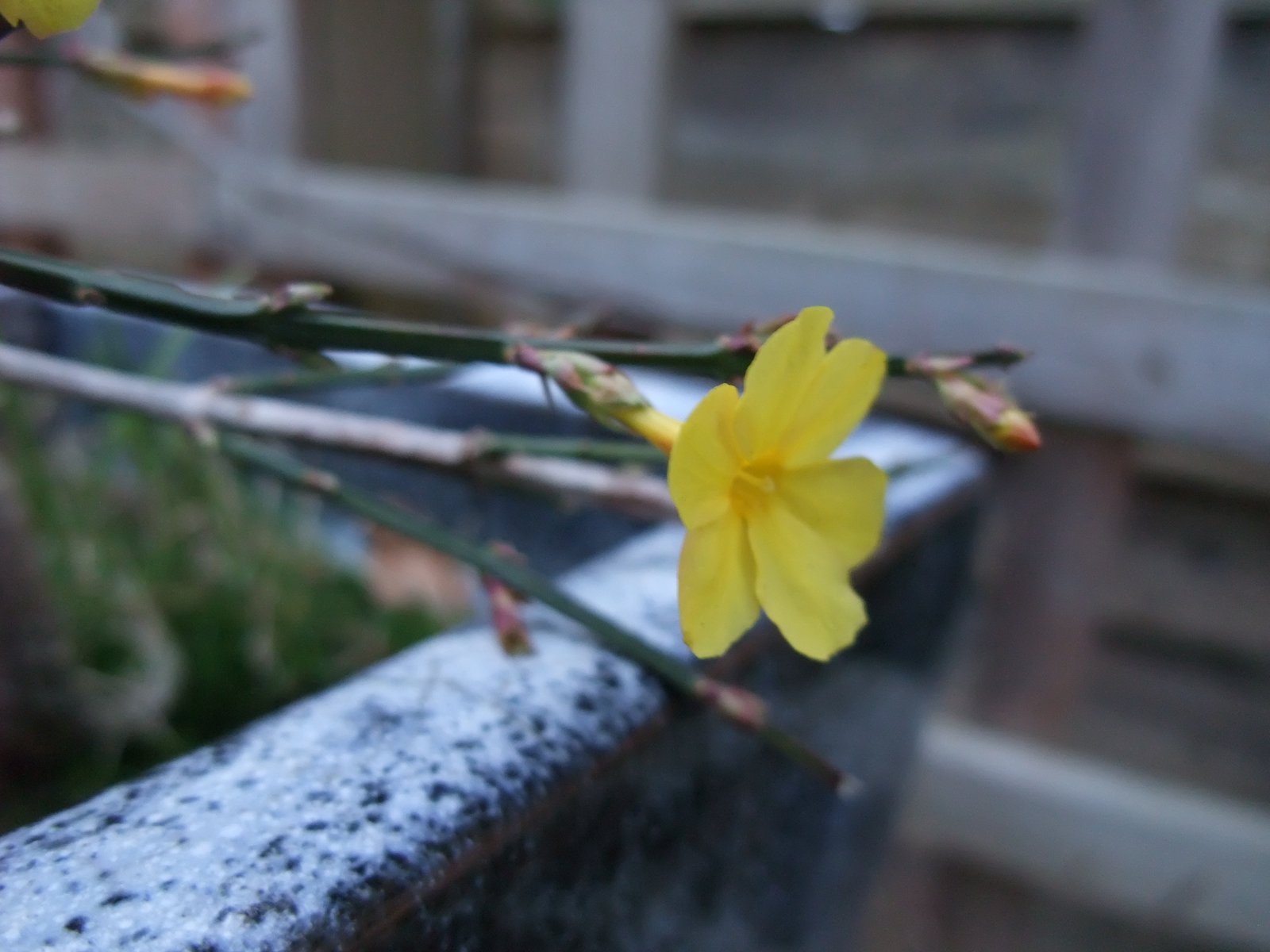
Jackdaws coming home to roost by the chimneys, making a lot of noiseA yellow jasmine flower in a blue pot
a tree like a waterfall
grass seeds like fairies kisses
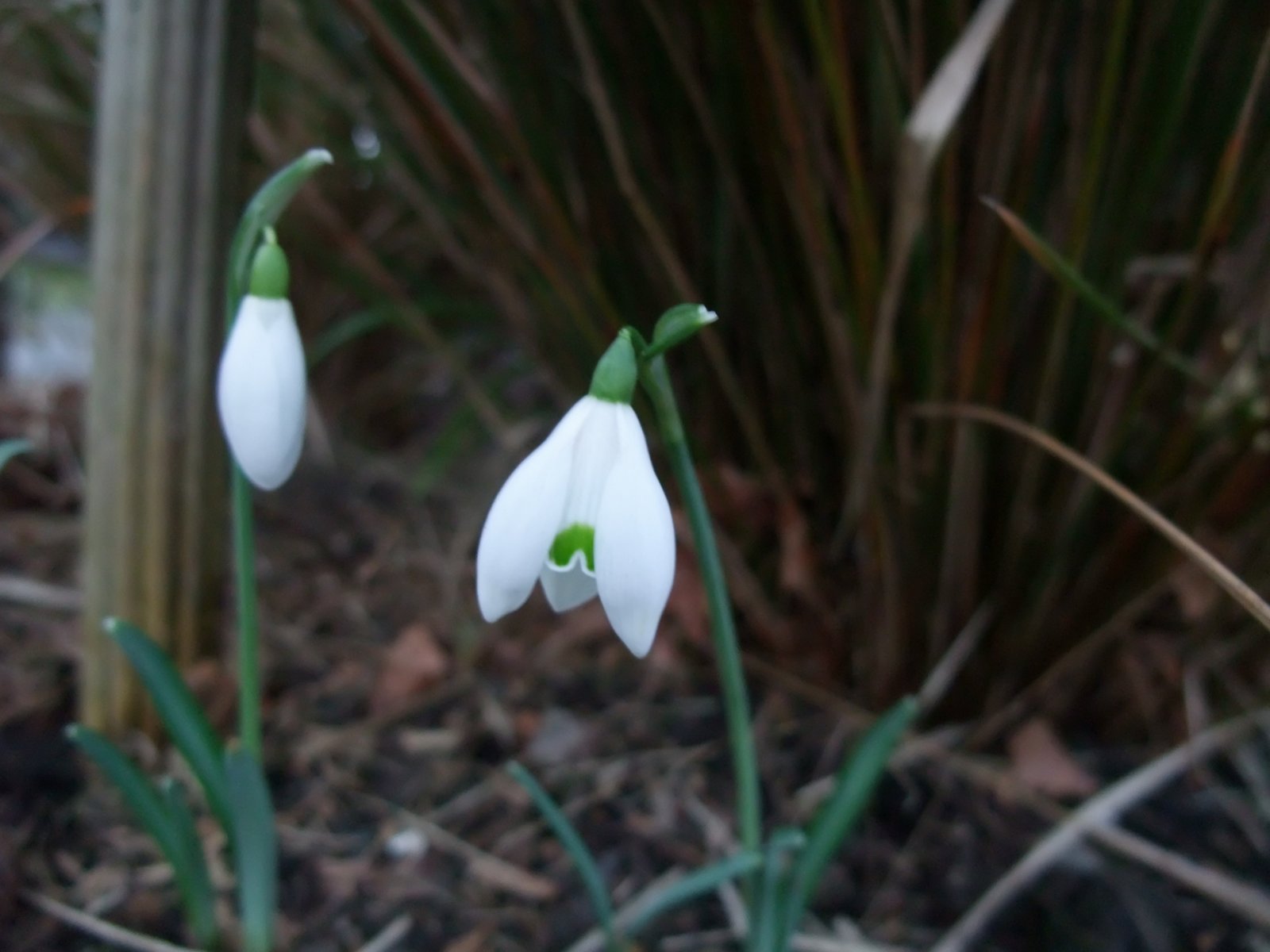
snowdrops nestling
at the base of the waterfall tree
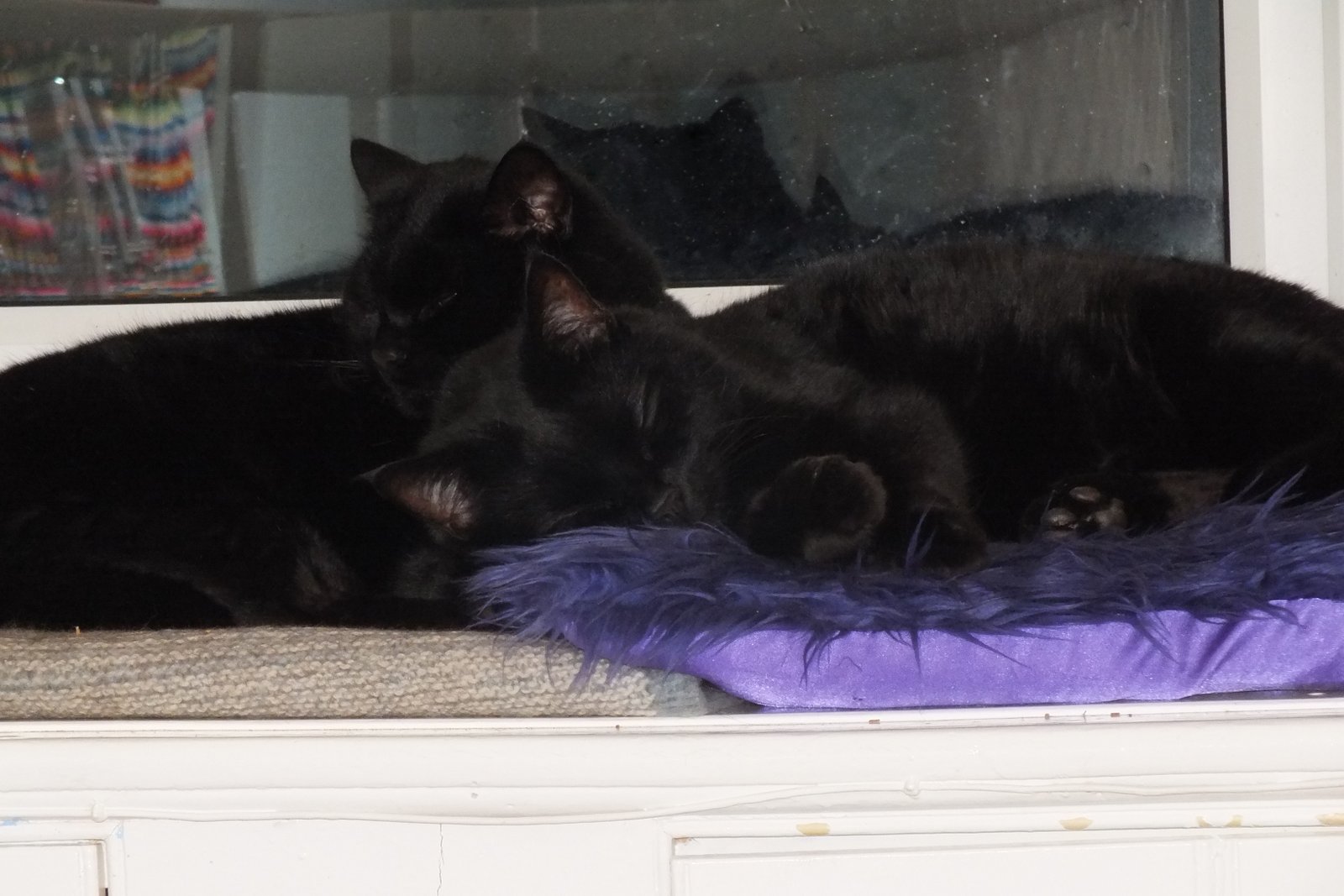
and Raisin who is always prowling about looking for biscuits
at night they sleep on a purple cushion just outside Granddad's bedroom door!
Wednesday, 6 February 2013
Dobbin
Some of the little, incidental treasures I live with in my study.
Mum's little globe pencil sharpener; a love heart from my love; my Robertson's Golly clarinetist; Dobbin's companion (a collapsing donkey!) and Dobbin, my little rocking horse bought in the far distant 60's; my Dad, John as a young man and the rescue Tigger, plucked from the gutter when collecting my daughter from school one day, many aeons ago ...
Oh, and books, read and unread ..... What could a house be without books, all those opportunities to travel away ....
Mum's little globe pencil sharpener; a love heart from my love; my Robertson's Golly clarinetist; Dobbin's companion (a collapsing donkey!) and Dobbin, my little rocking horse bought in the far distant 60's; my Dad, John as a young man and the rescue Tigger, plucked from the gutter when collecting my daughter from school one day, many aeons ago ...
Oh, and books, read and unread ..... What could a house be without books, all those opportunities to travel away ....
Subscribe to:
Posts (Atom)