Sunday, 8 March 2020

dyeing thread

Is not the same as dyeing fabric as I am discovering. Lovely daughter bought some yarn, bamboo and linen, very cheap, in white, for dying. And so, an experiment.

The first test wraps were bound with elastic bands and included some fine crochet cotton as well. So a small bundle, with all three types of thread, band wrapped, soda soaked, left to dry, dipped in dye and left to dry again


clear white divisions with some shading

After dyeing they were variously woven - this a test for something else, used to demo the dyed thread

And  crocheted to see how the effect translated, bamboo first then linen.

The second batch has yet to dry, bound with strips from plastic bags - unecological raffia. This is how ikat warps are tied prior to dyeing, but obviously with much more skill, planning and understanding than my efforts

They werent as effective at keeping out the dye, but have resulted in some interesting shading and some broader white spaces. The next step might be to re bind leaving some of the white unbound, then add a third colour, blending into some of the blue and petrol green but finding some of the white for the pure tone.

 Now where's that crochet hook?

Thursday, 27 February 2020

Family words about fathers

Howard Colman Rowe
I have read through all of Auntie Rhona's books now and have gone back to Ganna's for comparison. In both of their writings there is either a recreation of, or yearning for their lost father Howard.

Rhona would have been about thirteen when Howard died in 1914. In her books, as in Ganna's, the father figure is sometimes a man of gentle thoughtfulness, occasionally so much so that he is not entirely in the present moment. Rhona's novels also always have a small family of children, either at the heart of the story or firmly embedded in it. In one of them, Whatever the Heart Appoints, Candida Cornell has been waiting for her father to return from the war, during which he was badly injured, so delaying even further his return. In one passage, towards the end of the book, we see her inner musings and deep hope. That plaintive cry, "I have been without my father for years and years" wrung my heart with its poignancy


In Ganna's novels the father is never absent. often the family is entire and secure and there is deep and abiding love at its heart. Here, at the very beginning of Look on the Fields, Anny is travelling from London to Abbot's Ford, a loose rendition of Arklow where the girls grew up. Anny's father and mother have both died and she is coming to her Aunt and Uncle to live with them. She arrives at the station and her Uncle Jonathan (Howard) is so deep in his own thoughts that the travellers gradually clear until Anny is all alone with her suitcase, wondering at the waiting man further down the platform. Again, that gentle voice and ageless smile speaks so deeply of her love for the man who died when she was about 15.


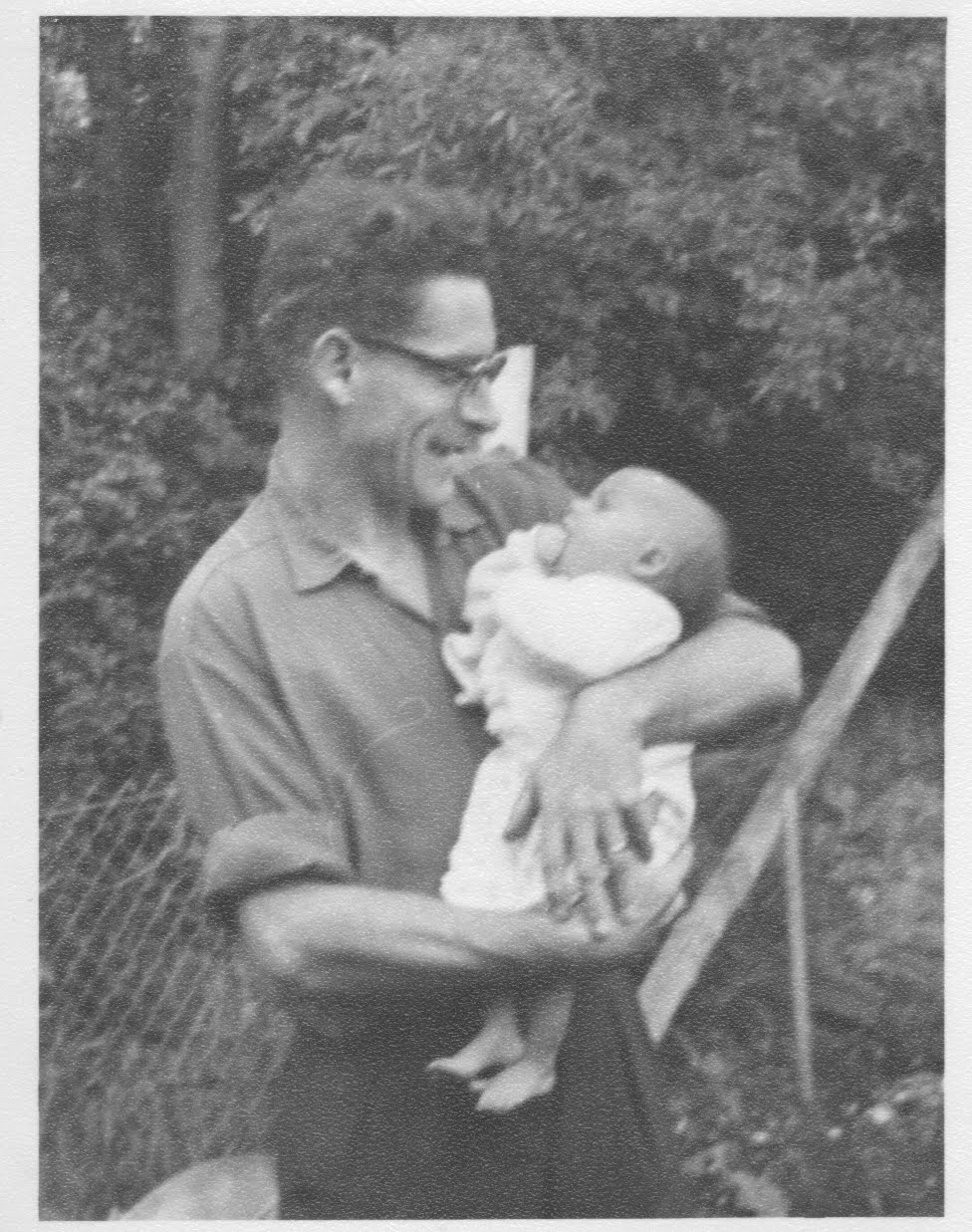
My little Mum, although she never lost her father, felt all her life that she was a disappointment to him, that he hadn't really wanted a child at all, and that she was in the way.  Here they are when she was around 8 or 9 I'd guess, looking very happy together at the beach hut in St Leonards, which was visited every summer.


As I am transcribing her diaries, I find that, for the most part, mentions of Daddy involve playing a game with him, getting him a meal, or being bought a gift by him for a birthday or Christmas, happy things. However, this little entry below, when she was 13, tells its own story of her need for his love and attention.


Daddy being cross was obviously a deep sadness for her.

And finally me - I too lost my "Daddy" young, he died the year I turned eight. I still, as a woman nearing the end of her 6th decade, find myself deeply moved by mentions of lost or dead fathers. It rings a chord in my heart. The film The Railway Children was released in 1970, two years after he died; our neighbours a family with four children, took me to see it. I have never forgotten my struggle to keep my tears inside as the father returns and Jenny Agutter, running through the clearing steam at the station, cries, her voice jubilant, "My Daddy, my Daddy!".

In my teens I took to writing poetry, mostly poor, but heartfelt. The words below were initially written aged 17 after I had again been moved to tears by something which touched on lost fathers. The words were revisited later as I turned 44, the age he was when he died.


For Dad

I often used to think of you Dad, when you'd gone,
And when I had to tell folk you were dead,
They'd start or look ashamed, apologise, and some
Would turn and laugh it off, one crass boy said

"Not dead I’ll bet, I ‘spect, he's just on holiday
He won't be long away"

I cried myself to sleep at night for many years,
And in my childhood’s sorrow called your name,
I reached my teens, but time still hadn't dried my tears,
I stood and cried for you again that day.

My loss still caught my heart, its tender edges frayed
You were so far away 

And now I’ve grown beyond the days that life gave you
Can see your loss, these years of mine you missed.
My darling girl, your unknown grandchild, sweet and true,
You never met her, never felt her kiss.

You're gone, but still it’s hard to keep those tears at bay,
You’ve been so long away


Daddy with his little "Dumpy"

Mesopotamia still being discovered

Flowing down the rivers Tigris and Euphrates, we've come to their point of closest conjunction until they reach the sea. So we've floated past Tell Asmar, Khafajah and Sippar and find ourselves at Jemdet Nasr and the wonderful Babylon, city of legend with it's blue Ishtar Gates, heaven scraping tower and hanging gardens


Obviously I can't create all those wonderful things in the small space allotted to me in this work, but I am trying to give an impression of increasing complexity given that here, lower down on the great alluvial plain, the serious business of irrigation, cultivation and specialisation really took off. Jemdet Nasr, here marked by a dark red-brown piece of agate, became a "type site", that is a site where a specific collection of artefacts are so distinctive that they mark some sort of change in culture: in this case, painted pottery, proto cuneiform tablets and cylinder seals.


And below I have marked Babylon with a triangle of turquoise for the Ishtar Gate and the high ziggurat, but I've also tried to evoke a sense of a city surrounded by gardens, cultivated land and waterways bringing that all important source of life.

Meanwhile, further north, up in the highlands I have added a new city, not on my original list. This is Mari, founded in 2900 BC as a nexus for the various trade routes which were developing and expanding as civilisation spread, goods moved across land and water, and supply and demand became the way of life. It was connected to the Euphrates by a canal, giving access to the major trade route, but protecting the city from flooding. It may well get more stitching, though I am keeping cities to the north relatively simple as a contrast to the luxuries in the south.


And in entirely different but still stitchy news, I am still working on the crewel work piece that I started in Fay Maxwell's workshop with the EG, back in November. The branches are coming along nicely; combinations of fly and feather stitch with raised chain band and French knots for texture.


The design is loosely based on the piece of fabric below, a sketchbook cover I made in a wonderful Sandra Brownlee workshop (at Studio 11). The fabric came from one of Ganna's cushions, the imagery on the fabric inspired by motifs from crewel embroidery


It amused me to take a crewel work inspired design and translate it back into crewel embroidery, but now with a modern twist.


I've played freely with the design, not least because freehand cutting of the felt pieces dictated a broad brush approach! It is amusing me, and is stitching on a totally different scale to Mesopotamia, which really requires a good light and plenty of magnification!!

Hope your stitching is going well wherever your creative spirit lies.


Sunday, 12 January 2020

Family words

I have been in communication with a delightful lady called Rosemary Roughter, an historian who is writing a piece about Louisa Coade, who was my great grandfather Howard's sister, known to me in family tales as "Aunt Louie". An enquiry by her regarding a novel written by Ganna's sister Rhona has lead me to reading Rhona's books, which I'm ashamed to say I have not done so far.

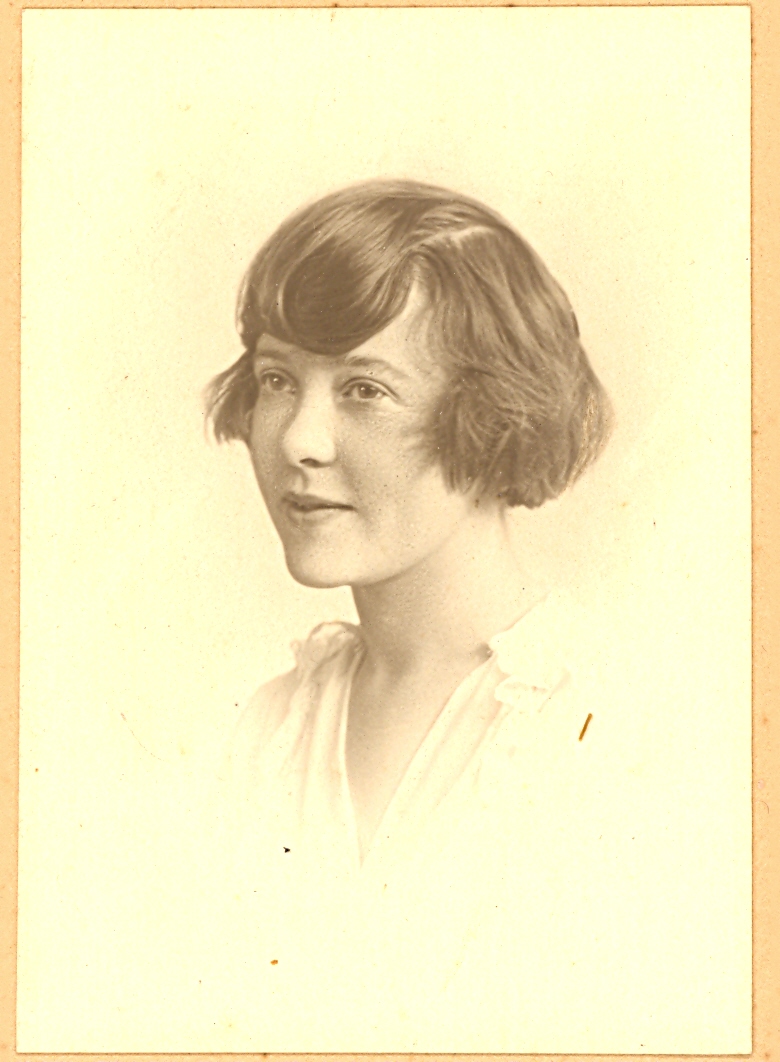
Rhona Katherine Rowe as a young girl
Rhona was the youngest of the three Rowe girls, and took after her mother Alice rather than Howard. This meant that she and her daughter Cecil were untainted by the genetic condition Osteogenesis Imperfecta, much to their benefit. She was, according to family tales, a very charming young woman who enjoyed the good things in life. You can see her here, in her youth, looking very sweet and pensive. She married Herbert Guy Dunning who ran a garage in St Leonards called Dunning Marriott and Smith. She and Guy lived a more extravagant lifestyle than her two sisters, and Guy was much disapproved of by Ganna and Mum, being rather too "hail fellow well met" in their view; prone to borrowing money and not paying it back. This was borne out after he died and Cecil took over his affairs; the business was deeply in debt. I remember her saying "I always wondered whether Daddy had another family somewhere - otherwise where on earth did all that money go?"

Rhona and Ethel published their novels at very similar times and I always pondered how much they were in competition  with one another. Rhona's first novel Stephen Sherrin came out in 1932, and the central character is a tender portrait of their father.

Stephen is a doctor in a small town in England, with a deep concern for the poverty in which some of his patients are living. His wife is dead and his two daughters, from whom he feels estranged, live with their smart young friends in London. The story moves between Stephen and his daughters, contrasting the rather shallow lives of these two London girls, all cleverness and appearances, with his own quiet but deeply felt devotion to helping those around him and appreciating their more human values.  It also focuses on a friend of Stephen's, an old man who is dying, and who is responsible for three young grandchildren whose adventures punctuate the comings and goings of the adults. Her writing is more sensual than her sister's; the books contain long passages describing the natural surroundings, often elaborately personified, which reflect and echo the thoughts of the characters. The novel also portrays a completely unconscious snobbery, which chimes with family comments about Rhona. There is an assumption of the superiority of the central characters and the ignorance and superstition amongst those poor with whom they come into contact. The house servant who cares for the old dying man is described as being "dirty shiftless and lazy, but her heart was in the right place", yet this woman does everything for the old man for no pay, just her board and lodging. Modern readers would balk at this, and also perhaps at the lack of action and excitement. I thought it a beautiful read; her attention to the motivations and feelings of the characters I found very engaging, and Stephen's heartfelt concern for his patients and his friends drew me to him as a character. At the end of the novel he makes the momentous decision to pass his practice over to his young assistant and fulfil a long held desire to travel "before it was too late. Before he got old and bitter". he takes himself off to Tilbury docks to "walk up the gangway to that great, magnificent boat and be carried smoothly over the seas - to what?" I wonder if Rhona here was releasing her lost father, who died when she was just fourteen, into a better place of freedom and fulfilment.

This is a short novel, I read it in the space of a day, and enjoyed it a great deal. Perhaps that reflects my sense of entering a very familiar space with a familiar cast of characters and attitudes - a family space in fact. I have since read her next publication, The Spring Begins; very risqué indeed for its time, but more of that later!

Wednesday, 25 December 2019

Keeping up - just

When I was young and still lived with Mum, she was always in a panic by Christmas Eve, with cards still undelivered and preparations still to make. She regularly sent out 100+ cards to friends and family near and far, and all the cards she received in return would be carefully stuck to the back of the sitting room door with minute pieces of sellotape so the paint remained undamaged. The resulting mosaic of colours and imagery would flutter and rustle gently every time the door was opened. So, with local cards in hand, off we would go on Christmas Eve delivering to friends who lived in our town; she would drive, I would "just hop out and pop it through the letterbox", a task which frequently involved a flight of steps in our hilly locality. Being young of course, I knew that when I was grown and in charge of my own life, I'd not be so tardy, I would be far better organised, I would be on top of things.

Hmmmmm ... it's Christmas Day and I have only just finished the composite gift for Darling Daughter. Fortunately she isn't with us until Boxing Day, so, just in time! It comprises a rather nice origami folded project pouch, simple to create with just two squares of fabric, you can find patterns all over, the one I followed was here.

The square of fabric is magically transformed, with a little bit of machine and hand stitching, into this, in a rather gentle pattern of branches and berries


Two vintage buttons (from Mum's button box of course) make the closure


Open up and splash of colour comes from the inner fabric, a vibrant batik


fold that inner flap up and you begin to see the pockets, and another little flap, decorated with beads to give a little lift


in all there are six pockets of various sizes, made to enclose


a little scissor case from a Sue Hawkins kit, and a needlecase from Clothkits, designed by Corinne Lapierre. The colours for the pouch, as you can see, chosen to match those of the contents. Even the scissors, peeking out of the pocket, have toning colours. These were started up in the Lakes in October, but took a back seat to a small quilt for a new small person, and a couple of other Christmas creations that needed to be finished first. In fact, it has all been a bit of a scramble!!


I do hope she likes them.

Oh, and sorry Mum, I was wrong - I seem to have inherited your last minute tendencies!!

Thursday, 28 November 2019

Ambushed by events

I have had a small project on the go - a cot quilt for the first child of the next generation to be born in my husband's family. He nicknamed her Flopsy when she was on the way, so Flopsy she has become to us. She was due to be born on the 20th November, but snuck in two weeks early. Her quilt (Flopsy's quilt) had been designed, planned, all parts cut out and ready to go, but not quite assembled. So now I am hurrying to catch up with events.

The quilt is just about finished - with Mrs Rabbit and, of course, Flopsy, Mopsy, Cotton-tail and Peter being tucked into their winter coats to go out and play. There are lovebirds to chat to along the way

And trees in the surrounding gardens and woods to run in and out and roundabout; they might frolic in fields of blue and yellow flowers and have busy chats with the bees.


Layered together with wadding and a snuggly brushed cotton backing, there is some hand quilting, but mostly machine. The binding is one where the backing is brought forward to the front, so the soft brushed cotton folds round the edges for little fingers to grasp.


There is just a little bit of hand quilting left to do (Flopsy must be highlighted of course), then the finished article can be tucked into a squishy parcel, along with a lovely soft blanket which darling daughter has crocheted for her, and a book from her great great uncle to amuse her as she grows. We hope she enjoys both snuggles and book for many years to come.

She does, of course, have her own name - in fact three of them and very lovely names they are too, but I won't be so indiscreet as to launch them into the ungoverned spaces of the internet.

In between times I have been doing other things too. I'm not sure you saw the finished "One Over the Eight" quilt that I have been making in our monthly patchwork class. We have, since then, moved on to several other things, all of which need finishing, some of which are not yet started


We had a lovely crewel work workshop at the Embroiderer's Guild with Fay Maxwell, a delightful and patient teacher - you can hear her talk about her crewel work in the linked video. She adds an extra element to the traditional crewel work by cutting out felt shapes for the basic design elements, which are tacked onto the backing cloth and then embroidered.  Freehand cutting of felt shapes was quite a challenge, especially as I was basing my design on fabric that once covered some cushions of my grandmother's; fabric that echoed crewel work designs itself. I think I managed OK. Now to finish the embroidery!


and finally, from last weekend, this little fox is gradually appearing, poking his nose through the bluebells, He was designed by one of our branch members for us to try out some bead embroidery during a half day workshop


So, quite a bit has been happening, just not in Mesopotamia!!

Friday, 1 November 2019

Helpmeets for stitching

Because my good friend and fellow Embroiderers' Guild member Steph and I are running some supported stitch sessions locally, I have been thinking more about how we use aids to stitching and why; I thought I'd share them with you here. 

First and foremost is comfort. Most of us have aches and pains of some sort or another, having reached the age where we have the privilege of doing our own thing, following our star to some extent, rather than being subsumed by the rest of the family's needs. Then of course there is light and the ability to see.

By preference my favourite spot is here, in my grandmother's chair ("that's the Bergere Chair Kath" I was always told, though I suspect it isn't!). I have cushions and a quilt for comfort, south facing natural light, a warm radiator nearby and Cecil's tables to my right and left. I have the magnifier with it's ring of light, and my "giraffe" - the floor stand which holds my embroidery frame, I love this, though it can be a bit picky about whether it stays put in terms of its neck and knees! When you look at the frame, you can see it is one of those with clip over half tubes of plastic on a tubular plastic frame.


On the fabric held within the frame I have a needle park, held on by a magnet on the back of the cloth,  and a thread card (excuse the unintentional advert), recycled biscuit packaging. On the back the number and brand of thread is noted on each hole. This way the skeins can stay at home, or in the basket - less likely to become a tangle then.


If you were looking over my shoulder this is what you'd see, Mesopotamia under magnification, though not quite at satellite image detail. You can see here the way the frame can be used to hold fabric that is wider than the capacity of the frame. Not RSN tight by any means, but I'm not working to RSN standards.


And close up we have Sippar, the twin cities each with it's own temple, tucked in by the Euphrates to the left, downriver from Khafajah and Tell Asmar (Eshnunna). The Tigris is there too, coming in from the right. We are coming down from the rain fed alluvial plains of Upper Mesopotamia, where to a large extent there was enough rain each year to support agriculture. Now we are nearing the southern plains where no agriculture was possible without extensive canal systems for irrigation,