An odd thing to say, in fact it sounds rather unfriendly really, but I find (oh drat there she is already) that so often, when we find ourselves thinking thoughts beginning with "I" there's bound to be a negative there somewhere. We have a disagreement with a friend - off we go afterwards thinking "if only I'd said ... that would have shown him"; we don't have these inner conversations when we have nothing more to add, only when we're trying to put ourselves in the right. Or we might be talking to someone about a problem they're having, "ah, if I were you I'd ...". But we're not them and however well meaning, we can't live their lives, only our own. Likewise, there are the little inner dialogues we have about ourselves; those imagined dramas in which we are central. We might ruminate over what we'd do, had we been involved in some terrible circumstance, the right thing of course, which saved the day; or we dwell on some frailty of our own, possibly physical "I'm so tired of hurting all the time", or perhaps psychological "I shan't try that, I'd be useless/a failure". Then there are the great plans we have for ourselves, those things we are going to do when, if, before, after. All the time we're thinking about them, well, we're not doing them, but we congratulate ourselves on the fantastic outcomes, in fact, sometimes we can become so pleased with ourselves that we actually forget that we've not done anything yet! It is a very human thing to do, and we live in a society that seems to encourage this more. The cult of celebrity is surely the most obvious manifestation of the importance of ME, while endless TV adverts tell us we're worth it, or persuade us that if we just had this car, or went on that river cruise, our lives would be wonderful. They place our neediness centre stage and assure us that this or that product will satisfy.
Hmmm, I'm not sure sure. I have a feeling that, each time we focus on this "I" that we so fervently believe in, we risk compounding life's difficulties. Those thoughts we have about what we'd have said to our friend or lover - surely these colour the next meeting; carry the disagreement deeper into the relationship, yet leave the poor soul no space to explain or defend. The well meaning advice is really more about us thinking we know best than about trying to understand that person's difficulty. As for all those inner dialogues; well, they really don't help at all do they? Those great plans and grand actions have a rather hollow ring, and can lead us to feel rather too pleased with ourselves, yet oddly empty. The misery dialogue focuses on just one aspect of the richness that is life, throws a gloomy shadow over our inner selves, leads us to believe that this pain, that frailty are the whole story of our lives, rather than a little part of them.
This isn't a new thought, I don't think I'm saying something clever here, or something that's not been said a thousand times before, by people more qualified than me to say it. It is at the heart of many philosophies, religions, self help books and counselling sessions. It's ubiquity shows how deep and lasting a quandary it is for we self aware animals. Yet we forget: time and time again we start the day with "I", placing this virtual mirror between ourselves and our lives, gazing into it with loving attention.
The path of mindfulness is, to my mind, a helpful way to move beyond this. It can seem like the same self obsession, watching the moments of one's day with loving focus, trying to be present in full at each opportunity life gives us. But the approach is quite different; it can help us notice when that "I" crops up and gently, kindly turn the tumbling mind to another route, one that looks outwards, free from self regard, seeing more of the life that is living, and less of the inward fantasies. It allows us to listen, really listen with our whole attention, rather than leaping mentally to the clever response we're preparing. It acknowledges the fantasy person we believe ourselves to be is just that, a fantasy, transient as dandelion seeds floating on the breeze.
It is not something I talk about, or write about often, that feels too preachy to me, and in my youth I seem to recall I was a rather preachy person; I hope I am wiser now. But I do try, each day, to look more and more out, and less and less in. I hope I am beginning to get the balance more on the side of life and living, I know I have a long way to go, but the journey is the important thing.
As for those ever longer advert breaks - well, when they turn up, I just hit the mute button, look away, and use the time for something better!
Saturday, 2 March 2013

Tuesday, 19 February 2013
Look on the Fields and others
I'm sorry, it has been ages since I've written anything. In part this is because I ran into a "problem",which turned out to be me not noticing hat there was a size limit on Picasa albums .... Aha! so that's what that funny error message means when my photo uploads fail. You'd think I'd have twigged that, having at least some sort knowledge of computers and the like.
What else have I been doing? Dyeing cloth, planning City and Guilds , doing practical design exercises, stitching shadow work in between times and reading. Oh, and going to work! Some of my reading has been of Ganna's novels. These are the three I have read since my last post.
 Look on the Fields was published in 1935, a year after Barney's Bend. Here is the cover, once more a lovely Rowland Hilder image.
It was, as I recall, the novel she felt had worked the least well, though for me it is a delight because it paints such a clear portrait of her family. At it's heart are three children living in Ireland, who welcome their cousin into the family. She is a fragile soul, who reminds me of Aunt Connie - Ganna's eldest sister, who was the most brittle boned of the three girls. In this story, her ankle is crushed in an accident - in reality, Connie's ankle was trodden on by a horse and was thereafter, twisted and weak. At the heart of the family are their mother, who watches the comings and goings of her household with patient amusement, and their their father, a gentle dreamy man who is the small town's dispensing chemist, as was my great grandfather in Arklow, where they grew up. She paints such a clear picture of this little seaside town, with it's groups of donkeys trotting down the high street at market time, and the ever present sea shushing at the shore... she touches on religion and on Ireland's struggle for independence; it was something she experienced fist hand as a young woman, and was part of the reason they left Ireland, the other being the death of her own gentle, dreamy father in 1914.
 Grey Geese is also set in Ireland, near Arklow, but out on the plain beneath the blue brooding hills, that change with the weather. It concerns the way in which family hatred can twist a family for generations. It also has overtones of the political background, but is more concerned with the relationship between a young woman, widowed by the political struggle, her three children, and her father. He chimes with a previous character in Barney's Bend; both have a spiteful nature, that mocks all around it and manipulates others. She writes of the difficulties of poverty in a small 1930's Irish town, the standing forever to the back of the queue in the main shop, where each knows the others' business; waiting until all have been served, and the Widow has privacy to beg.
These were all written before the Second World War, in 1934/5/6 when my mother was a child. Then came the war, and a gap in both time and the progress of life.
By 1952, when the next novel appears, Ganna had looked after, then lost her own mother, my mother was grown, England had been through hell and people had struggled on. Her later novels were written, and set, in England, where she had moved in 1921 as a newly engaged young woman. They center around similar people, but in a different world. For Flute and Piccolo was her last novel, published in 1955. I am saving the intervening two because one is my favourite, and because I realised that I'd not read this one.
 This novel is set in a town that feels a little like Hastings, but Hastings of the 1950's where church bells still toll through the quiet of Sunday afternoons. We are moving in small town polite society, where all business is known and nothing interrupts weekend tennis at the club. Again, the story is of families, and how the various characters interact with each other. One, a rather dowdy woman is the long time wife of the eldest son of the family. Near the middle of the novel she experiences the latest of what are obviously a string of failed pregnancies; we see her hope and delight when she knows she is pregnant, and feel her numb despair as the pregnancy fails once more. I know that Mum, Ganna's only child, was herself conceived after multiple miscarriages, a phantom pregnancy and the stubborn resistance of my grandfather, who wanted no children. As I read this novel, I asked myself how much of her own experience flows in her description of this woman's, always seemly, suffering. The novel, which is in part about the coming of age of the two youngest family members, also portrays the very delicate and gentle relationship between the (once more widowed) mother of the family, and a man who was a childhood sweetheart, and is once more in her life. As with her other novels, the thing that is valued above all else, is kindness, the same kindness that was at the heart of my childhood.
What else have I been doing? Dyeing cloth, planning City and Guilds , doing practical design exercises, stitching shadow work in between times and reading. Oh, and going to work! Some of my reading has been of Ganna's novels. These are the three I have read since my last post.
 Look on the Fields was published in 1935, a year after Barney's Bend. Here is the cover, once more a lovely Rowland Hilder image.
It was, as I recall, the novel she felt had worked the least well, though for me it is a delight because it paints such a clear portrait of her family. At it's heart are three children living in Ireland, who welcome their cousin into the family. She is a fragile soul, who reminds me of Aunt Connie - Ganna's eldest sister, who was the most brittle boned of the three girls. In this story, her ankle is crushed in an accident - in reality, Connie's ankle was trodden on by a horse and was thereafter, twisted and weak. At the heart of the family are their mother, who watches the comings and goings of her household with patient amusement, and their their father, a gentle dreamy man who is the small town's dispensing chemist, as was my great grandfather in Arklow, where they grew up. She paints such a clear picture of this little seaside town, with it's groups of donkeys trotting down the high street at market time, and the ever present sea shushing at the shore... she touches on religion and on Ireland's struggle for independence; it was something she experienced fist hand as a young woman, and was part of the reason they left Ireland, the other being the death of her own gentle, dreamy father in 1914.
 Grey Geese is also set in Ireland, near Arklow, but out on the plain beneath the blue brooding hills, that change with the weather. It concerns the way in which family hatred can twist a family for generations. It also has overtones of the political background, but is more concerned with the relationship between a young woman, widowed by the political struggle, her three children, and her father. He chimes with a previous character in Barney's Bend; both have a spiteful nature, that mocks all around it and manipulates others. She writes of the difficulties of poverty in a small 1930's Irish town, the standing forever to the back of the queue in the main shop, where each knows the others' business; waiting until all have been served, and the Widow has privacy to beg.
These were all written before the Second World War, in 1934/5/6 when my mother was a child. Then came the war, and a gap in both time and the progress of life.
By 1952, when the next novel appears, Ganna had looked after, then lost her own mother, my mother was grown, England had been through hell and people had struggled on. Her later novels were written, and set, in England, where she had moved in 1921 as a newly engaged young woman. They center around similar people, but in a different world. For Flute and Piccolo was her last novel, published in 1955. I am saving the intervening two because one is my favourite, and because I realised that I'd not read this one.
 This novel is set in a town that feels a little like Hastings, but Hastings of the 1950's where church bells still toll through the quiet of Sunday afternoons. We are moving in small town polite society, where all business is known and nothing interrupts weekend tennis at the club. Again, the story is of families, and how the various characters interact with each other. One, a rather dowdy woman is the long time wife of the eldest son of the family. Near the middle of the novel she experiences the latest of what are obviously a string of failed pregnancies; we see her hope and delight when she knows she is pregnant, and feel her numb despair as the pregnancy fails once more. I know that Mum, Ganna's only child, was herself conceived after multiple miscarriages, a phantom pregnancy and the stubborn resistance of my grandfather, who wanted no children. As I read this novel, I asked myself how much of her own experience flows in her description of this woman's, always seemly, suffering. The novel, which is in part about the coming of age of the two youngest family members, also portrays the very delicate and gentle relationship between the (once more widowed) mother of the family, and a man who was a childhood sweetheart, and is once more in her life. As with her other novels, the thing that is valued above all else, is kindness, the same kindness that was at the heart of my childhood.
Thursday, 7 February 2013
Granddad's Garden - for Charlotte
In granddad's front garden this evening there were ...
Jackdaws coming home to roost by the chimneys, making a lot of noise


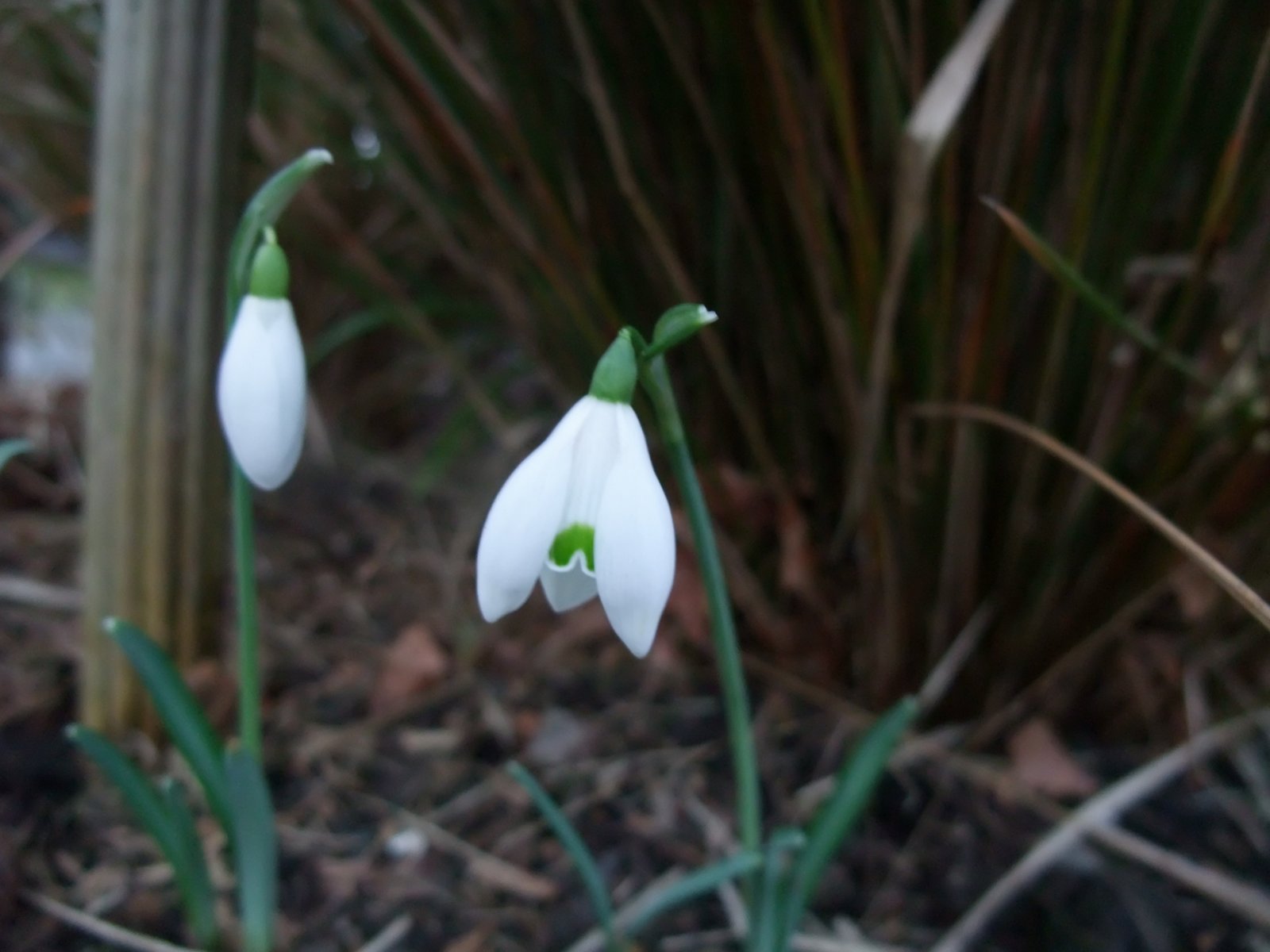
snowdrops nestling


a wild speckly thrush

and a fox who visited us when it snowed, we left him a bowl of water to drink from


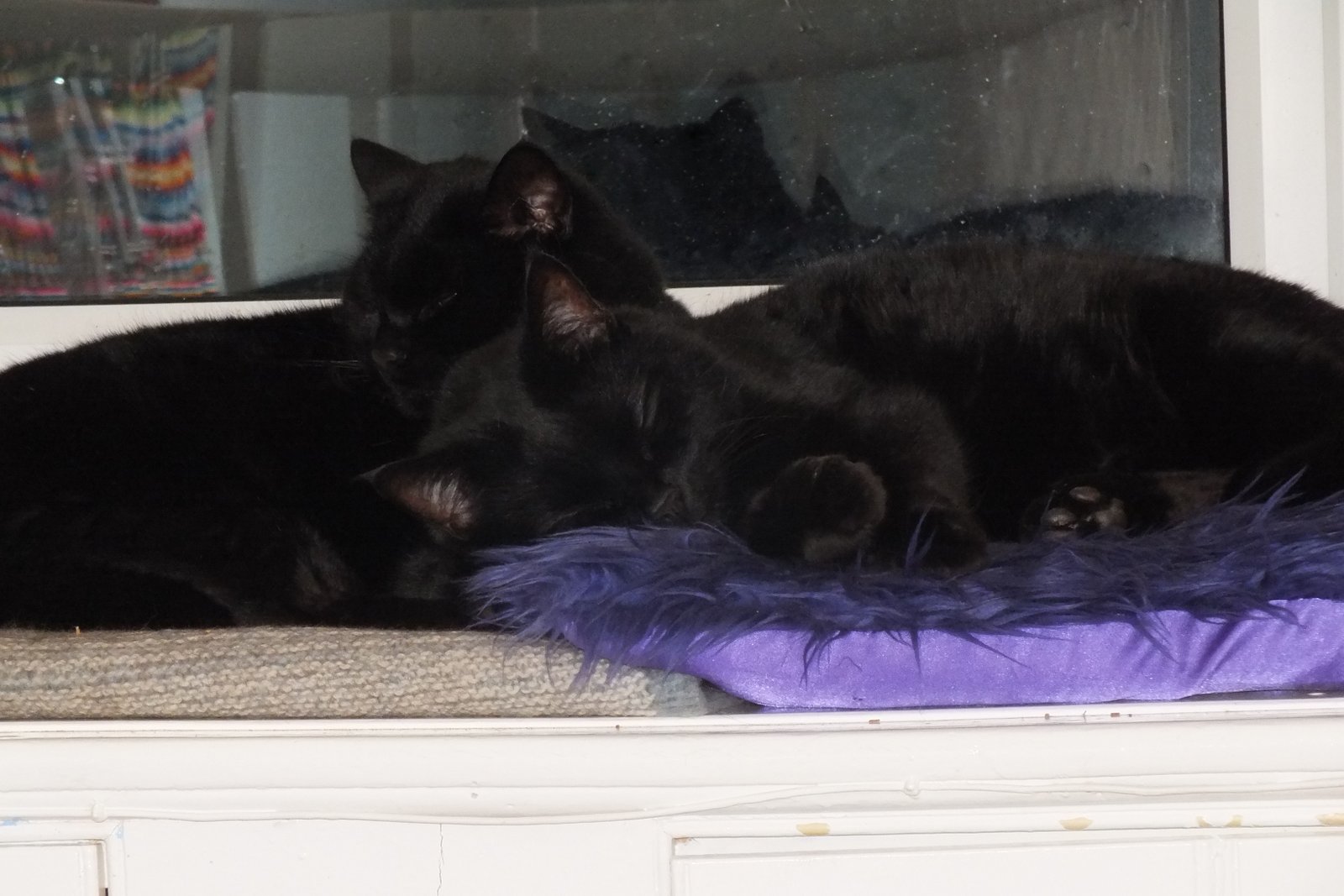
in Grandad's house there are two cats
Rum, who likes to hide his head in his paws

Rum, who likes to hide his head in his paws

and Raisin who is always prowling about looking for biscuits
 at night they sleep on a purple cushion just outside Granddad's bedroom door!


Wednesday, 6 February 2013
Dobbin
Some of the little, incidental treasures I live with in my study.
Mum's little globe pencil sharpener; a love heart from my love; my Robertson's Golly clarinetist; Dobbin's companion (a collapsing donkey!) and Dobbin, my little rocking horse bought in the far distant 60's; my Dad, John as a young man and the rescue Tigger, plucked from the gutter when collecting my daughter from school one day, many aeons ago ...
Oh, and books, read and unread ..... What could a house be without books, all those opportunities to travel away ....

Mum's little globe pencil sharpener; a love heart from my love; my Robertson's Golly clarinetist; Dobbin's companion (a collapsing donkey!) and Dobbin, my little rocking horse bought in the far distant 60's; my Dad, John as a young man and the rescue Tigger, plucked from the gutter when collecting my daughter from school one day, many aeons ago ...
Oh, and books, read and unread ..... What could a house be without books, all those opportunities to travel away ....
Sunday, 20 January 2013
Winter chill
We have some snow - not a huge amount, much less here on the South Coast than further West or inland, but enough to look very charming.
We're doing our best to make sure the birds and beasts have enough to eat and drink. There are several very beautiful foxes who stroll through in the early morning; one a very lordly dog fox. I've not managed to catch any of them with the camera, but am keeping a bowl of water ice free in case they need to drink.
The Jay is a regular visitor, though very shy - he'll swoop away across the garden at the slightest movement, even if we are indoors but near the window

The little water boy bravely holds out his shell of water, as the snow gathers on his head

much to the delight of robin, who seems to think it's OK to take a bath in water meant for drinking

while at the bottom of the garden, there is the most delicate tracery of branches weaving a snowy web in the air


Monday, 14 January 2013
Knitting a snood
I seem to be doing an awful lot of things at the moment! One of them is catching up on this piece of knitting which has been on the needles, by my estimate, for over two years now. Two years I hear you gasp in horror! Hmmmm, yes, it is rather a long time isn't it? I know it's that long, because I was just near the start when my dear soul and I went up to his daughter's just before Christmas two years ago - where her delightful puppy, Bella, thought that perhaps she could help and the whole thing nearly ended in a dreadful tangle! In my defence, it is 11 pattern repeats, of 20 rows each, over 240 stitches, round and round and round and round. But, at last, I'm nearing the end. Do you do Ravlery? I do, and its tremendously useful, because you can see what other people have done with the thing you are knitting. This "thing" is a snood, or it will be when it is finished; my second piece of lace knitting. It has a rather lovely, but scarily complicated looking edging, intended to be knitted separately and then attached. If done this way, it means counting out 120 pattern repeats, hoping your tension in this bit allows your edging to stretch all the way round, then laboriously sewing it on. So I had a look at what others had done, and found advice to knit the edging in with the rest of the knitting. Now that sounded even more scary, so I did several test rows first to make sure I understood what the edging involved before even thinking about incorporating it into the rest of the knitting.
Here's how it happens. You have a little group of seven stitches on your needle (which become nine for a while). You also have the rest of your knitting, on its circular needles (that extra shiny one is one end of this bit) dangling below the bit you're working on, all wriggly ....

at the end of every other row, you knit the final stitch together with the next stitch on the main piece, so you're trying to handle three needles and two bits of knitting with only two hands to do it all.

It's all rather finicky to start with as the circular needle that holds the lace squirms about and wiggle waggles like a live thing, and the little needles that hold the edging threaten to slip out of their stitches at every turn. You also have to make sure, after the knit the two bits together bit, that you push the stitches on the circular needle right back so they don't slip off while you continue with the edging. I finally I got the hang of it and now I am almost half way there.

Here's how it happens. You have a little group of seven stitches on your needle (which become nine for a while). You also have the rest of your knitting, on its circular needles (that extra shiny one is one end of this bit) dangling below the bit you're working on, all wriggly ....
at the end of every other row, you knit the final stitch together with the next stitch on the main piece, so you're trying to handle three needles and two bits of knitting with only two hands to do it all.
It's all rather finicky to start with as the circular needle that holds the lace squirms about and wiggle waggles like a live thing, and the little needles that hold the edging threaten to slip out of their stitches at every turn. You also have to make sure, after the knit the two bits together bit, that you push the stitches on the circular needle right back so they don't slip off while you continue with the edging. I finally I got the hang of it and now I am almost half way there.
It's all coming together rather nicely, and the best bit about it is that you don't have to count the repeats; you know when it's done, because there are no more stitches on your squirmy circular needle and you're back to where you started again ... or at least, I hope that's where I'll be!
Monday, 7 January 2013
Barney's Bend

Just now, for obvious reasons, lots of people are full of their plans for the New Year; new starts, old starts revisited, infinite ways to be better, more resolute - which is of course the etymological root of these resolutions. I've always found resolute rather hard - I can manage steady, stoic, enduring, dogged, but the minute I try to be resolute I find the inner nag who sits on my shoulder saying "Aha! we know where that leads don't we? You just can't manage it, you've tried before and you know you always fail" so my resolve shrivels and creeps away to some quiet corner, all hunched and woebegone, and my seasonal portion of self defeat takes up residence in its place.
So, this is not a resolution, but it is a hope. I'd like to read through all of my grandmother's novels, one by one, this year. To spend some time with them, with her, to see what she has to say. I have read them before, several times; they have been with me all my life, since they were written long before I was born. She wrote in part for pleasure, in part because she came from a literary and artistic family, but also to supplement my grandfather's income with enough extra to ensure that they could send Mum to a fee paying school. She was a very delicate child, breaking bones at the slightest knock or tumble, a trait she shared with her mother, her aunt and her grandfather, who bequeathed us some faulty genes. So Ganna wrote to ensure that her one beloved daughter could go to a school where there was less rough and tumble, less danger of damaging activities.
Her first novel was called Barney's Bend; that's its cover up there, with illustration by Rowland Hilder. Because I know our history, I know that it is set in Arklow, County Wicklow, which is where she grew up. Mum and I went there together some twenty years ago, so I recognise the geography. It is decidedly not a "modern" novel. There is no exciting action in exotic locations, no guns or knives or violently dismembered bodies graphically described, no sex, licit or illicit. I do read novels like those as well, so am not saying that with a moue of disapproval, but Ganna's novels are simple ones, about people and what makes them tick. Make no mistake, when I say simple, I don't mean simplistic or lightweight. She was a deep thinking woman, and one with profound beliefs, but her writing, in this novel, centres around a small Southern Irish town in the early part of the 20th Century, where cars and motorbikes were a rarity, where donkeys were traded at the monthly fair, where the evening light came from the sky or from fire, lamp or candlelight. Her characters are finely drawn, but their concerns are those of ordinary life, not of earth shattering events or heroic feats. She writes of daily incidents drawn with such, to my mind, exquisite observation, that their true meaning is shown.
Most of us live quiet lives, we don't holiday frequently in exotic places, indulge in passionate and sexually athletic affairs, or find ourselves caught up in intricate and convoluted events, involving foreign spies or slightly psychotic loners, with mystical powers of deduction. To be sure, novels like this can take us out of ourselves, they are perhaps the modern day equivalent of the myths and legends told by winter firelight in times past. But tales like that take us away from ourselves, to fantasise about what life would be like if only ... Barney's Bend is about a small group of farming folk, whose lives are intertwined, and about the consequences for one another of the things they do. It is about what matters in love and in life, about what is of value. The characters' thoughts are described, so we understand their motives and their actions. They do nothing earth shattering, and because of this, one is drawn into their world in a very genuine way; they are recognisably human, and their human failings are those we share. To my mind, and I do know I am biased, the novel encapsulates something very precious, the realisation that our lives are driven by what we think as much as by events; that because of this it is important to be true to ourselves, and those around us; important to be aware that we are responsible for what we do, we can bring good or bad into the world, each thought, each action has a definite and concrete value in reality. This makes it all sound rather preachy; believe me, I can't stand preachy. Her writing is so deft, so painterly in it's descriptions, so grounded in her understanding of motive and so evocative of human lives lived, that she reveals how this life, this here and now, is very real, and very precious. I love this book, just as I know I loved it when I last read it, and the time before. I am conscious that this is a gift given, to know her mind, and to understand her remembered wisdom, even though she is no longer with me.
Subscribe to:
Posts (Atom)